
Low-Income Corporate Tax Credit (statewide cap is $123,042,188). The second is the Disabled/Displaced Corporate Tax Credit (statewide cap is $5 million). Many people think it sounds too good to be true, but it’s not. You can give to a qualified charity or tuition organization instead of giving it to the state government for taxes. Over time, these contributions have become increasingly popular for Arizona residents. Nancy Mongeau, vice president of Tri-State BHHS Legacy Foundation, said tax credit contributions positively impact Qualified Charitable Organizations such as the Legacy Connection Backpack Buddies project. “In Arizona, where one in four students lives in poverty, many children attend school without the necessary clothes or educational supplies. Thanks to tax credit donations to Legacy Connection, our Qualified Charitable Organization, we are able to make a powerful difference in the lives of local Arizona families through the Tri-State Backpack Buddies project by providing clothes and educational and hygiene supplies to all students in need,” she said. Qualified Charitable Tax Credit contributions can also provide for other local nonprofits the foundation supports, such as Bullhead City Meals on Wheels, CASA Council of Mohave County, and the Boys & Girls Clubs of the Colorado River. “Tax credit contributions for educational institutions such as public and charter schools are also vitally important,” Mongeau said. “Your tax-deductible donation can support the entire school or specific school clubs and sports such as Key Club, Chess Club, ROTC, football and cheerleading.” Beverly Siemens, court-appointed special advocate and CASA Council of Mohave County board president, believes that foster children need and deserve what any child needs and deserves. She said that tax credit contributions to CASA Council, an all-volunteer Qualified Foster Care Organization, help a child with basic and special individual needs and provide the donor a foster care tax credit of up to $500 for a single filer and $1,000 for a couple. “The Charitable Organization Foster Care Tax Credit program is an amazing opportunity for local Arizona residents to provide funding for children in foster care. CASA Council provides a variety of essentials that promote a child’s self-esteem and enrich the lives of our communities’ dependent children. The tax credit is a perfect way for taxpayers to have a say in where their tax dollars go, and at the same time, provide meaningful support for organizations they believe in.” A few other changes were made this year, according to Linda Jordan, owner of H&R Block franchises in Kingman, Bullhead City, Fort Mohave, Lake Havasu City and Laughlin. Jordan said that under the CARES Act, passed in response to the pandemic, taxpayers who make contributions that do not qualify for the credits (because they are over the thresholds, or are to a non-qualifying charity) can take a $300 deduction, even if they do not itemize. “Taxpayers can take $300 for charitable contributions off the adjusted income without itemizing on the federal tax return. So you can get a tax credit on the state and a deduction on the federal tax return,” she said. The CARES Act also included some other charitable incentives for bigger donations. Higher- income, charitably minded people may want to talk to their tax advisers. “Every Arizona taxpayer should check to see if they can take advantage of these credits. We are happy to answer questions for any taxpayer, so that everyone gets the advantage of every credit to which they are entitled,” Jordan said. These contributions are an essential way for Arizonans to support their favorite charitable causes during difficult times. “This is your chance to invest in our local community’s future,” Mongeau said. “Thanks to the Arizona Tax Credit, you can choose which Qualified Organizations benefit from your Arizona tax liability. Your tax-deductible donation ends up costing you nothing. It is a simple but powerful way to reach out and impact our community.” “This is your chance to invest in our local community’s future. Thanks to the Arizona Tax Credit, you can choose which Qualified Organizations benefit from your Arizona tax liability.” 8 FRONTDOORS MEDIA | TAX CREDIT GIVING GUIDE
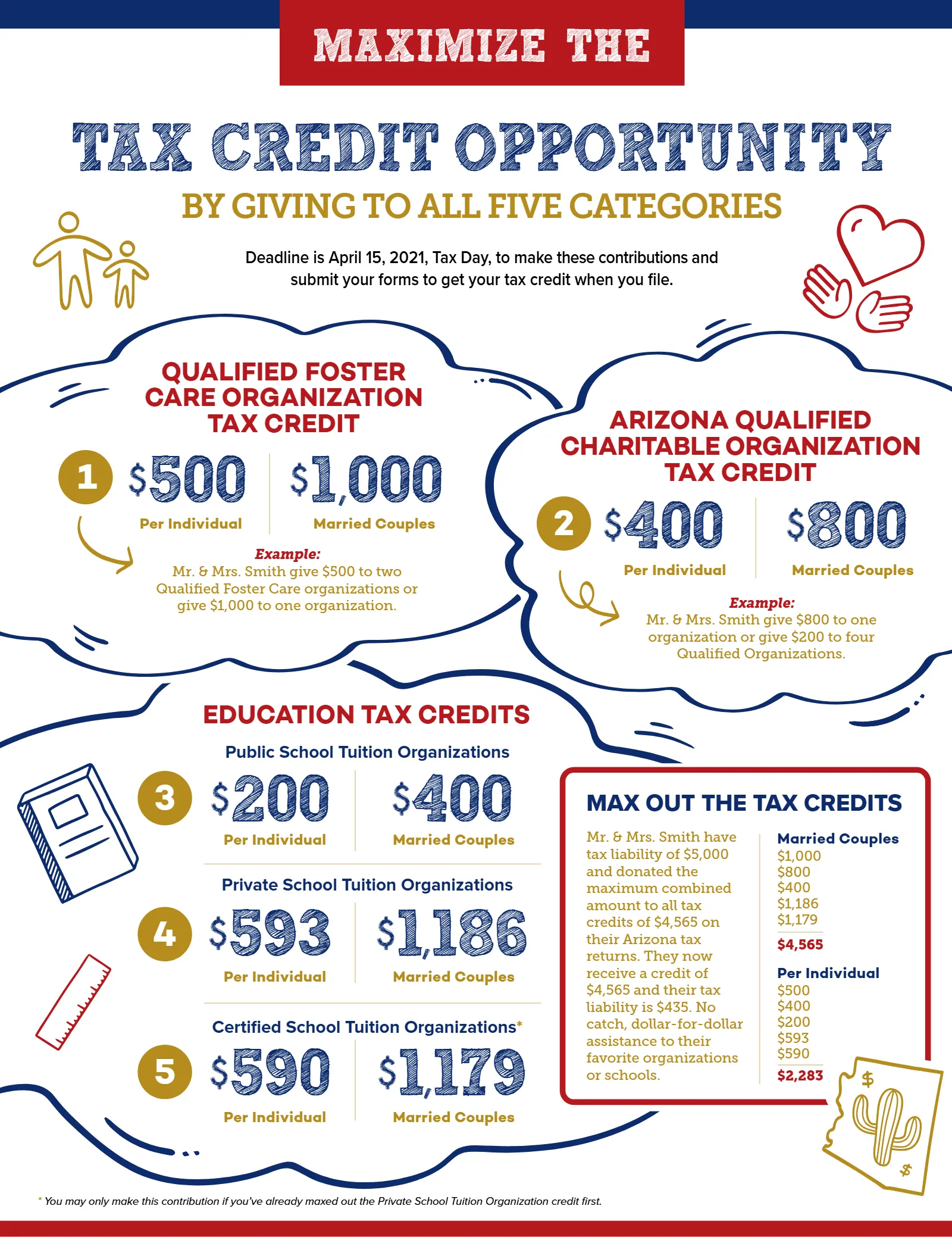
EDUCATION TAX CREDITS $ 400 $ 1 , 186 $ 1 , 179 Public School Tuition Organizations Private School Tuition Organizations Certified School Tuition Organizations* Married Couples Married Couples Married Couples Per Individual Per Individual Per Individual $ 200 $ 593 $ 590 3 4 5 Deadline is April 15, 2021, Tax Day, to make these contributions and submit your forms to get your tax credit when you file. BY GIVING TO ALL FIVE CATEGORIES QUALIFIED FOSTER CARE ORGANIZATION TAX CREDIT * You may only make this contribution if you’ve already maxed out the Private School Tuition Organization credit first. $ 1 , 000 Married Couples Per Individual $ 500 Example: Mr. & Mrs. Smith give $500 to two Qualified Foster Care organizations or give $1,000 to one organization. TAX CREDIT OPPORTUNITY MAXIMIZE THE 1 ARIZONA QUALIFIED CHARITABLE ORGANIZATION TAX CREDIT Example: Mr. & Mrs. Smith give $800 to one organization or give $200 to four Qualified Organizations. Married Couples Per Individual $ 800 $ 400 2 Mr. & Mrs. Smith have tax liability of $5,000 and donated the maximum combined amount to all tax credits of $4,565 on their Arizona tax returns. They now receive a credit of $4,565 and their tax liability is $435. No catch, dollar-for-dollar assistance to their favorite organizations or schools. Married Couples $1,000 $800 $400 $1,186 $1,179 $4,565 Per Individual $500 $400 $200 $593 $590 $2,283 MAX OUT THE TAX CREDITS