
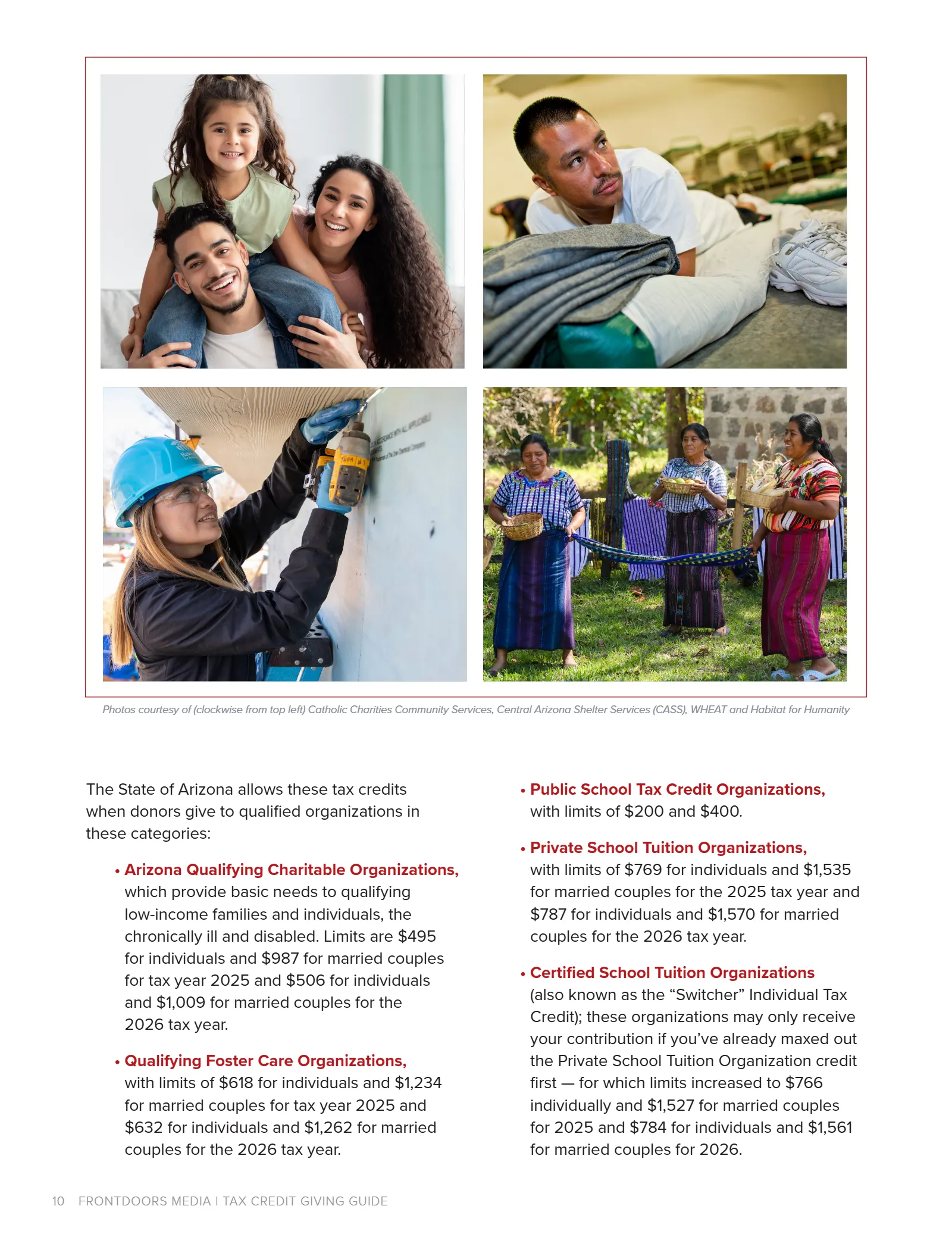
10 FRONTDOORS MEDIA | TAX CREDIT GIVING GUIDE The State of Arizona allows these tax credits when donors give to qualified organizations in these categories: • Arizona Qualifying Charitable Organizations, which provide basic needs to qualifying low-income families and individuals, the chronically ill and disabled. Limits are $495 for individuals and $987 for married couples for tax year 2025 and $506 for individuals and $1,009 for married couples for the 2026 tax year. • Qualifying Foster Care Organizations, with limits of $618 for individuals and $1,234 for married couples for tax year 2025 and $632 for individuals and $1,262 for married couples for the 2026 tax year. • Public School Tax Credit Organizations, with limits of $200 and $400. • Private School Tuition Organizations, with limits of $769 for individuals and $1,535 for married couples for the 2025 tax year and $787 for individuals and $1,570 for married couples for the 2026 tax year. • Certified School Tuition Organizations (also known as the “Switcher” Individual Tax Credit); these organizations may only receive your contribution if you’ve already maxed out the Private School Tuition Organization credit first — for which limits increased to $766 individually and $1,527 for married couples for 2025 and $784 for individuals and $1,561 for married couples for 2026. Photos courtesy of (clockwise from top left) Catholic Charities Community Services, Central Arizona Shelter Services (CASS), WHEAT and Habitat for Humanity
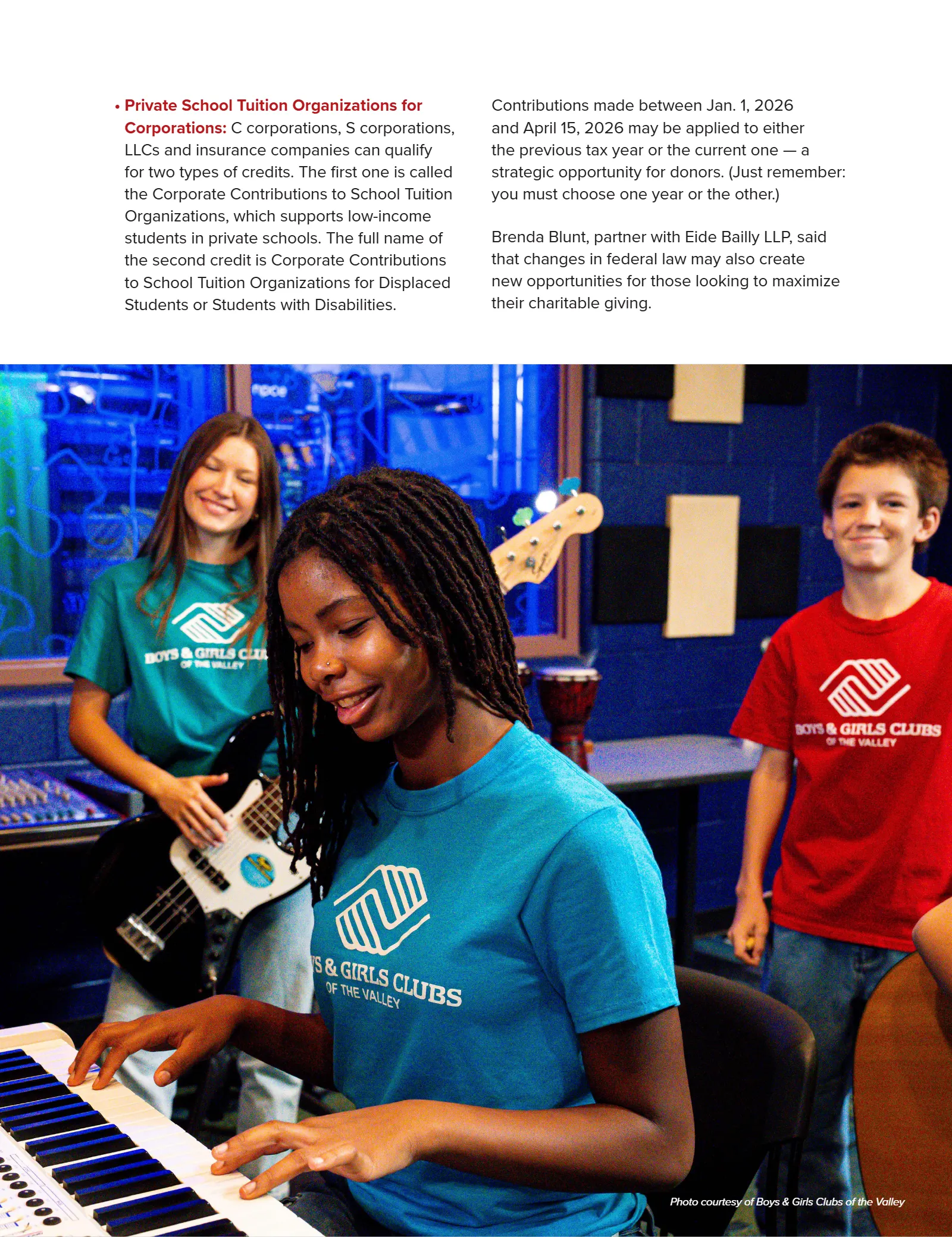
• Private School Tuition Organizations for Corporations: C corporations, S corporations, LLCs and insurance companies can qualify for two types of credits. The first one is called the Corporate Contributions to School Tuition Organizations, which supports low-income students in private schools. The full name of the second credit is Corporate Contributions to School Tuition Organizations for Displaced Students or Students with Disabilities. Contributions made between Jan. 1, 2026 and April 15, 2026 may be applied to either the previous tax year or the current one — a strategic opportunity for donors. (Just remember: you must choose one year or the other.) Brenda Blunt, partner with Eide Bailly LLP, said that changes in federal law may also create new opportunities for those looking to maximize their charitable giving. Photo courtesy of Boys & Girls Clubs of the Valley