
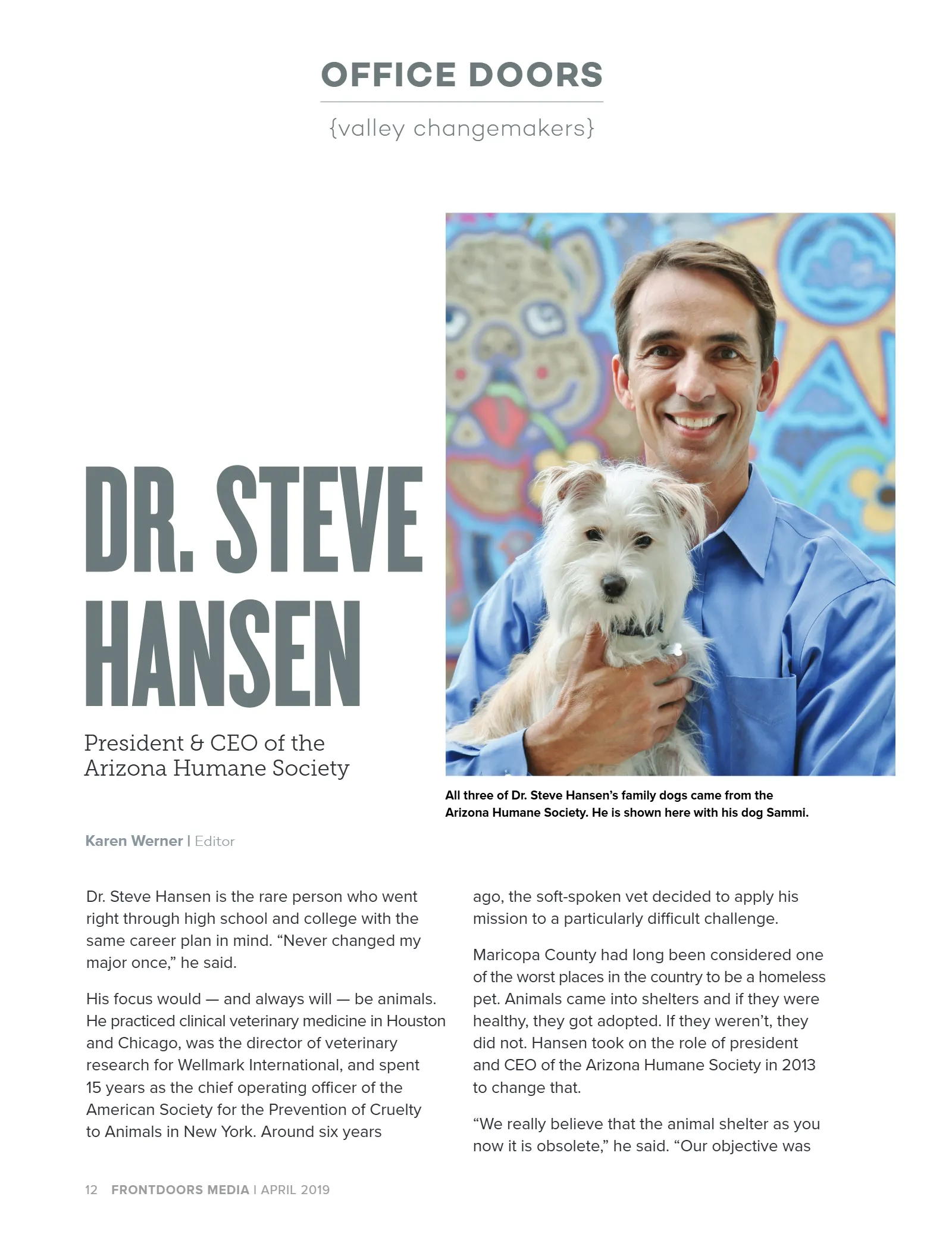
Dr. Steve Hansen is the rare person who went right through high school and college with the same career plan in mind. “Never changed my major once,” he said. His focus would — and always will — be animals. He practiced clinical veterinary medicine in Houston and Chicago, was the director of veterinary research for Wellmark International, and spent 15 years as the chief operating officer of the American Society for the Prevention of Cruelty to Animals in New York. Around six years ago, the soft-spoken vet decided to apply his mission to a particularly difficult challenge. Maricopa County had long been considered one of the worst places in the country to be a homeless pet. Animals came into shelters and if they were healthy, they got adopted. If they weren’t, they did not. Hansen took on the role of president and CEO of the Arizona Humane Society in 2013 to change that. “We really believe that the animal shelter as you now it is obsolete,” he said. “Our objective was Karen Werner | Editor President & CEO of the Arizona Humane Society DR. STEVE HANSEN All three of Dr. Steve Hansen’s family dogs came from the Arizona Humane Society. He is shown here with his dog Sammi. OFFICE DOORS {valley changemakers} 12 FRONTDOORS MEDIA | APRIL 2019
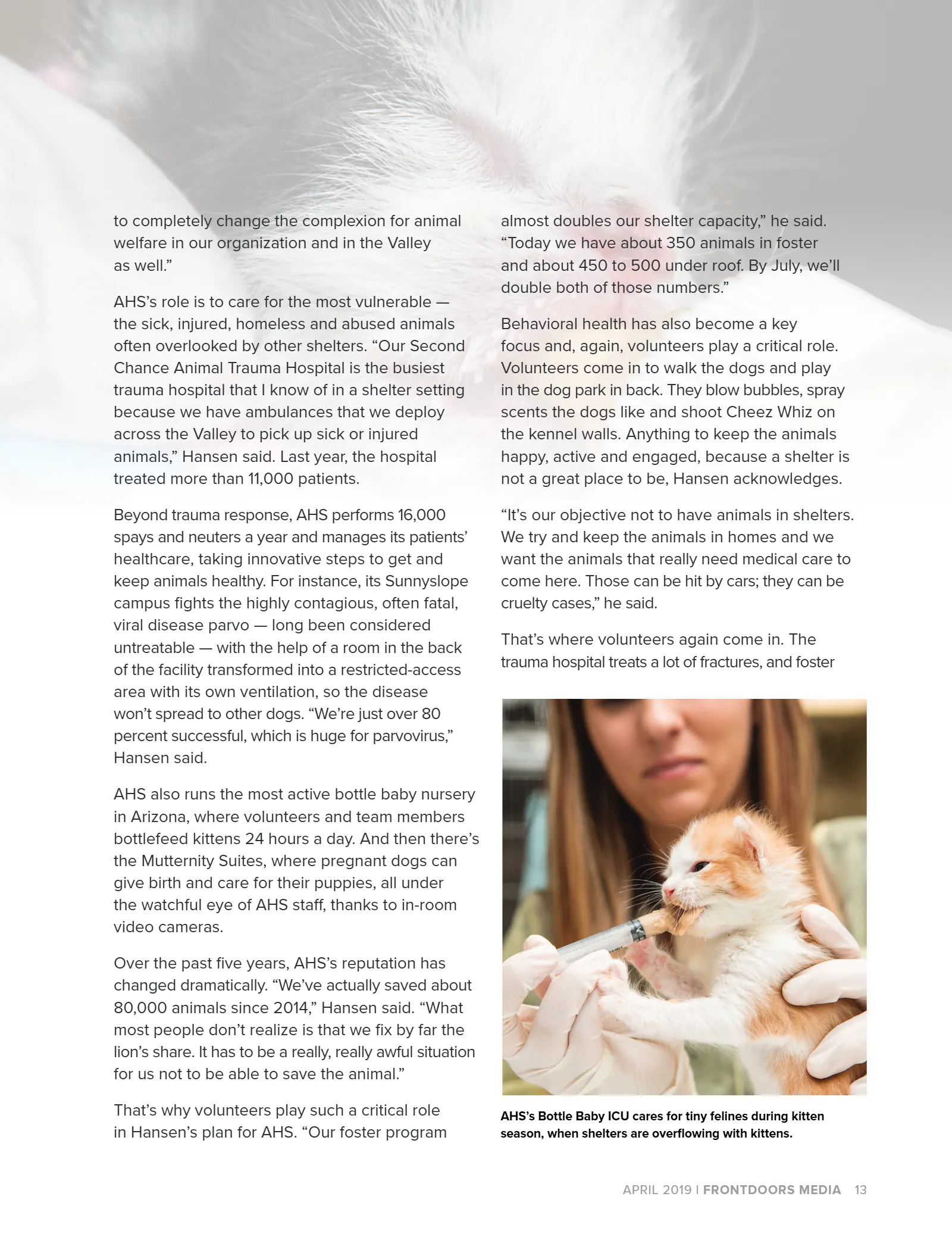
to completely change the complexion for animal welfare in our organization and in the Valley as well.” AHS’s role is to care for the most vulnerable — the sick, injured, homeless and abused animals often overlooked by other shelters. “Our Second Chance Animal Trauma Hospital is the busiest trauma hospital that I know of in a shelter setting because we have ambulances that we deploy across the Valley to pick up sick or injured animals,” Hansen said. Last year, the hospital treated more than 11,000 patients. Beyond trauma response, AHS performs 16,000 spays and neuters a year and manages its patients’ healthcare, taking innovative steps to get and keep animals healthy. For instance, its Sunnyslope campus fights the highly contagious, often fatal, viral disease parvo — long been considered untreatable — with the help of a room in the back of the facility transformed into a restricted-access area with its own ventilation, so the disease won’t spread to other dogs. “We’re just over 80 percent successful, which is huge for parvovirus,” Hansen said. AHS also runs the most active bottle baby nursery in Arizona, where volunteers and team members bottlefeed kittens 24 hours a day. And then there’s the Mutternity Suites, where pregnant dogs can give birth and care for their puppies, all under the watchful eye of AHS staff, thanks to in-room video cameras. Over the past five years, AHS’s reputation has changed dramatically. “We’ve actually saved about 80,000 animals since 2014,” Hansen said. “What most people don’t realize is that we fix by far the lion’s share. It has to be a really, really awful situation for us not to be able to save the animal.” That’s why volunteers play such a critical role in Hansen’s plan for AHS. “Our foster program almost doubles our shelter capacity,” he said. “Today we have about 350 animals in foster and about 450 to 500 under roof. By July, we’ll double both of those numbers.” Behavioral health has also become a key focus and, again, volunteers play a critical role. Volunteers come in to walk the dogs and play in the dog park in back. They blow bubbles, spray scents the dogs like and shoot Cheez Whiz on the kennel walls. Anything to keep the animals happy, active and engaged, because a shelter is not a great place to be, Hansen acknowledges. “It’s our objective not to have animals in shelters. We try and keep the animals in homes and we want the animals that really need medical care to come here. Those can be hit by cars; they can be cruelty cases,” he said. That’s where volunteers again come in. The trauma hospital treats a lot of fractures, and foster AHS’s Bottle Baby ICU cares for tiny felines during kitten season, when shelters are overflowing with kittens. APRIL 2019 | FRONTDOORS MEDIA 13