
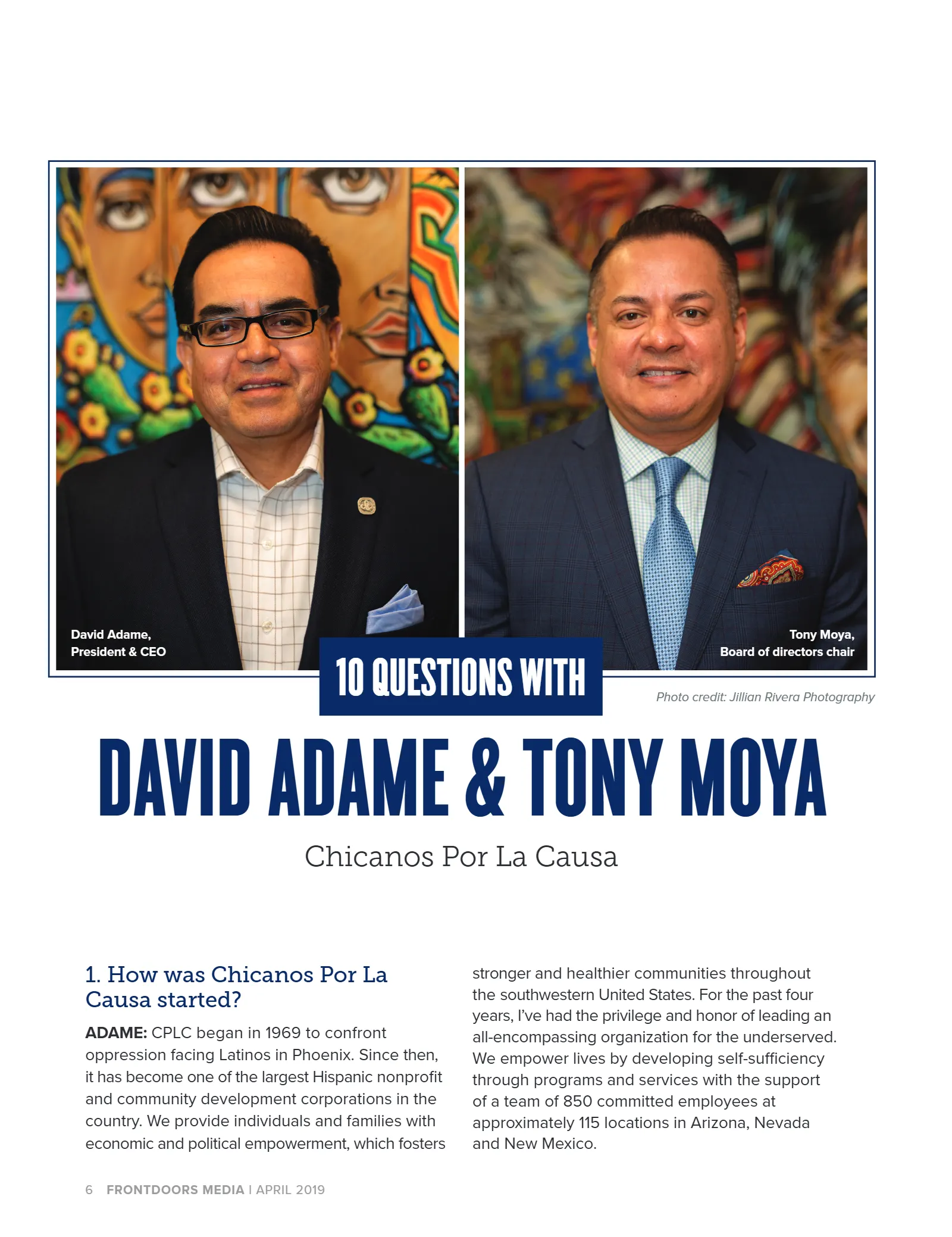
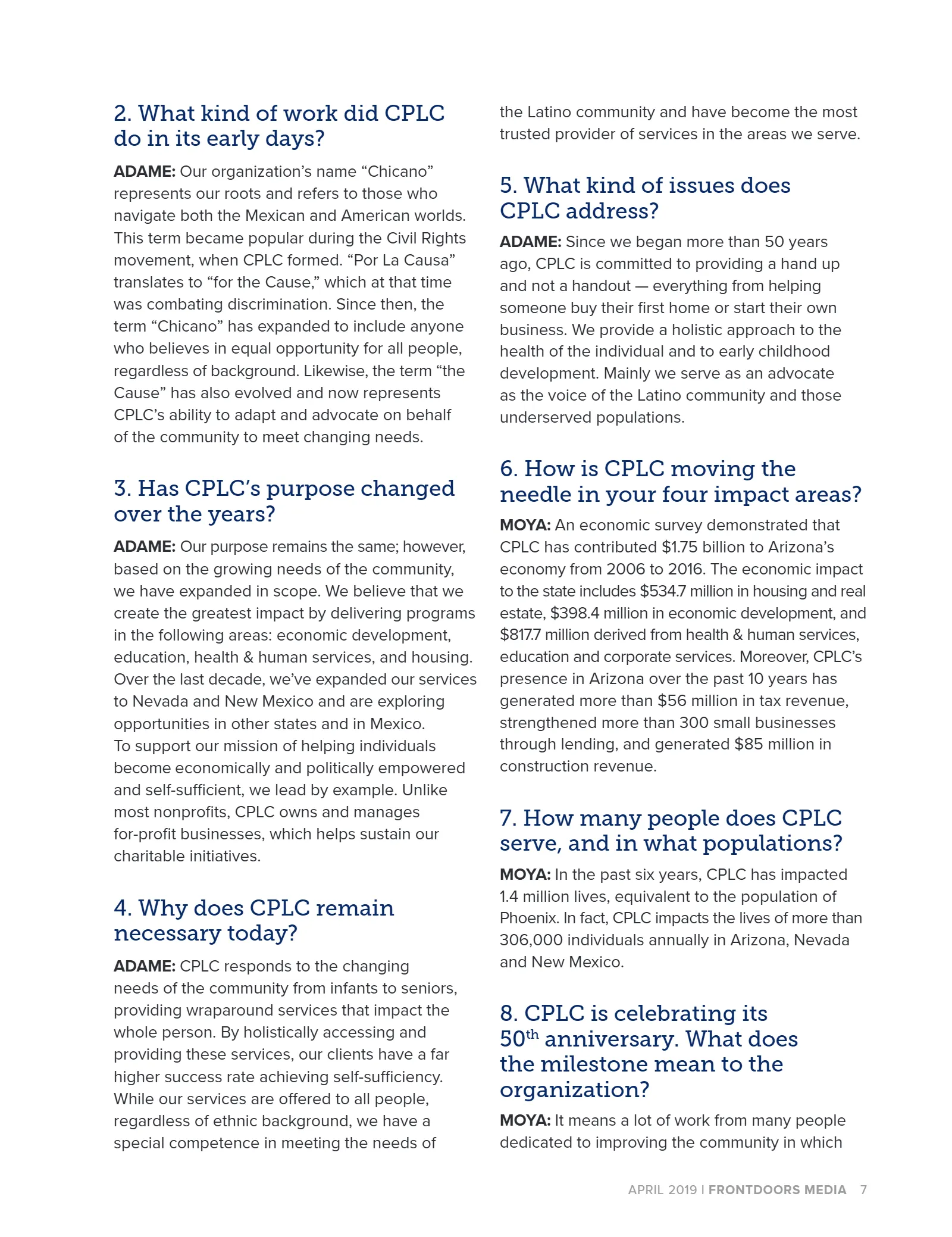
Photo credit: Jillian Rivera Photography Tony Moya, Board of directors chair David Adame, President & CEO 10 QUESTIONS WITH 1. How was Chicanos Por La Causa started? ADAME: CPLC began in 1969 to confront oppression facing Latinos in Phoenix. Since then, it has become one of the largest Hispanic nonprofit and community development corporations in the country. We provide individuals and families with economic and political empowerment, which fosters stronger and healthier communities throughout the southwestern United States. For the past four years, I’ve had the privilege and honor of leading an all-encompassing organization for the underserved. We empower lives by developing self-sufficiency through programs and services with the support of a team of 850 committed employees at approximately 115 locations in Arizona, Nevada and New Mexico. DAVID ADAME & TONY MOYA Chicanos Por La Causa 6 FRONTDOORS MEDIA | APRIL 2019
2. What kind of work did CPLC do in its early days? ADAME: Our organization’s name “Chicano” represents our roots and refers to those who navigate both the Mexican and American worlds. This term became popular during the Civil Rights movement, when CPLC formed. “Por La Causa” translates to “for the Cause,” which at that time was combating discrimination. Since then, the term “Chicano” has expanded to include anyone who believes in equal opportunity for all people, regardless of background. Likewise, the term “the Cause” has also evolved and now represents CPLC’s ability to adapt and advocate on behalf of the community to meet changing needs. 3. Has CPLC’s purpose changed over the years? ADAME: Our purpose remains the same; however, based on the growing needs of the community, we have expanded in scope. We believe that we create the greatest impact by delivering programs in the following areas: economic development, education, health & human services, and housing. Over the last decade, we’ve expanded our services to Nevada and New Mexico and are exploring opportunities in other states and in Mexico. To support our mission of helping individuals become economically and politically empowered and self-sufficient, we lead by example. Unlike most nonprofits, CPLC owns and manages for-profit businesses, which helps sustain our charitable initiatives. 4. Why does CPLC remain necessary today? ADAME: CPLC responds to the changing needs of the community from infants to seniors, providing wraparound services that impact the whole person. By holistically accessing and providing these services, our clients have a far higher success rate achieving self-sufficiency. While our services are offered to all people, regardless of ethnic background, we have a special competence in meeting the needs of the Latino community and have become the most trusted provider of services in the areas we serve. 5. What kind of issues does CPLC address? ADAME: Since we began more than 50 years ago, CPLC is committed to providing a hand up and not a handout — everything from helping someone buy their first home or start their own business. We provide a holistic approach to the health of the individual and to early childhood development. Mainly we serve as an advocate as the voice of the Latino community and those underserved populations. 6. How is CPLC moving the needle in your four impact areas? MOYA: An economic survey demonstrated that CPLC has contributed $1.75 billion to Arizona’s economy from 2006 to 2016. The economic impact to the state includes $534.7 million in housing and real estate, $398.4 million in economic development, and $817.7 million derived from health & human services, education and corporate services. Moreover, CPLC’s presence in Arizona over the past 10 years has generated more than $56 million in tax revenue, strengthened more than 300 small businesses through lending, and generated $85 million in construction revenue. 7. How many people does CPLC serve, and in what populations? MOYA: In the past six years, CPLC has impacted 1.4 million lives, equivalent to the population of Phoenix. In fact, CPLC impacts the lives of more than 306,000 individuals annually in Arizona, Nevada and New Mexico. 8. CPLC is celebrating its 50 th anniversary. What does the milestone mean to the organization? MOYA: It means a lot of work from many people dedicated to improving the community in which APRIL 2019 | FRONTDOORS MEDIA 7