
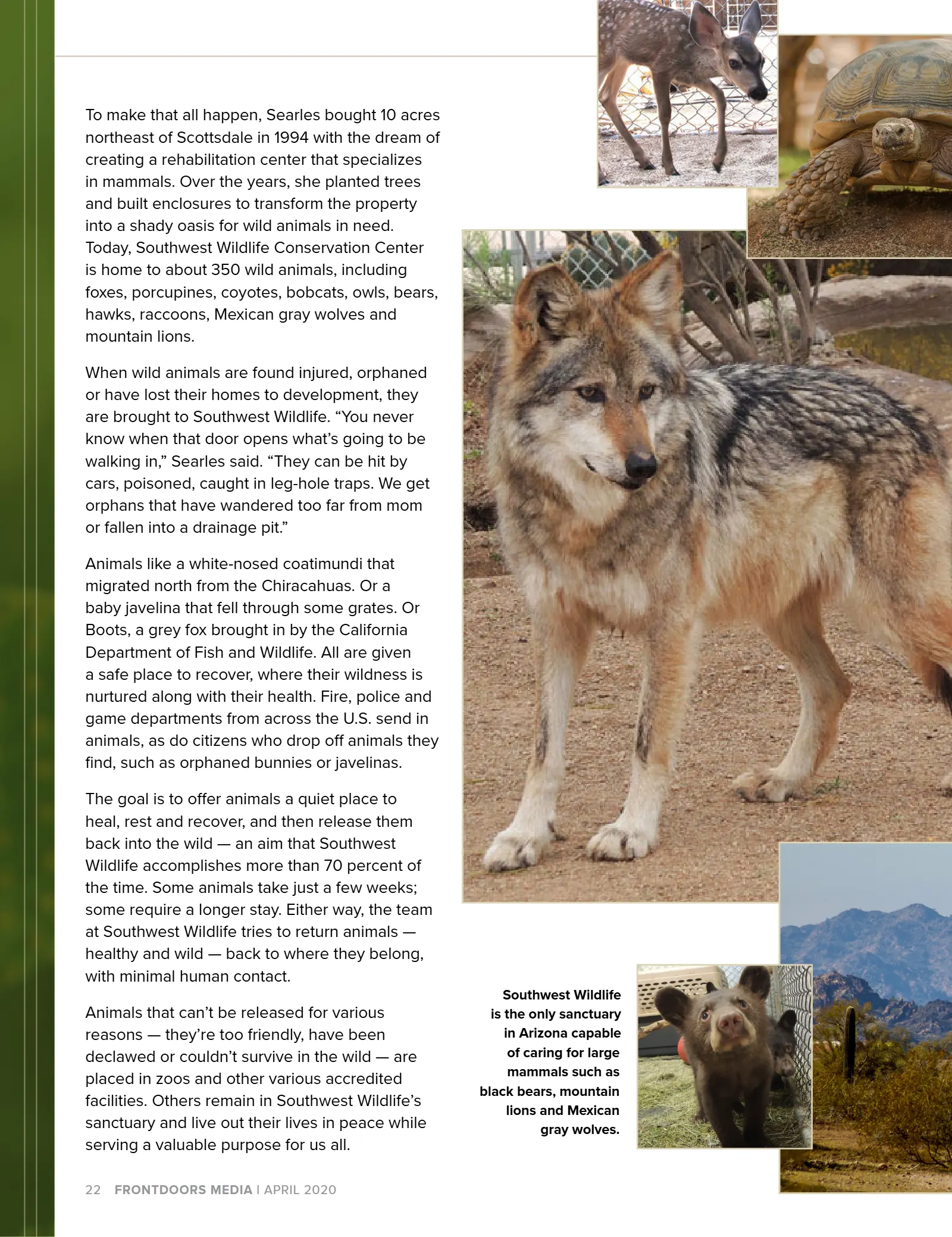
22 FRONTDOORS MEDIA | APRIL 2 020 To make that all happen, Searles bought 10 acres northeast of Scottsdale in 1994 with the dream of creating a rehabilitation center that specializes in mammals. Over the years, she planted trees and built enclosures to transform the property into a shady oasis for wild animals in need. Today, Southwest Wildlife Conservation Center is home to about 350 wild animals, including foxes, porcupines, coyotes, bobcats, owls, bears, hawks, raccoons, Mexican gray wolves and mountain lions. When wild animals are found injured, orphaned or have lost their homes to development, they are brought to Southwest Wildlife. “You never know when that door opens what’s going to be walking in,” Searles said. “They can be hit by cars, poisoned, caught in leg-hole traps. We get orphans that have wandered too far from mom or fallen into a drainage pit.” Animals like a white-nosed coatimundi that migrated north from the Chiracahuas. Or a baby javelina that fell through some grates. Or Boots, a grey fox brought in by the California Department of Fish and Wildlife. All are given a safe place to recover, where their wildness is nurtured along with their health. Fire, police and game departments from across the U.S. send in animals, as do citizens who drop off animals they find, such as orphaned bunnies or javelinas. The goal is to offer animals a quiet place to heal, rest and recover, and then release them back into the wild — an aim that Southwest Wildlife accomplishes more than 70 percent of the time. Some animals take just a few weeks; some require a longer stay. Either way, the team at Southwest Wildlife tries to return animals — healthy and wild — back to where they belong, with minimal human contact. Animals that can’t be released for various reasons — they’re too friendly, have been declawed or couldn’t survive in the wild — are placed in zoos and other various accredited facilities. Others remain in Southwest Wildlife’s sanctuary and live out their lives in peace while serving a valuable purpose for us all. Southwest Wildlife is the only sanctuary in Arizona capable of caring for large mammals such as black bears, mountain lions and Mexican gray wolves.
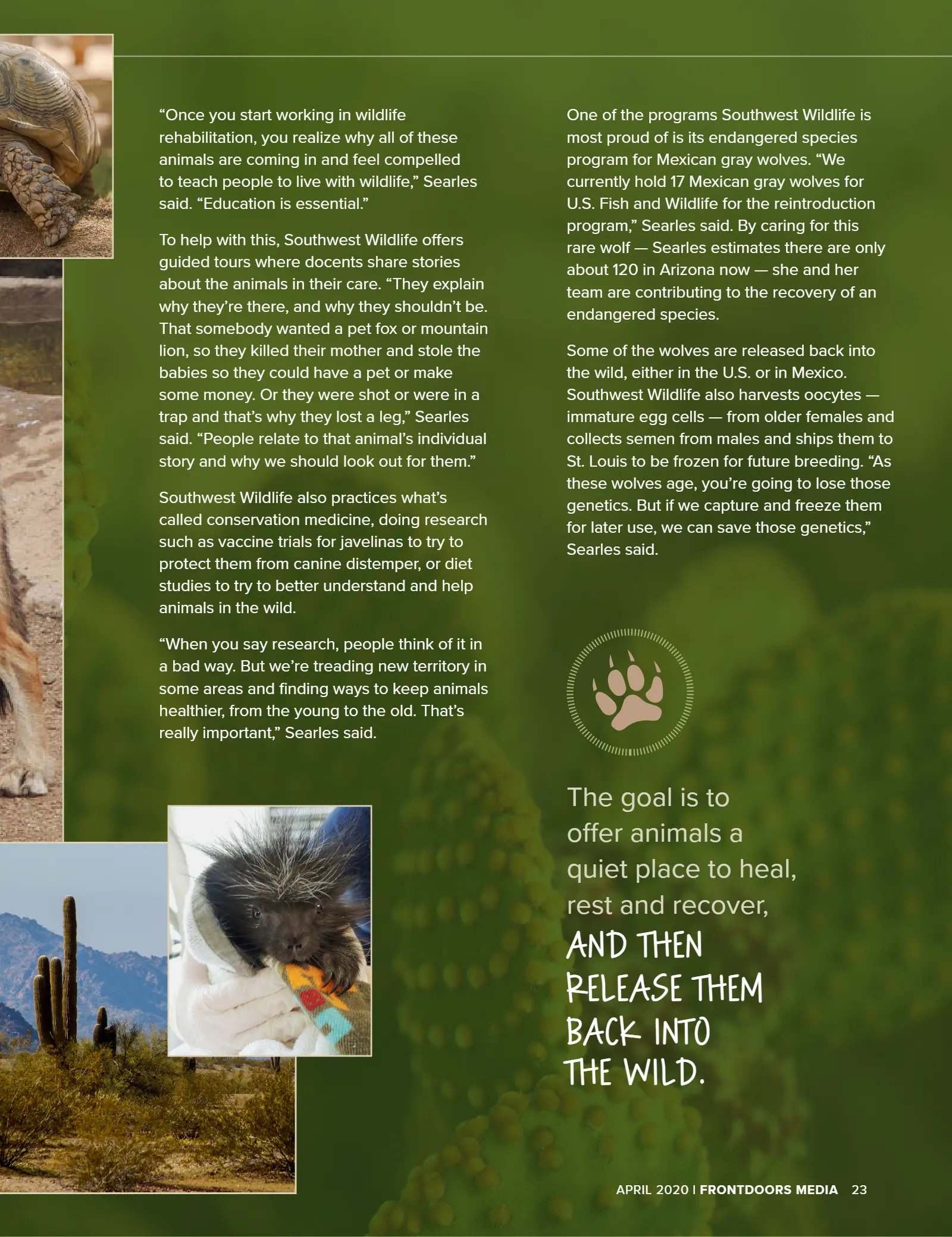
The goal is to offer animals a quiet place to heal, rest and recover, AND THEN AND THEN RELEASE THEM RELEASE THEM BACK BACK INTO INTO THE WILD. THE WILD. “Once you start working in wildlife rehabilitation, you realize why all of these animals are coming in and feel compelled to teach people to live with wildlife,” Searles said. “Education is essential.” To help with this, Southwest Wildlife offers guided tours where docents share stories about the animals in their care. “They explain why they’re there, and why they shouldn’t be. That somebody wanted a pet fox or mountain lion, so they killed their mother and stole the babies so they could have a pet or make some money. Or they were shot or were in a trap and that’s why they lost a leg,” Searles said. “People relate to that animal’s individual story and why we should look out for them.” Southwest Wildlife also practices what’s called conservation medicine, doing research such as vaccine trials for javelinas to try to protect them from canine distemper, or diet studies to try to better understand and help animals in the wild. “When you say research, people think of it in a bad way. But we’re treading new territory in some areas and finding ways to keep animals healthier, from the young to the old. That’s really important,” Searles said. APRIL 2 020 | FRONTDOORS MEDIA 23 One of the programs Southwest Wildlife is most proud of is its endangered species program for Mexican gray wolves. “We currently hold 17 Mexican gray wolves for U.S. Fish and Wildlife for the reintroduction program,” Searles said. By caring for this rare wolf — Searles estimates there are only about 120 in Arizona now — she and her team are contributing to the recovery of an endangered species. Some of the wolves are released back into the wild, either in the U.S. or in Mexico. Southwest Wildlife also harvests oocytes — immature egg cells — from older females and collects semen from males and ships them to St. Louis to be frozen for future breeding. “As these wolves age, you’re going to lose those genetics. But if we capture and freeze them for later use, we can save those genetics,” Searles said.