
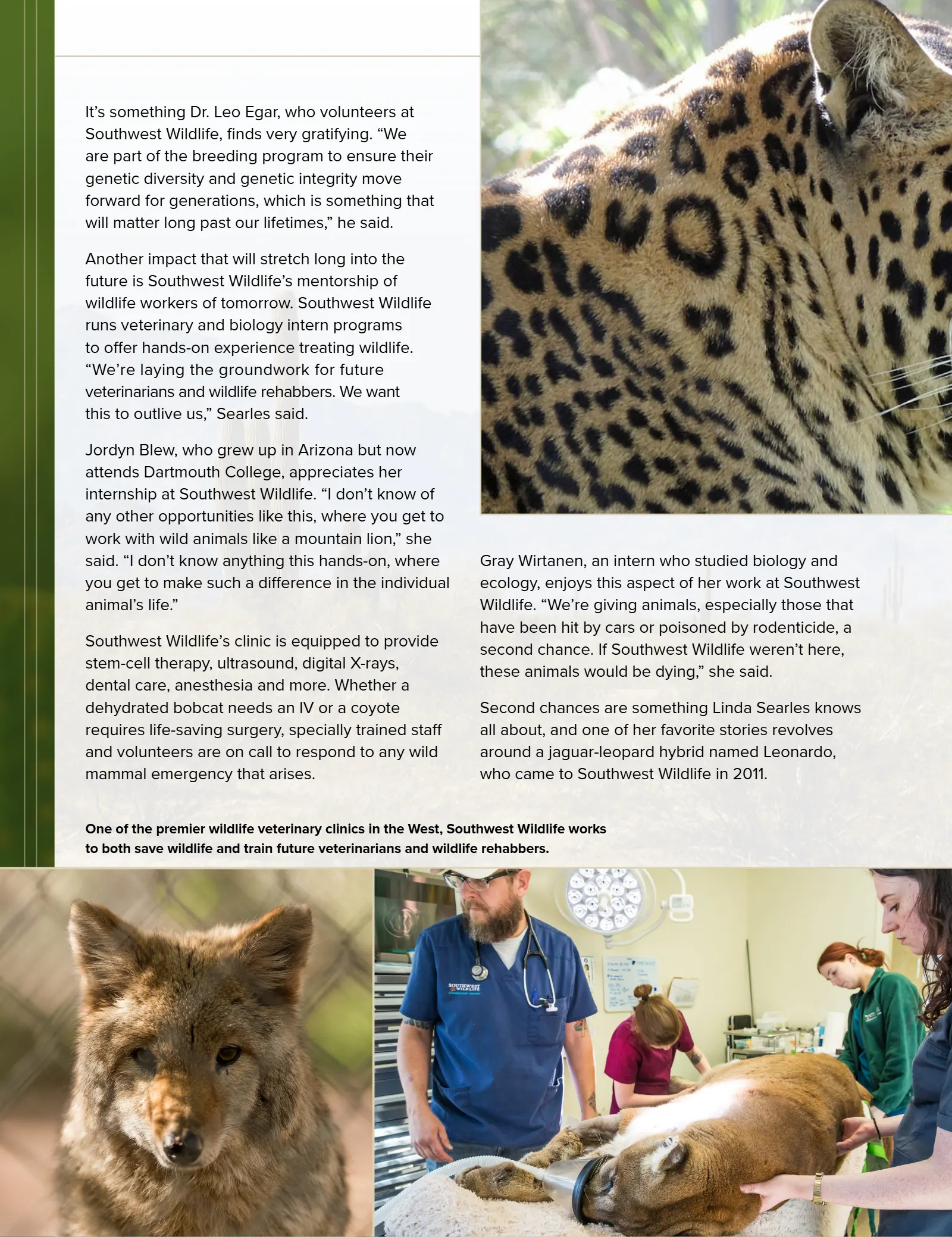
24 FRONTDOORS MEDIA | DECEMBER 2019 24 FRONTDOORS MEDIA | APRIL 2 020 It’s something Dr. Leo Egar, who volunteers at Southwest Wildlife, finds very gratifying. “We are part of the breeding program to ensure their genetic diversity and genetic integrity move forward for generations, which is something that will matter long past our lifetimes,” he said. Another impact that will stretch long into the future is Southwest Wildlife’s mentorship of wildlife workers of tomorrow. Southwest Wildlife runs veterinary and biology intern programs to offer hands-on experience treating wildlife. “We’re laying the groundwork for future veterinarians and wildlife rehabbers. We want this to outlive us,” Searles said. Jordyn Blew, who grew up in Arizona but now attends Dartmouth College, appreciates her internship at Southwest Wildlife. “I don’t know of any other opportunities like this, where you get to work with wild animals like a mountain lion,” she said. “I don’t know anything this hands-on, where you get to make such a difference in the individual animal’s life.” Southwest Wildlife’s clinic is equipped to provide stem-cell therapy, ultrasound, digital X-rays, dental care, anesthesia and more. Whether a dehydrated bobcat needs an IV or a coyote requires life-saving surgery, specially trained staff and volunteers are on call to respond to any wild mammal emergency that arises. Gray Wirtanen, an intern who studied biology and ecology, enjoys this aspect of her work at Southwest Wildlife. “We’re giving animals, especially those that have been hit by cars or poisoned by rodenticide, a second chance. If Southwest Wildlife weren’t here, these animals would be dying,” she said. Second chances are something Linda Searles knows all about, and one of her favorite stories revolves around a jaguar-leopard hybrid named Leonardo, who came to Southwest Wildlife in 2011. One of the premier wildlife veterinary clinics in the West, Southwest Wildlife works to both save wildlife and train future veterinarians and wildlife rehabbers.
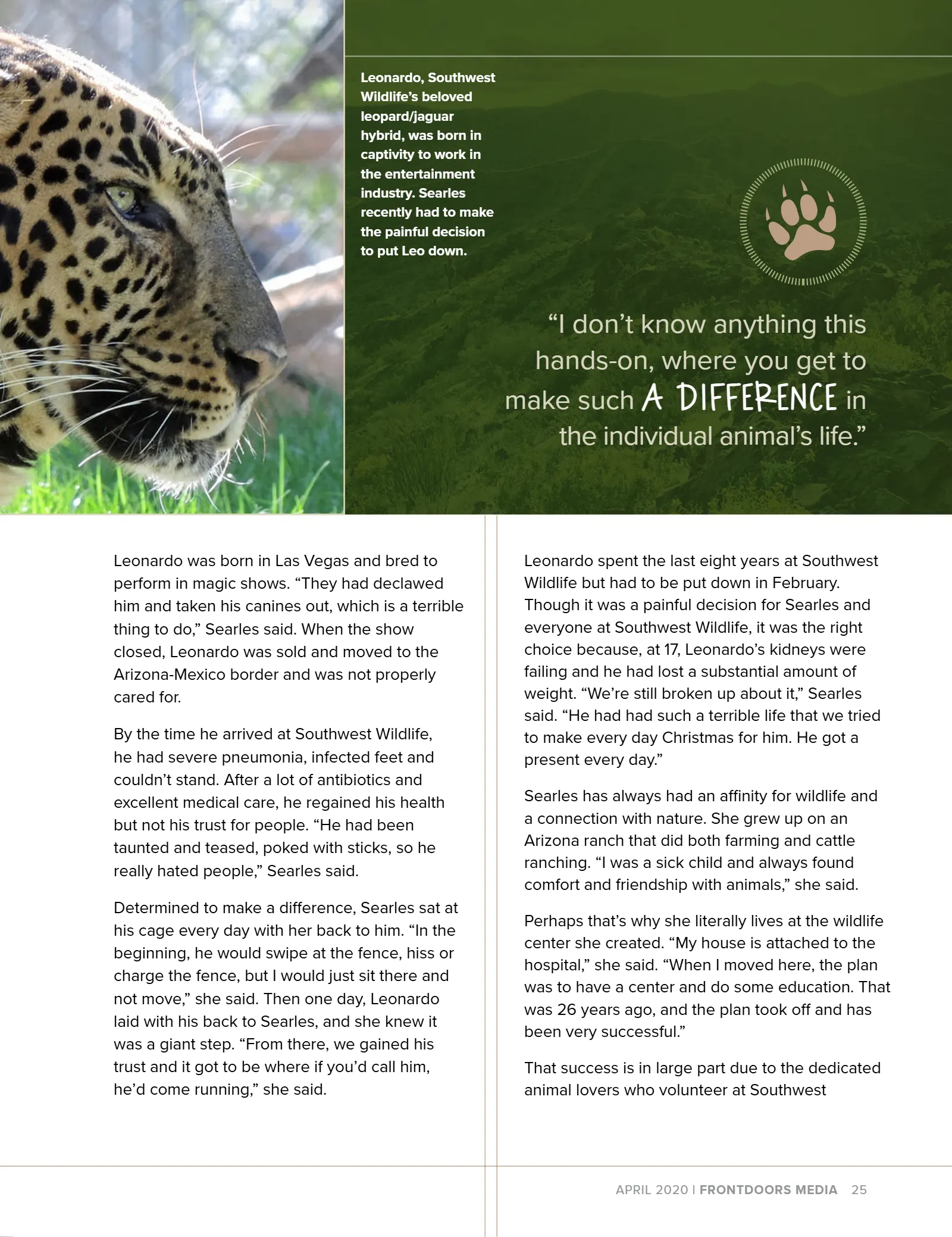
APRIL 2 020 | FRONTDOORS MEDIA 25 Leonardo was born in Las Vegas and bred to perform in magic shows. “They had declawed him and taken his canines out, which is a terrible thing to do,” Searles said. When the show closed, Leonardo was sold and moved to the Arizona-Mexico border and was not properly cared for. By the time he arrived at Southwest Wildlife, he had severe pneumonia, infected feet and couldn’t stand. After a lot of antibiotics and excellent medical care, he regained his health but not his trust for people. “He had been taunted and teased, poked with sticks, so he really hated people,” Searles said. Determined to make a difference, Searles sat at his cage every day with her back to him. “In the beginning, he would swipe at the fence, hiss or charge the fence, but I would just sit there and not move,” she said. Then one day, Leonardo laid with his back to Searles, and she knew it was a giant step. “From there, we gained his trust and it got to be where if you’d call him, he’d come running,” she said. Leonardo spent the last eight years at Southwest Wildlife but had to be put down in February. Though it was a painful decision for Searles and everyone at Southwest Wildlife, it was the right choice because, at 17, Leonardo’s kidneys were failing and he had lost a substantial amount of weight. “We’re still broken up about it,” Searles said. “He had had such a terrible life that we tried to make every day Christmas for him. He got a present every day.” Searles has always had an affinity for wildlife and a connection with nature. She grew up on an Arizona ranch that did both farming and cattle ranching. “I was a sick child and always found comfort and friendship with animals,” she said. Perhaps that’s why she literally lives at the wildlife center she created. “My house is attached to the hospital,” she said. “When I moved here, the plan was to have a center and do some education. That was 26 years ago, and the plan took off and has been very successful.” That success is in large part due to the dedicated animal lovers who volunteer at Southwest “I don’t know anything this hands-on, where you get to make such A DIFFERENCE A DIFFERENCE in the individual animal’s life.” Leonardo, Southwest Wildlife’s beloved leopard/jaguar hybrid, was born in captivity to work in the entertainment industry. Searles recently had to make the painful decision to put Leo down.