
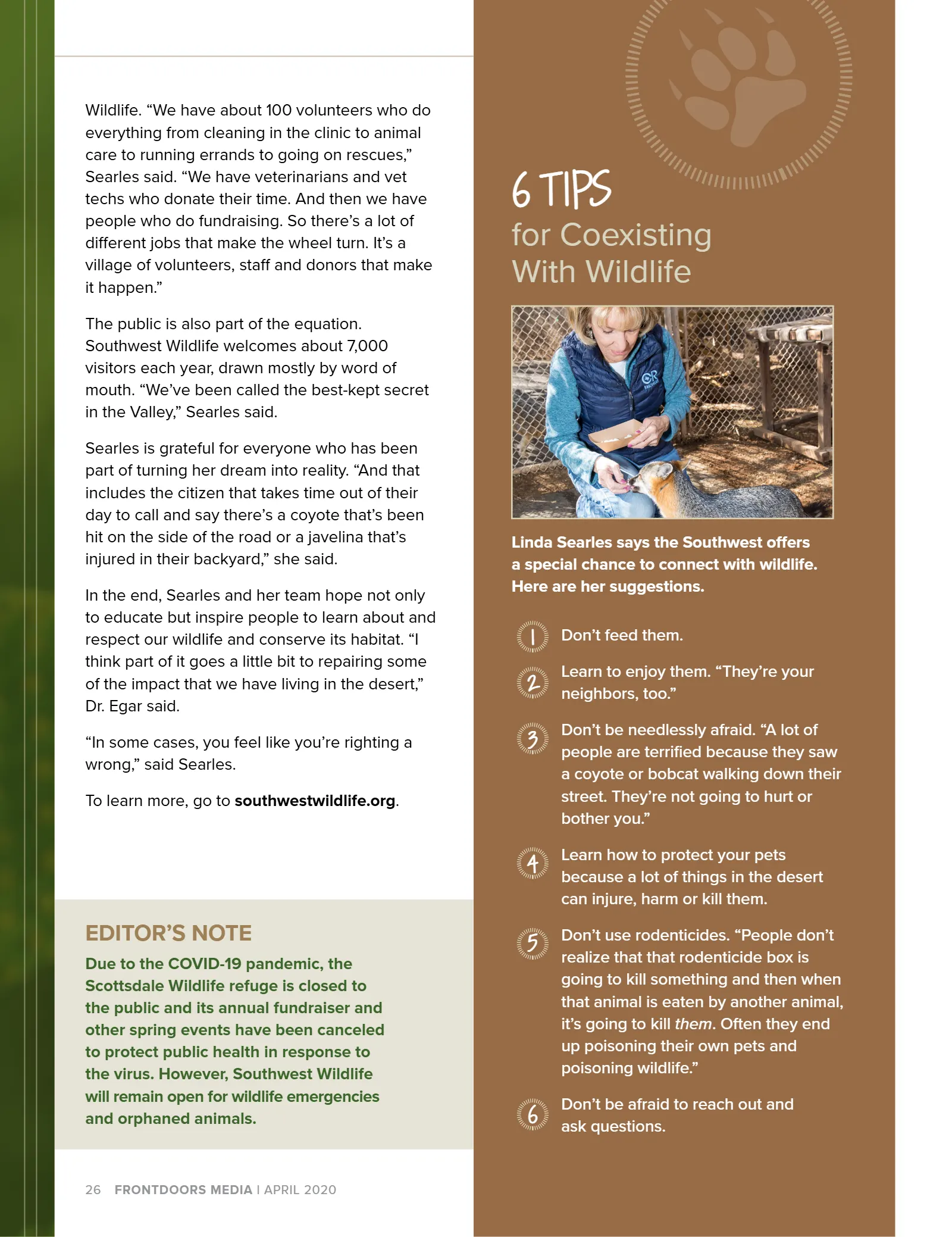

Linda Searles says the Southwest offers a special chance to connect with wildlife. Here are her suggestions. Wildlife. “We have about 100 volunteers who do everything from cleaning in the clinic to animal care to running errands to going on rescues,” Searles said. “We have veterinarians and vet techs who donate their time. And then we have people who do fundraising. So there’s a lot of different jobs that make the wheel turn. It’s a village of volunteers, staff and donors that make it happen.” The public is also part of the equation. Southwest Wildlife welcomes about 7,000 visitors each year, drawn mostly by word of mouth. “We’ve been called the best-kept secret in the Valley,” Searles said. Searles is grateful for everyone who has been part of turning her dream into reality. “And that includes the citizen that takes time out of their day to call and say there’s a coyote that’s been hit on the side of the road or a javelina that’s injured in their backyard,” she said. In the end, Searles and her team hope not only to educate but inspire people to learn about and respect our wildlife and conserve its habitat. “I think part of it goes a little bit to repairing some of the impact that we have living in the desert,” Dr. Egar said. “In some cases, you feel like you’re righting a wrong,” said Searles. To learn more, go to southwestwildlife.org . 6 TIPS 6 TIPS for Coexisting With Wildlife EDITOR’S NOTE Due to the COVID-19 pandemic, the Scottsdale Wildlife refuge is closed to the public and its annual fundraiser and other spring events have been canceled to protect public health in response to the virus. However, Southwest Wildlife will remain open for wildlife emergencies and orphaned animals. 1 1 2 2 3 3 4 4 5 5 6 6 Don’t feed them. Learn to enjoy them. “They’re your neighbors, too.” Don’t be needlessly afraid. “A lot of people are terrified because they saw a coyote or bobcat walking down their street. They’re not going to hurt or bother you.” Learn how to protect your pets because a lot of things in the desert can injure, harm or kill them. Don’t use rodenticides. “People don’t realize that that rodenticide box is going to kill something and then when that animal is eaten by another animal, it’s going to kill them . Often they end up poisoning their own pets and poisoning wildlife.” Don’t be afraid to reach out and ask questions. 26 FRONTDOORS MEDIA | APRIL 2 020
NEXT DOORS {ahead of the curve} It’s difficult to figure out where to start. I’m late writing my column this month because I wanted to hold out as long as possible, in case of some substantive paradigm change that would have been unthinkable even days or weeks ago. So I’m sitting on my porch on Sunday, March 29 as I write this, social distancing on one of the most gloriously beautiful days of the year. The juxtaposition between the natural beauty that’s begging the soul to go out and interact with others versus the unthinkable crisis that’s keeping most of us in our homes is jarring. In less than three weeks, the world economy has crashed. You’ve read plenty about that. So I’ll focus on what we focus on, those individuals and organizations that give back to our community. So many of them are hurting. Some organizations aren’t able to function normally, some not at all. Many of the Valley’s most high-profile fundraising events, generating millions of dollars for those in need, have been postponed or canceled. The arts are shuttered. People have lost their jobs. We are entering into a period of unpredictability never seen before, with no end in sight, and with many of the public service organizations we rely on to help us deal with troubled times struggling to survive. According to the Alliance of Arizona Nonprofits, in just the first few weeks of the crisis, nonprofits have seen more than $36.7 million in revenue loss. The best way to deal with this crisis is to do what we’ve always done — come together as a community . Tom Evans | Contributing Editor WHERE DO WE GO FROM HERE? Uniting to help during the coronavirus outbreak