
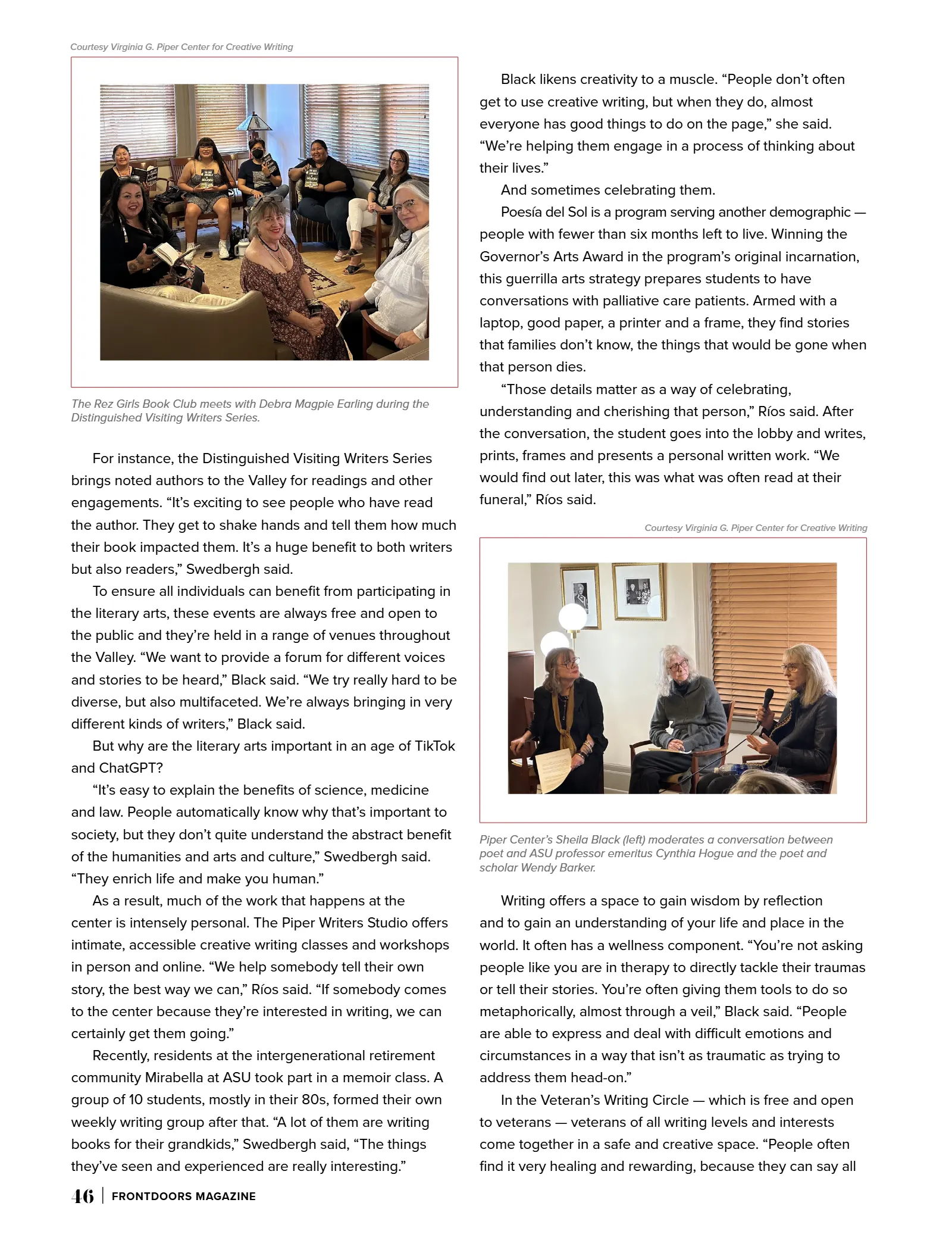
46 | FRONTDOORS MAGAZINE The Rez Girls Book Club meets with Debra Magpie Earling during the Distinguished Visiting Writers Series. Courtesy Virginia G. Piper Center for Creative Writing Courtesy Virginia G. Piper Center for Creative Writing For instance, the Distinguished Visiting Writers Series brings noted authors to the Valley for readings and other engagements. “It’s exciting to see people who have read the author. They get to shake hands and tell them how much their book impacted them. It’s a huge benefit to both writers but also readers,” Swedbergh said. To ensure all individuals can benefit from participating in the literary arts, these events are always free and open to the public and they’re held in a range of venues throughout the Valley. “We want to provide a forum for different voices and stories to be heard,” Black said. “We try really hard to be diverse, but also multifaceted. We’re always bringing in very different kinds of writers,” Black said. But why are the literary arts important in an age of TikTok and ChatGPT? “It’s easy to explain the benefits of science, medicine and law. People automatically know why that’s important to society, but they don’t quite understand the abstract benefit of the humanities and arts and culture,” Swedbergh said. “They enrich life and make you human.” As a result, much of the work that happens at the center is intensely personal. The Piper Writers Studio offers intimate, accessible creative writing classes and workshops in person and online. “We help somebody tell their own story, the best way we can,” Ríos said. “If somebody comes to the center because they’re interested in writing, we can certainly get them going.” Recently, residents at the intergenerational retirement community Mirabella at ASU took part in a memoir class. A group of 10 students, mostly in their 80s, formed their own weekly writing group after that. “A lot of them are writing books for their grandkids,” Swedbergh said, “The things they’ve seen and experienced are really interesting.” Black likens creativity to a muscle. “People don’t often get to use creative writing, but when they do, almost everyone has good things to do on the page,” she said. “We’re helping them engage in a process of thinking about their lives.” And sometimes celebrating them. Poesía del Sol is a program serving another demographic — people with fewer than six months left to live. Winning the Governor’s Arts Award in the program’s original incarnation, this guerrilla arts strategy prepares students to have conversations with palliative care patients. Armed with a laptop, good paper, a printer and a frame, they find stories that families don’t know, the things that would be gone when that person dies. “Those details matter as a way of celebrating, understanding and cherishing that person,” Ríos said. After the conversation, the student goes into the lobby and writes, prints, frames and presents a personal written work. “We would find out later, this was what was often read at their funeral,” Ríos said. Writing offers a space to gain wisdom by reflection and to gain an understanding of your life and place in the world. It often has a wellness component. “You’re not asking people like you are in therapy to directly tackle their traumas or tell their stories. You’re often giving them tools to do so metaphorically, almost through a veil,” Black said. “People are able to express and deal with difficult emotions and circumstances in a way that isn’t as traumatic as trying to address them head-on.” In the Veteran’s Writing Circle — which is free and open to veterans — veterans of all writing levels and interests come together in a safe and creative space. “People often find it very healing and rewarding, because they can say all Piper Center’s Sheila Black (left) moderates a conversation between poet and ASU professor emeritus Cynthia Hogue and the poet and scholar Wendy Barker.
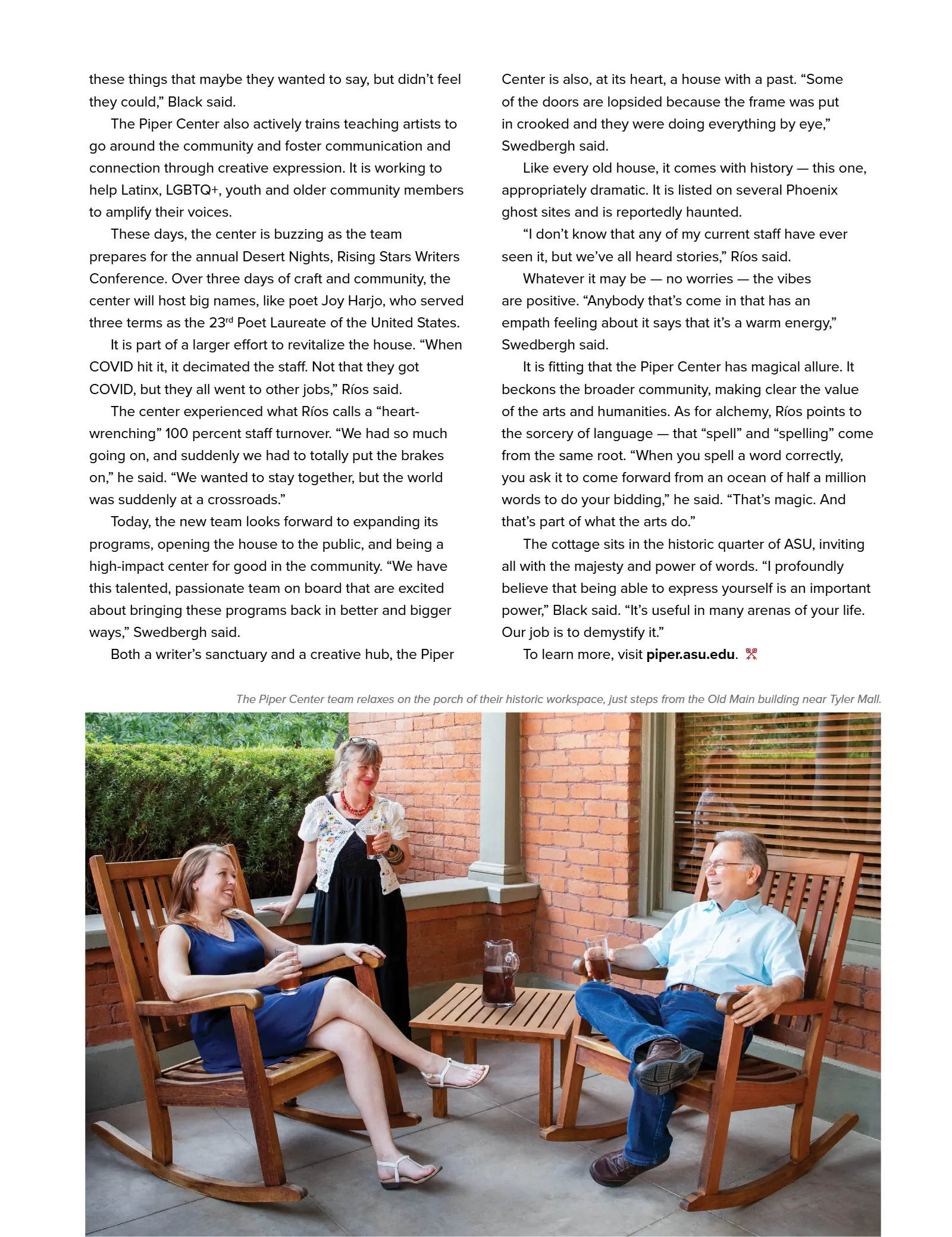
FRONTDOORS MAGAZINE | 47 The Piper Center team relaxes on the porch of their historic workspace, just steps from the Old Main building near Tyler Mall. these things that maybe they wanted to say, but didn’t feel they could,” Black said. The Piper Center also actively trains teaching artists to go around the community and foster communication and connection through creative expression. It is working to help Latinx, LGBTQ+, youth and older community members to amplify their voices. These days, the center is buzzing as the team prepares for the annual Desert Nights, Rising Stars Writers Conference. Over three days of craft and community, the center will host big names, like poet Joy Harjo, who served three terms as the 23 rd Poet Laureate of the United States. It is part of a larger effort to revitalize the house. “When COVID hit it, it decimated the staff. Not that they got COVID, but they all went to other jobs,” Ríos said. The center experienced what Ríos calls a “heart- wrenching” 100 percent staff turnover. “We had so much going on, and suddenly we had to totally put the brakes on,” he said. “We wanted to stay together, but the world was suddenly at a crossroads.” Today, the new team looks forward to expanding its programs, opening the house to the public, and being a high-impact center for good in the community. “We have this talented, passionate team on board that are excited about bringing these programs back in better and bigger ways,” Swedbergh said. Both a writer’s sanctuary and a creative hub, the Piper Center is also, at its heart, a house with a past. “Some of the doors are lopsided because the frame was put in crooked and they were doing everything by eye,” Swedbergh said. Like every old house, it comes with history — this one, appropriately dramatic. It is listed on several Phoenix ghost sites and is reportedly haunted. “I don’t know that any of my current staff have ever seen it, but we’ve all heard stories,” Ríos said. Whatever it may be — no worries — the vibes are positive. “Anybody that’s come in that has an empath feeling about it says that it’s a warm energy,” Swedbergh said. It is fitting that the Piper Center has magical allure. It beckons the broader community, making clear the value of the arts and humanities. As for alchemy, Ríos points to the sorcery of language — that “spell” and “spelling” come from the same root. “When you spell a word correctly, you ask it to come forward from an ocean of half a million words to do your bidding,” he said. “That’s magic. And that’s part of what the arts do.” The cottage sits in the historic quarter of ASU, inviting all with the majesty and power of words. “I profoundly believe that being able to express yourself is an important power,” Black said. “It’s useful in many arenas of your life. Our job is to demystify it.” To learn more, visit piper.asu.edu .