
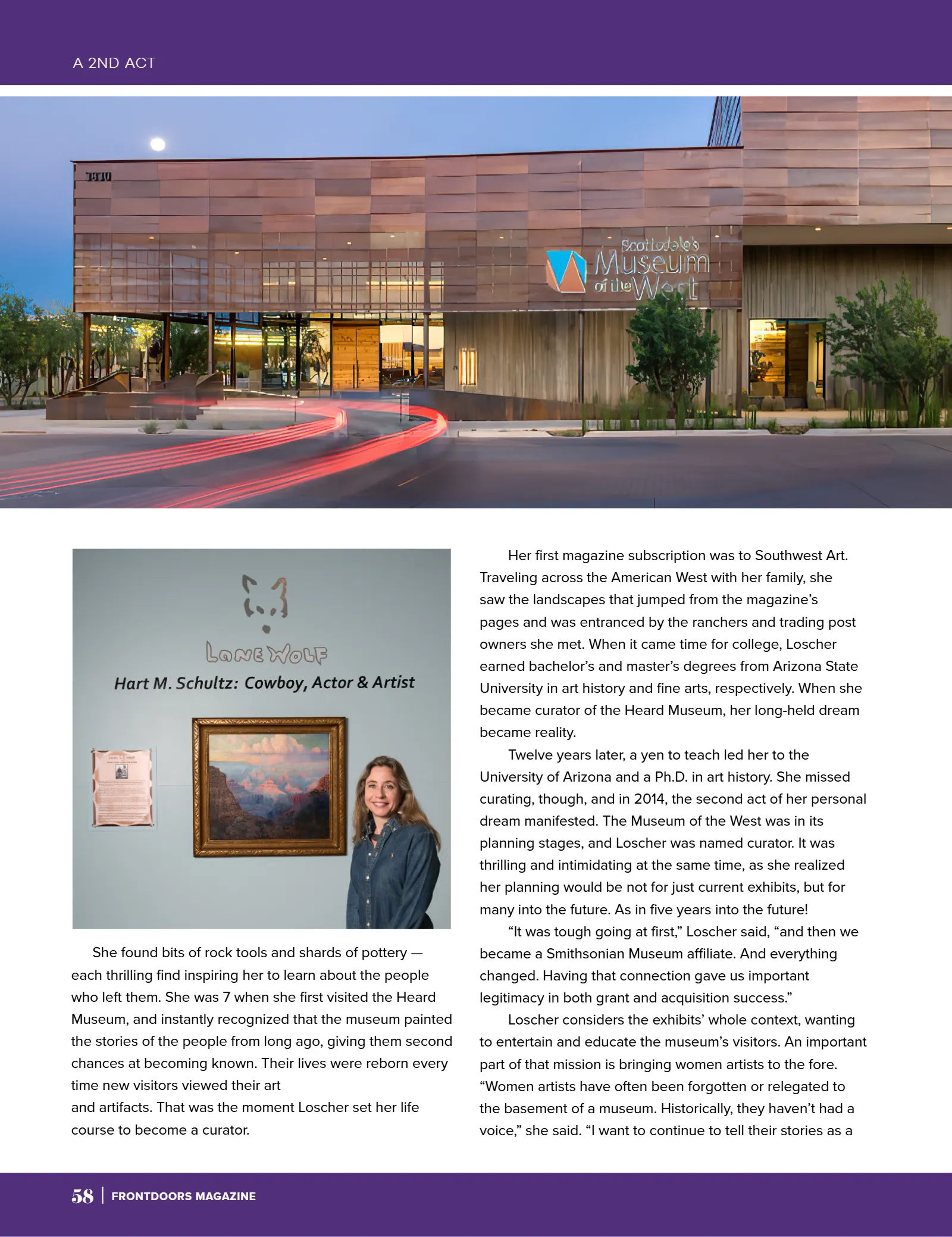
She found bits of rock tools and shards of pottery — each thrilling find inspiring her to learn about the people who left them. She was 7 when she first visited the Heard Museum, and instantly recognized that the museum painted the stories of the people from long ago, giving them second chances at becoming known. Their lives were reborn every time new visitors viewed their art and artifacts. That was the moment Loscher set her life course to become a curator. Her first magazine subscription was to Southwest Art. Traveling across the American West with her family, she saw the landscapes that jumped from the magazine’s pages and was entranced by the ranchers and trading post owners she met. When it came time for college, Loscher earned bachelor’s and master’s degrees from Arizona State University in art history and fine arts, respectively. When she became curator of the Heard Museum, her long-held dream became reality. Twelve years later, a yen to teach led her to the University of Arizona and a Ph.D. in art history. She missed curating, though, and in 2014, the second act of her personal dream manifested. The Museum of the West was in its planning stages, and Loscher was named curator. It was thrilling and intimidating at the same time, as she realized her planning would be not for just current exhibits, but for many into the future. As in five years into the future! “It was tough going at first,” Loscher said, “and then we became a Smithsonian Museum affiliate. And everything changed. Having that connection gave us important legitimacy in both grant and acquisition success.” Loscher considers the exhibits’ whole context, wanting to entertain and educate the museum’s visitors. An important part of that mission is bringing women artists to the fore. “Women artists have often been forgotten or relegated to the basement of a museum. Historically, they haven’t had a voice,” she said. “I want to continue to tell their stories as a 58 | FRONTDOORS MAGAZINE A 2ND ACT
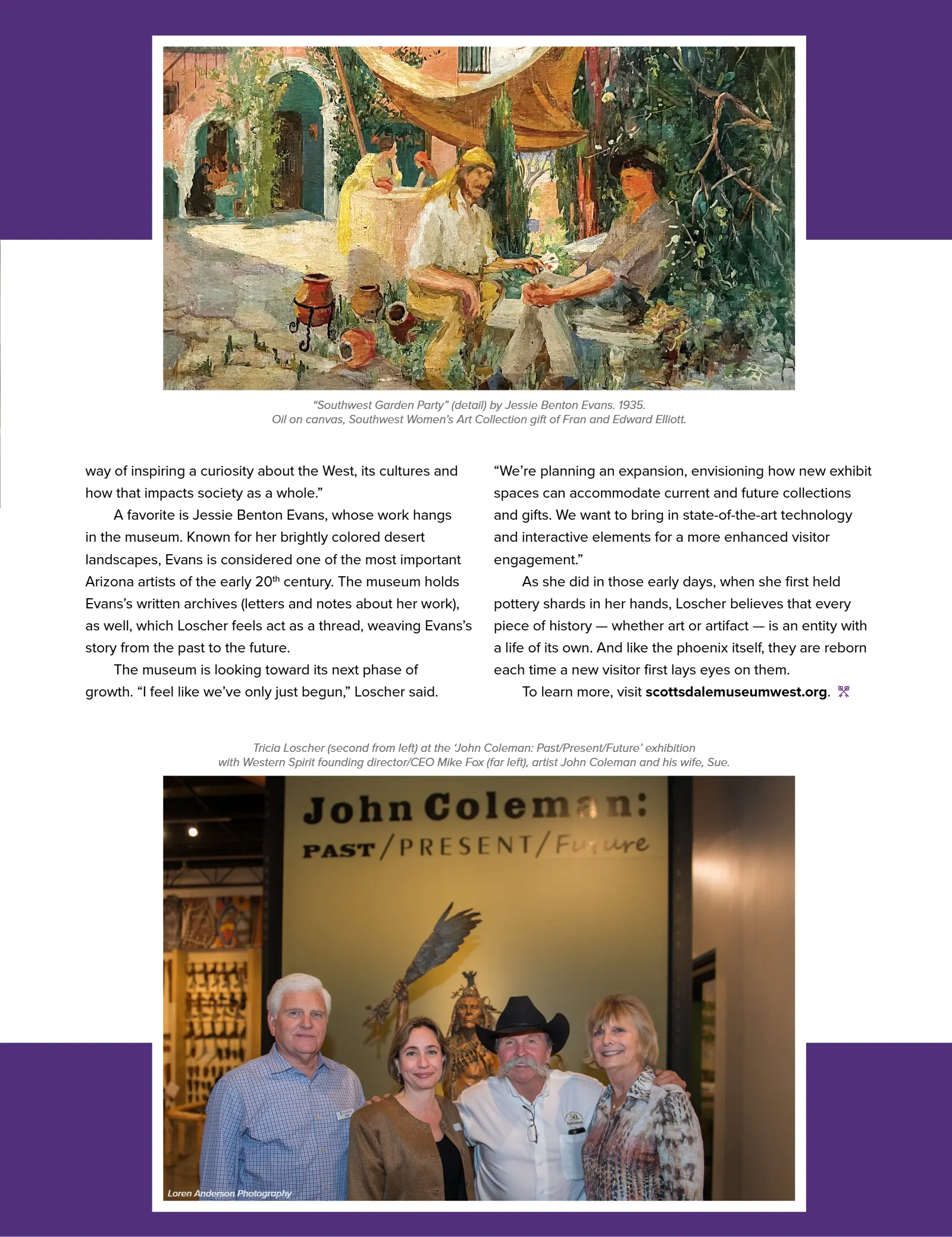
way of inspiring a curiosity about the West, its cultures and how that impacts society as a whole.” A favorite is Jessie Benton Evans, whose work hangs in the museum. Known for her brightly colored desert landscapes, Evans is considered one of the most important Arizona artists of the early 20 th century. The museum holds Evans’s written archives (letters and notes about her work), as well, which Loscher feels act as a thread, weaving Evans’s story from the past to the future. The museum is looking toward its next phase of growth. “I feel like we’ve only just begun,” Loscher said. “We’re planning an expansion, envisioning how new exhibit spaces can accommodate current and future collections and gifts. We want to bring in state-of-the-art technology and interactive elements for a more enhanced visitor engagement.” As she did in those early days, when she first held pottery shards in her hands, Loscher believes that every piece of history — whether art or artifact — is an entity with a life of its own. And like the phoenix itself, they are reborn each time a new visitor first lays eyes on them. To learn more, visit scottsdalemuseumwest.org . Loren Anderson Photography Tricia Loscher (second from left) at the ‘John Coleman: Past/Present/Future’ exhibition with Western Spirit founding director/CEO Mike Fox (far left), artist John Coleman and his wife, Sue. “Southwest Garden Party” (detail) by Jessie Benton Evans. 1935. Oil on canvas, Southwest Women’s Art Collection gift of Fran and Edward Elliott.