
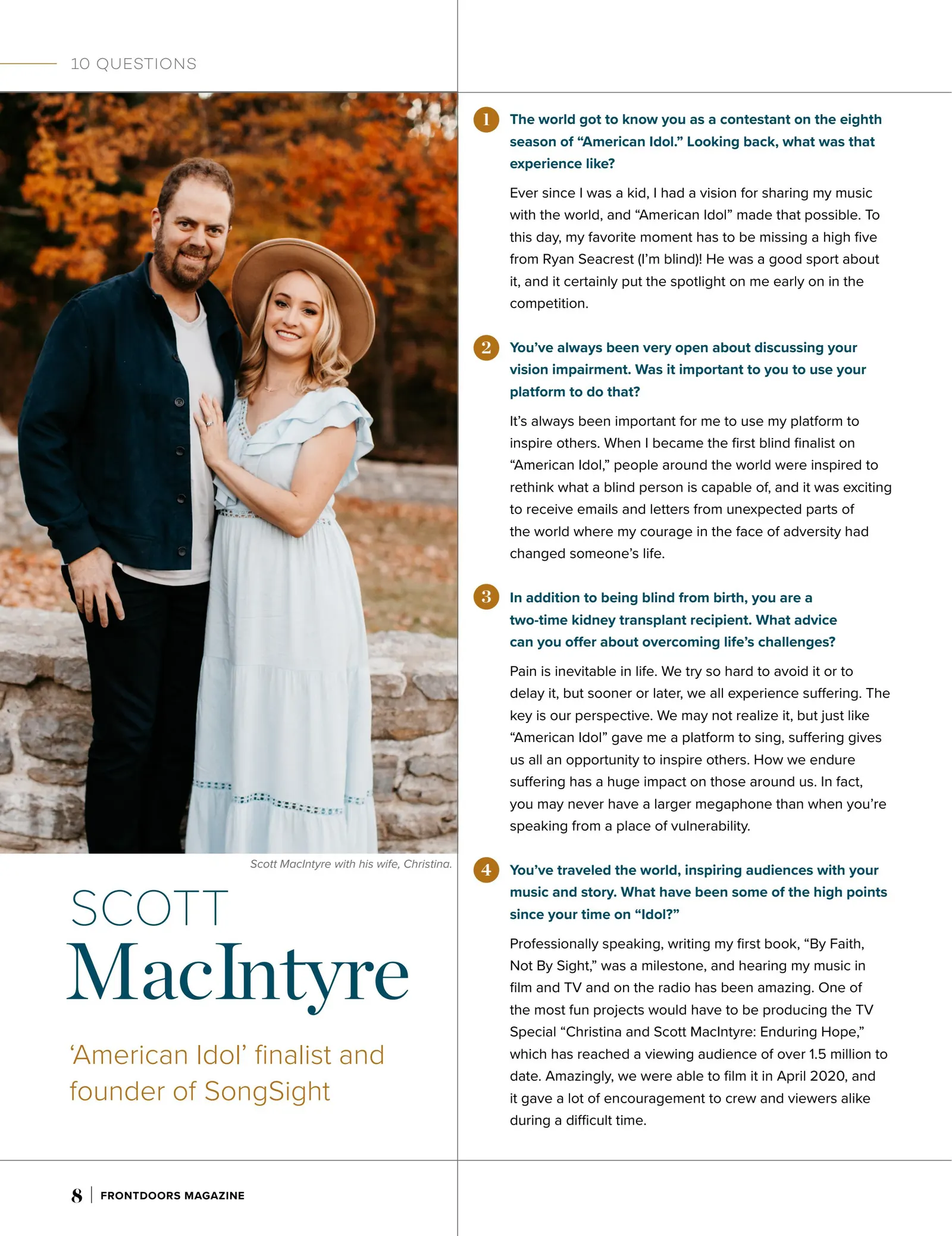
8 | FRONTDOORS MAGAZINE 2 3 The world got to know you as a contestant on the eighth season of “American Idol.” Looking back, what was that experience like? Ever since I was a kid, I had a vision for sharing my music with the world, and “American Idol” made that possible. To this day, my favorite moment has to be missing a high five from Ryan Seacrest (I’m blind)! He was a good sport about it, and it certainly put the spotlight on me early on in the competition. You’ve always been very open about discussing your vision impairment. Was it important to you to use your platform to do that? It’s always been important for me to use my platform to inspire others. When I became the first blind finalist on “American Idol,” people around the world were inspired to rethink what a blind person is capable of, and it was exciting to receive emails and letters from unexpected parts of the world where my courage in the face of adversity had changed someone’s life. In addition to being blind from birth, you are a two-time kidney transplant recipient. What advice can you offer about overcoming life’s challenges? Pain is inevitable in life. We try so hard to avoid it or to delay it, but sooner or later, we all experience suffering. The key is our perspective. We may not realize it, but just like “American Idol” gave me a platform to sing, suffering gives us all an opportunity to inspire others. How we endure suffering has a huge impact on those around us. In fact, you may never have a larger megaphone than when you’re speaking from a place of vulnerability. You’ve traveled the world, inspiring audiences with your music and story. What have been some of the high points since your time on “Idol?” Professionally speaking, writing my first book, “By Faith, Not By Sight,” was a milestone, and hearing my music in film and TV and on the radio has been amazing. One of the most fun projects would have to be producing the TV Special “Christina and Scott MacIntyre: Enduring Hope,” which has reached a viewing audience of over 1.5 million to date. Amazingly, we were able to film it in April 2020, and it gave a lot of encouragement to crew and viewers alike during a difficult time. 1 4 SCOTT ‘American Idol’ finalist and founder of SongSight MacIntyre Scott MacIntyre with his wife, Christina. 10 QUESTIONS
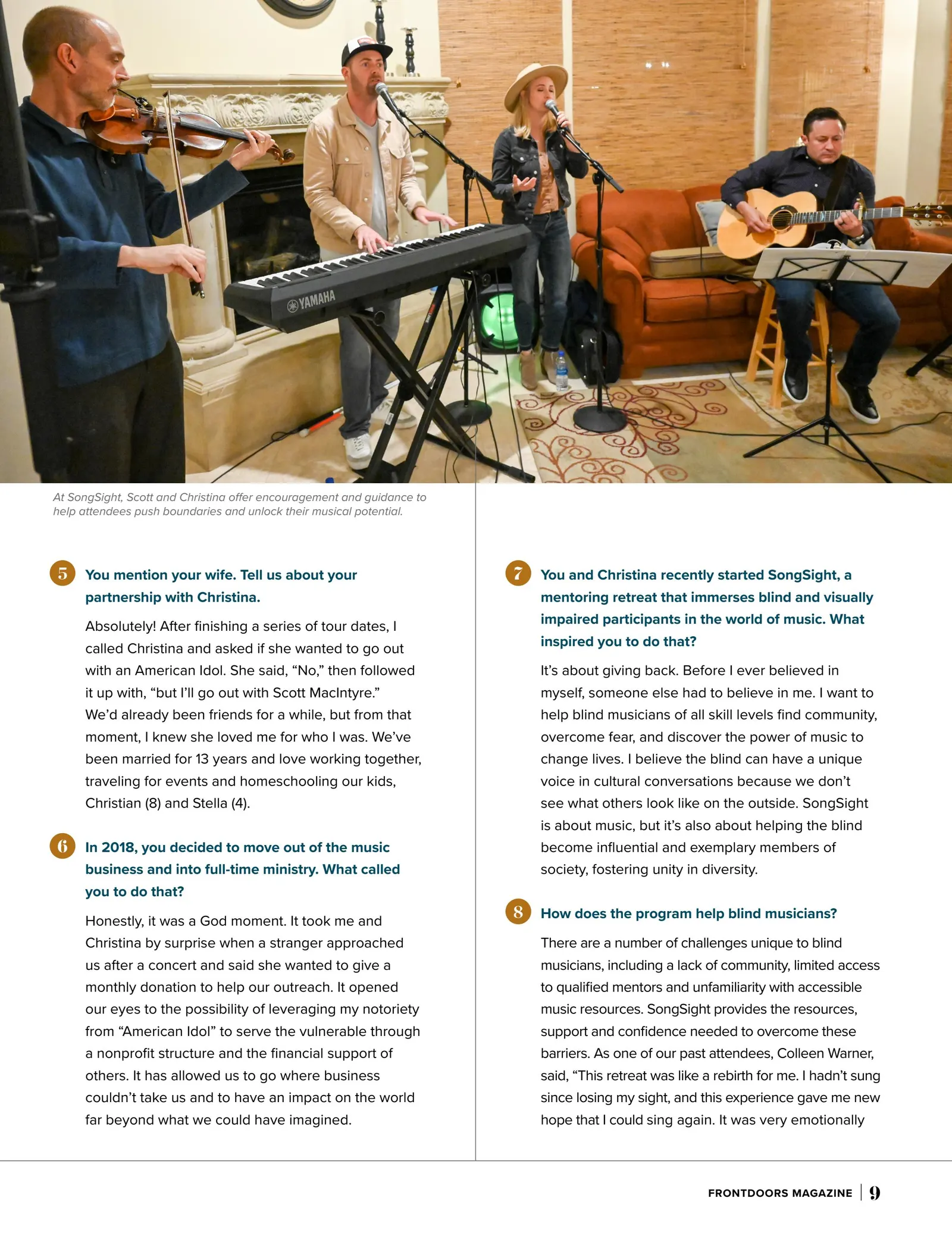
FRONTDOORS MAGAZINE | 9 You mention your wife. Tell us about your partnership with Christina. Absolutely! After finishing a series of tour dates, I called Christina and asked if she wanted to go out with an American Idol. She said, “No,” then followed it up with, “but I’ll go out with Scott MacIntyre.” We’d already been friends for a while, but from that moment, I knew she loved me for who I was. We’ve been married for 13 years and love working together, traveling for events and homeschooling our kids, Christian (8) and Stella (4). In 2018, you decided to move out of the music business and into full-time ministry. What called you to do that? Honestly, it was a God moment. It took me and Christina by surprise when a stranger approached us after a concert and said she wanted to give a monthly donation to help our outreach. It opened our eyes to the possibility of leveraging my notoriety from “American Idol” to serve the vulnerable through a nonprofit structure and the financial support of others. It has allowed us to go where business couldn’t take us and to have an impact on the world far beyond what we could have imagined. 5 6 You and Christina recently started SongSight, a mentoring retreat that immerses blind and visually impaired participants in the world of music. What inspired you to do that? It’s about giving back. Before I ever believed in myself, someone else had to believe in me. I want to help blind musicians of all skill levels find community, overcome fear, and discover the power of music to change lives. I believe the blind can have a unique voice in cultural conversations because we don’t see what others look like on the outside. SongSight is about music, but it’s also about helping the blind become influential and exemplary members of society, fostering unity in diversity. How does the program help blind musicians? There are a number of challenges unique to blind musicians, including a lack of community, limited access to qualified mentors and unfamiliarity with accessible music resources. SongSight provides the resources, support and confidence needed to overcome these barriers. As one of our past attendees, Colleen Warner, said, “This retreat was like a rebirth for me. I hadn’t sung since losing my sight, and this experience gave me new hope that I could sing again. It was very emotionally 7 8 At SongSight, Scott and Christina offer encouragement and guidance to help attendees push boundaries and unlock their musical potential.