
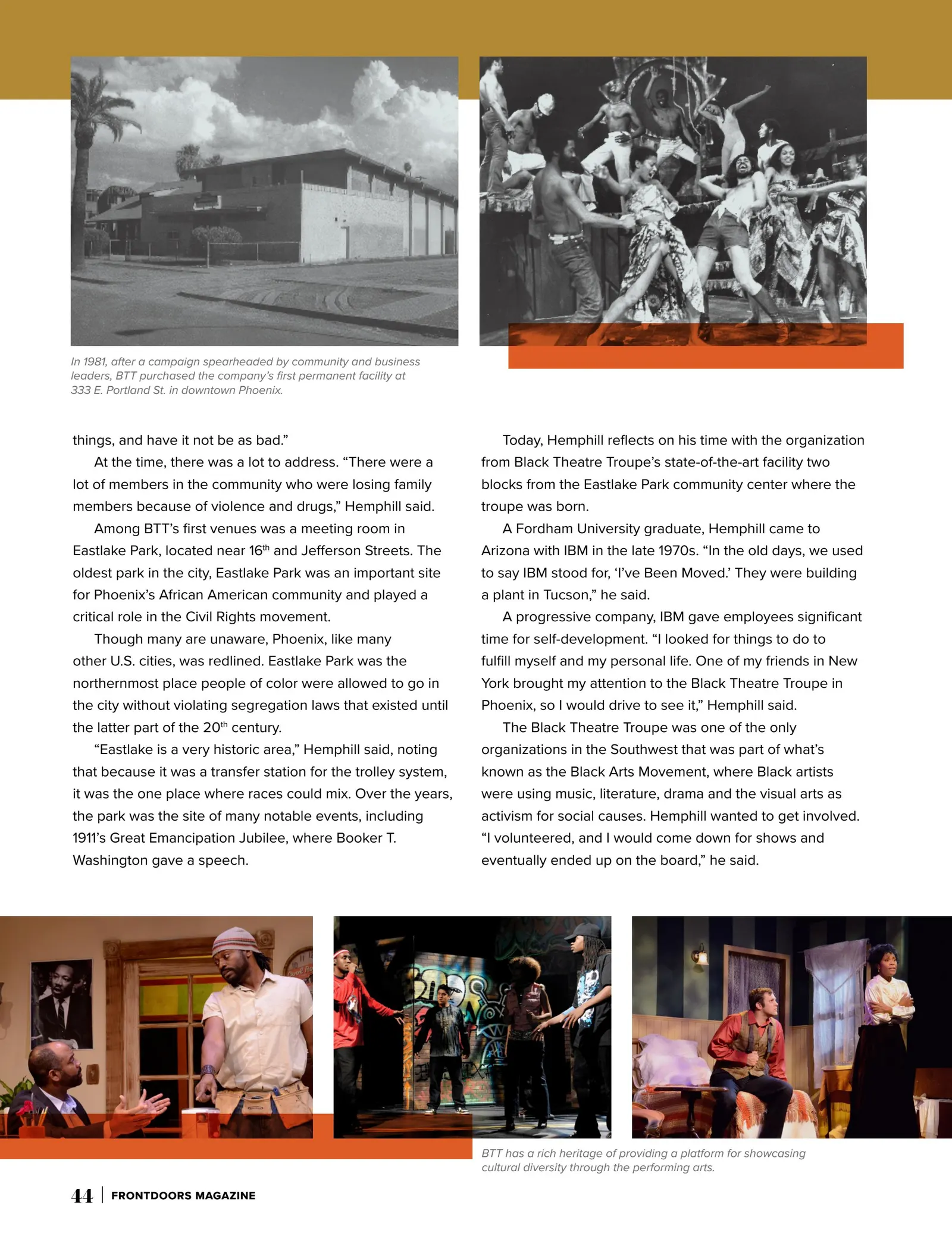
44 | FRONTDOORS MAGAZINE things, and have it not be as bad.” At the time, there was a lot to address. “There were a lot of members in the community who were losing family members because of violence and drugs,” Hemphill said. Among BTT’s first venues was a meeting room in Eastlake Park, located near 16 th and Jefferson Streets. The oldest park in the city, Eastlake Park was an important site for Phoenix’s African American community and played a critical role in the Civil Rights movement. Though many are unaware, Phoenix, like many other U.S. cities, was redlined. Eastlake Park was the northernmost place people of color were allowed to go in the city without violating segregation laws that existed until the latter part of the 20 th century. “Eastlake is a very historic area,” Hemphill said, noting that because it was a transfer station for the trolley system, it was the one place where races could mix. Over the years, the park was the site of many notable events, including 1911’s Great Emancipation Jubilee, where Booker T. Washington gave a speech. Today, Hemphill reflects on his time with the organization from Black Theatre Troupe’s state-of-the-art facility two blocks from the Eastlake Park community center where the troupe was born. A Fordham University graduate, Hemphill came to Arizona with IBM in the late 1970s. “In the old days, we used to say IBM stood for, ‘I’ve Been Moved.’ They were building a plant in Tucson,” he said. A progressive company, IBM gave employees significant time for self-development. “I looked for things to do to fulfill myself and my personal life. One of my friends in New York brought my attention to the Black Theatre Troupe in Phoenix, so I would drive to see it,” Hemphill said. The Black Theatre Troupe was one of the only organizations in the Southwest that was part of what’s known as the Black Arts Movement, where Black artists were using music, literature, drama and the visual arts as activism for social causes. Hemphill wanted to get involved. “I volunteered, and I would come down for shows and eventually ended up on the board,” he said. 44 | FRONTDOORS MAGAZINE In 1981, after a campaign spearheaded by community and business leaders, BTT purchased the company’s first permanent facility at 333 E. Portland St. in downtown Phoenix. BTT has a rich heritage of providing a platform for showcasing cultural diversity through the performing arts.
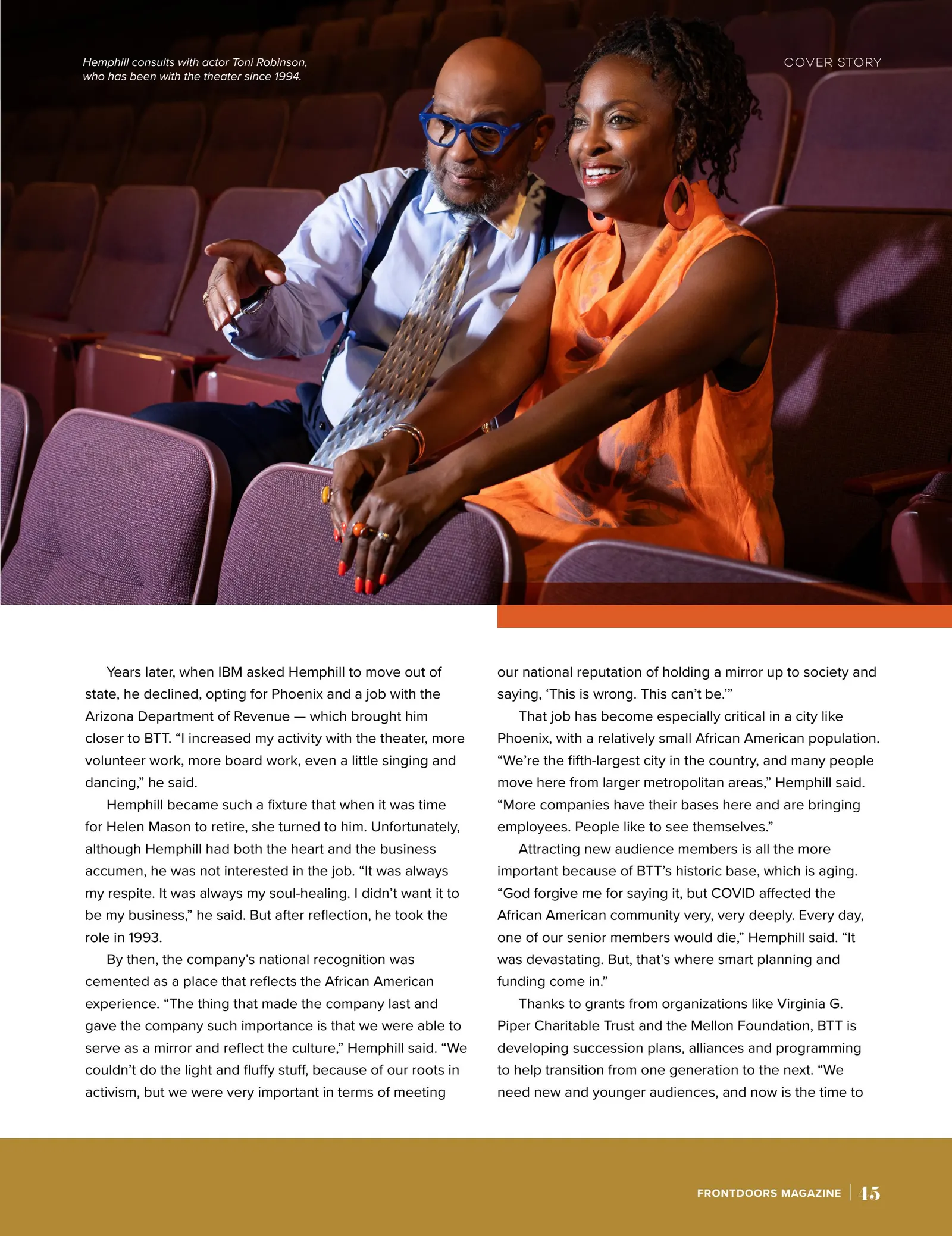
Hemphill consults with actor Toni Robinson, who has been with the theater since 1994. COVER STORY Years later, when IBM asked Hemphill to move out of state, he declined, opting for Phoenix and a job with the Arizona Department of Revenue — which brought him closer to BTT. “I increased my activity with the theater, more volunteer work, more board work, even a little singing and dancing,” he said. Hemphill became such a fixture that when it was time for Helen Mason to retire, she turned to him. Unfortunately, although Hemphill had both the heart and the business accumen, he was not interested in the job. “It was always my respite. It was always my soul-healing. I didn’t want it to be my business,” he said. But after reflection, he took the role in 1993. By then, the company’s national recognition was cemented as a place that reflects the African American experience. “The thing that made the company last and gave the company such importance is that we were able to serve as a mirror and reflect the culture,” Hemphill said. “We couldn’t do the light and fluffy stuff, because of our roots in activism, but we were very important in terms of meeting our national reputation of holding a mirror up to society and saying, ‘This is wrong. This can’t be.’” That job has become especially critical in a city like Phoenix, with a relatively small African American population. “We’re the fifth-largest city in the country, and many people move here from larger metropolitan areas,” Hemphill said. “More companies have their bases here and are bringing employees. People like to see themselves.” Attracting new audience members is all the more important because of BTT’s historic base, which is aging. “God forgive me for saying it, but COVID affected the African American community very, very deeply. Every day, one of our senior members would die,” Hemphill said. “It was devastating. But, that’s where smart planning and funding come in.” Thanks to grants from organizations like Virginia G. Piper Charitable Trust and the Mellon Foundation, BTT is developing succession plans, alliances and programming to help transition from one generation to the next. “We need new and younger audiences, and now is the time to FRONTDOORS MAGAZINE | 45