
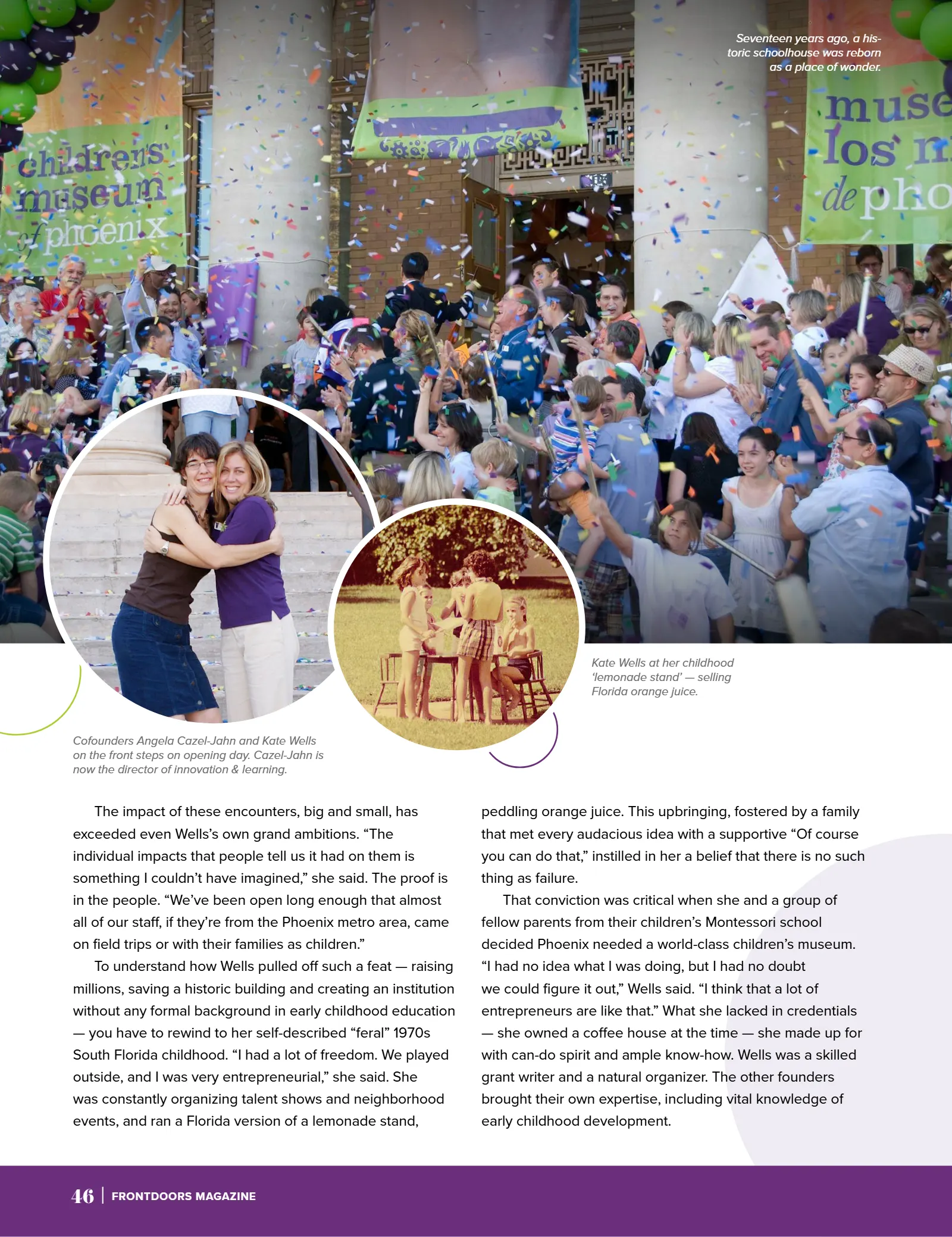
46 | FRONTDOORS MAGAZINE The impact of these encounters, big and small, has exceeded even Wells’s own grand ambitions. “The individual impacts that people tell us it had on them is something I couldn’t have imagined,” she said. The proof is in the people. “We’ve been open long enough that almost all of our staff, if they’re from the Phoenix metro area, came on field trips or with their families as children.” To understand how Wells pulled off such a feat — raising millions, saving a historic building and creating an institution without any formal background in early childhood education — you have to rewind to her self-described “feral” 1970s South Florida childhood. “I had a lot of freedom. We played outside, and I was very entrepreneurial,” she said. She was constantly organizing talent shows and neighborhood events, and ran a Florida version of a lemonade stand, peddling orange juice. This upbringing, fostered by a family that met every audacious idea with a supportive “Of course you can do that,” instilled in her a belief that there is no such thing as failure. That conviction was critical when she and a group of fellow parents from their children’s Montessori school decided Phoenix needed a world-class children’s museum. “I had no idea what I was doing, but I had no doubt we could figure it out,” Wells said. “I think that a lot of entrepreneurs are like that.” What she lacked in credentials — she owned a coffee house at the time — she made up for with can-do spirit and ample know-how. Wells was a skilled grant writer and a natural organizer. The other founders brought their own expertise, including vital knowledge of early childhood development. 46 | FRONTDOORS MAGAZINE 46 | FRONTDOORS MAGAZINE Kate Wells at her childhood ‘lemonade stand’ — selling Florida orange juice. Seventeen years ago, a his - toric schoolhouse was reborn as a place of wonder. Cofounders Angela Cazel-Jahn and Kate Wells on the front steps on opening day. Cazel-Jahn is now the director of innovation & learning.
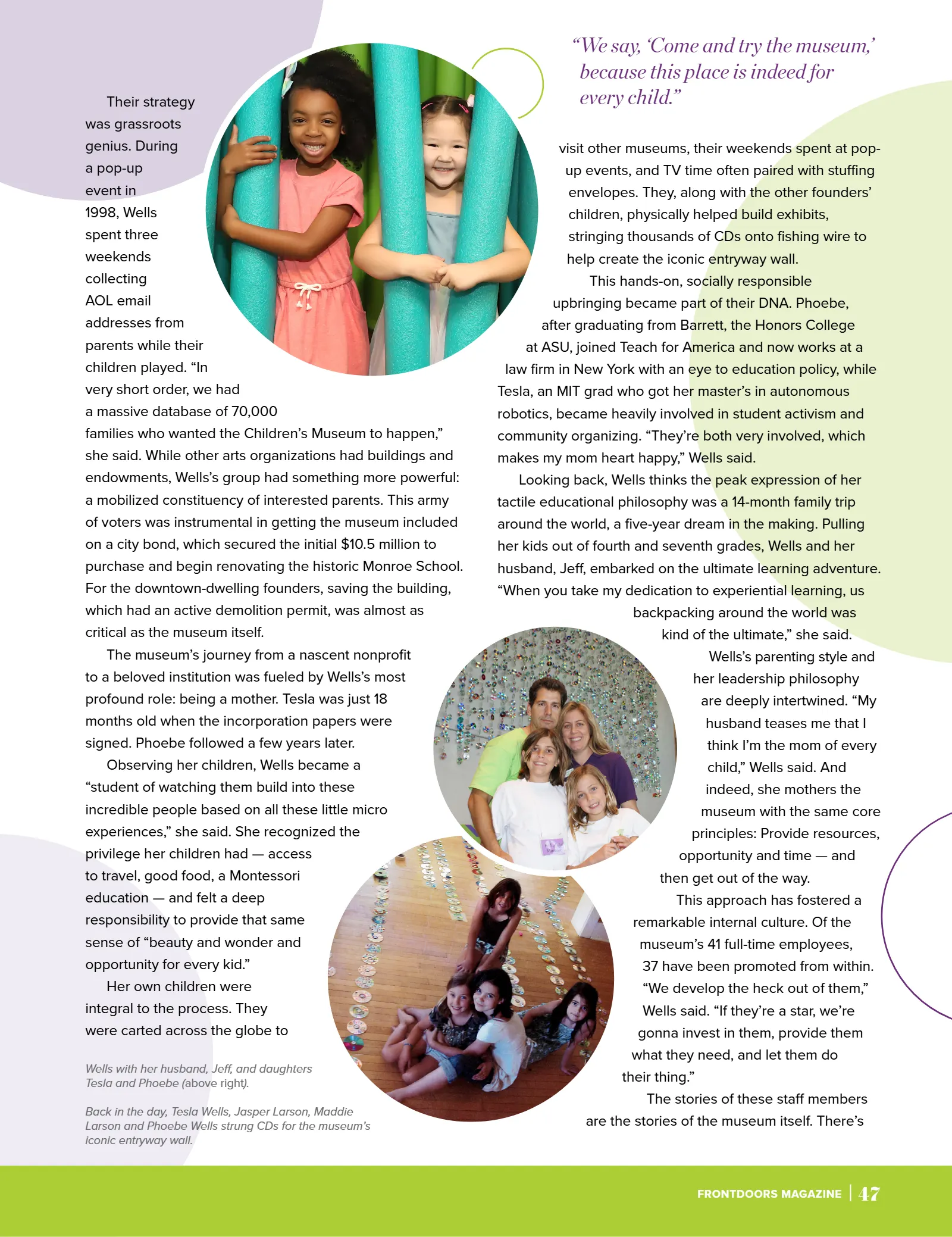
Their strategy was grassroots genius. During a pop-up event in 1998, Wells spent three weekends collecting AOL email addresses from parents while their children played. “In very short order, we had a massive database of 70,000 families who wanted the Children’s Museum to happen,” she said. While other arts organizations had buildings and endowments, Wells’s group had something more powerful: a mobilized constituency of interested parents. This army of voters was instrumental in getting the museum included on a city bond, which secured the initial $10.5 million to purchase and begin renovating the historic Monroe School. For the downtown-dwelling founders, saving the building, which had an active demolition permit, was almost as critical as the museum itself. The museum’s journey from a nascent nonprofit to a beloved institution was fueled by Wells’s most profound role: being a mother. Tesla was just 18 months old when the incorporation papers were signed. Phoebe followed a few years later. Observing her children, Wells became a “student of watching them build into these incredible people based on all these little micro experiences,” she said. She recognized the privilege her children had — access to travel, good food, a Montessori education — and felt a deep responsibility to provide that same sense of “beauty and wonder and opportunity for every kid.” Her own children were integral to the process. They were carted across the globe to visit other museums, their weekends spent at pop- up events, and TV time often paired with stuffing envelopes. They, along with the other founders’ children, physically helped build exhibits, stringing thousands of CDs onto fishing wire to help create the iconic entryway wall. This hands-on, socially responsible upbringing became part of their DNA. Phoebe, after graduating from Barrett, the Honors College at ASU, joined Teach for America and now works at a law firm in New York with an eye to education policy, while Tesla, an MIT grad who got her master’s in autonomous robotics, became heavily involved in student activism and community organizing. “They’re both very involved, which makes my mom heart happy,” Wells said. Looking back, Wells thinks the peak expression of her tactile educational philosophy was a 14-month family trip around the world, a five-year dream in the making. Pulling her kids out of fourth and seventh grades, Wells and her husband, Jeff, embarked on the ultimate learning adventure. “When you take my dedication to experiential learning, us backpacking around the world was kind of the ultimate,” she said. Wells’s parenting style and her leadership philosophy are deeply intertwined. “My husband teases me that I think I’m the mom of every child,” Wells said. And indeed, she mothers the museum with the same core principles: Provide resources, opportunity and time — and then get out of the way. This approach has fostered a remarkable internal culture. Of the museum’s 41 full-time employees, 37 have been promoted from within. “We develop the heck out of them,” Wells said. “If they’re a star, we’re gonna invest in them, provide them what they need, and let them do their thing.” The stories of these staff members are the stories of the museum itself. There’s “ We say, ‘Come and try the museum,’ because this place is indeed for every child.” FRONTDOORS MAGAZINE | 47 FRONTDOORS MAGAZINE | 47 Wells with her husband, Jeff, and daughters Tesla and Phoebe ( above right ). Back in the day, Tesla Wells, Jasper Larson, Maddie Larson and Phoebe Wells strung CDs for the museum’s iconic entryway wall.