
AUGUST 2017 12 | FRONTDOORSMEDIA .COM COVER STORY CONTINUED “There was no grand expectation or objective coming in,” Ward said. “When I came into this organization it was a week away from bankruptcy. So the immediate objective was survival. The immediate objective was to keep music alive in this community not only for the aesthetic value of it but to help bolster a cultural economy that can attract and retain the kinds of businesses that we need for economic development.” The climb back would be steep. The organization had to be right-sized. Ward began the process with the musicians, who, he said are the “real heroes of this story.” They had already taken a significant pay cut, the largest of any American orchestra up until that time. Ward had to ask them to forgive the “snapback” or restoration payment they had been promised. “Their choice was to either walk and go on strike, which, frankly they had the right to do, or take a giant leap of faith on someone who would had never run a nonprofit, had never run a symphony, and who, in full disclosure, ran as a Republican and busted unions” at LucasArts, Ward said. The musicians did something that is considered rare in American unions today, Ward said, which “is they put the needs of the community before their own needs and they forgave that snapback in order to give me enough runway to turn around the symphony.” With their sacrifice, the musicians, Ward said, kept music alive for the community. Aside from the financial concerns of the Phoenix Symphony, the mission was somewhat askew. Basically it came down to misplaced aspirations to become the L.A. Philharmonic. “There were three fatal flaws with that,” Ward said. “The first was it suggested to our musicians that they weren’t as good as the L.A. Philharmonic. Whether or not that’s correct, and it’s not, that’s no way to motivate a creative workforce. Secondly, the previous regime had gone out into our communities saying we want to be the L.A. Philharmonic and the problem is that it fell on deaf ears, because this community is about Phoenix and Arizona, not L.A. And finally, the organization began to spend like the L.A. Philharmonic, which is the financial mess that I inherited.” The prevailing dialogue in the Valley, Ward said at the time, has nothing to do with the arts, let alone the Symphony. “The dialogue in this community is all about our inability to diversify our economic base to attract and retain the kinds of businesses that we need,” Ward said. For the Symphony to get traction and a seat at the table, he said, they would need to align their needs with the needs of the community. “We have to be part of a solution,” he said. So Ward and the Symphony’s Board of Directors worked with musicians to come up with a vision, which is intact today: To be Arizona’s largest arts leader in the revitalization of Arizona. That means doing its part to help solve the issues that the state has in terms of growth. “Our mission,” Ward said, “became to leverage what’s unique to us, which is the joy of music, in three distinct ways: to
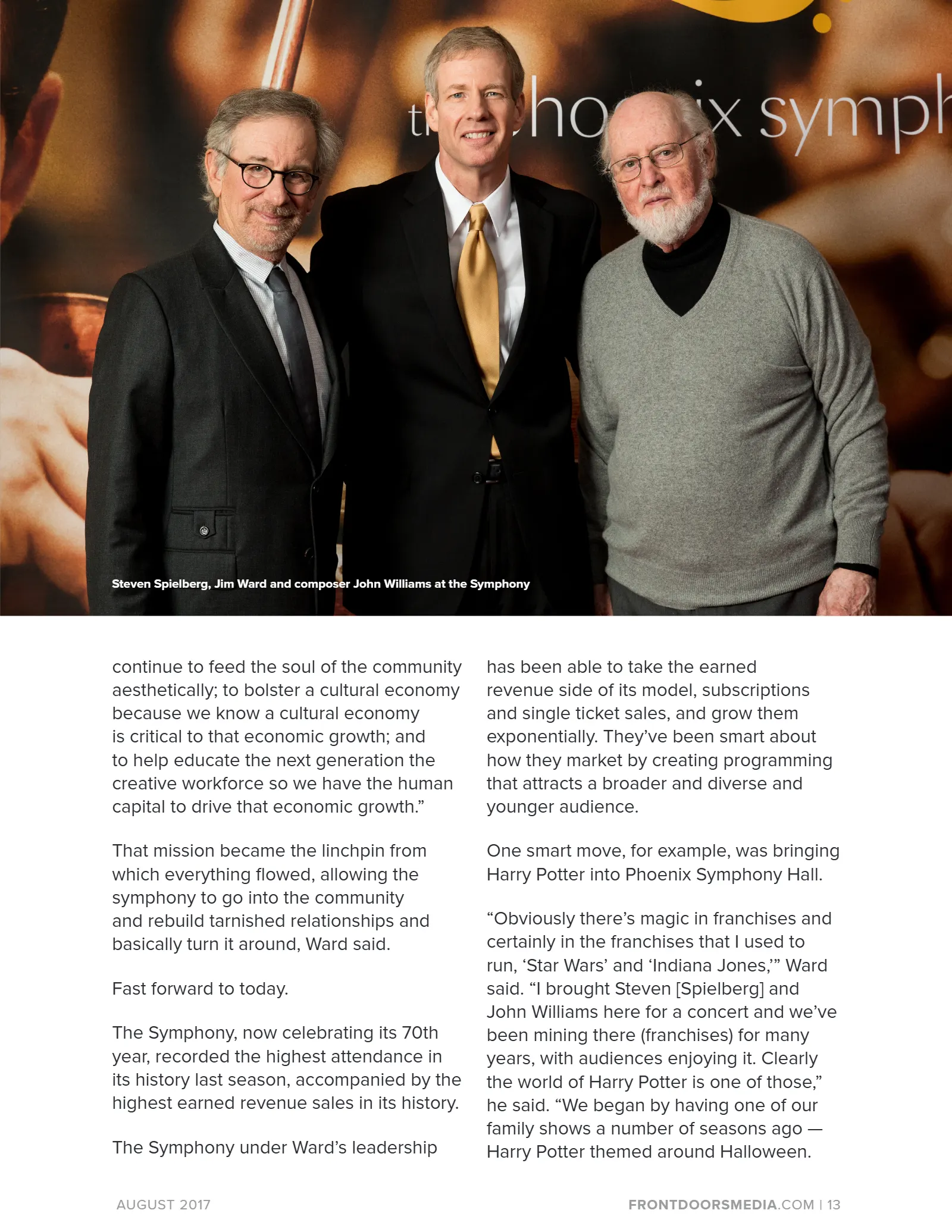
AUGUST 2017 FRONTDOORSMEDIA .COM | 13 continue to feed the soul of the community aesthetically; to bolster a cultural economy because we know a cultural economy is critical to that economic growth; and to help educate the next generation the creative workforce so we have the human capital to drive that economic growth.” That mission became the linchpin from which everything flowed, allowing the symphony to go into the community and rebuild tarnished relationships and basically turn it around, Ward said. Fast forward to today. The Symphony, now celebrating its 70th year, recorded the highest attendance in its history last season, accompanied by the highest earned revenue sales in its history. The Symphony under Ward’s leadership has been able to take the earned revenue side of its model, subscriptions and single ticket sales, and grow them exponentially. They’ve been smart about how they market by creating programming that attracts a broader and diverse and younger audience. One smart move, for example, was bringing Harry Potter into Phoenix Symphony Hall. “Obviously there’s magic in franchises and certainly in the franchises that I used to run, ‘Star Wars’ and ‘Indiana Jones,’” Ward said. “I brought Steven [Spielberg] and John Williams here for a concert and we’ve been mining there (franchises) for many years, with audiences enjoying it. Clearly the world of Harry Potter is one of those,” he said. “We began by having one of our family shows a number of seasons ago — Harry Potter themed around Halloween. Steven Spielberg, Jim Ward and composer John Williams at the Symphony