
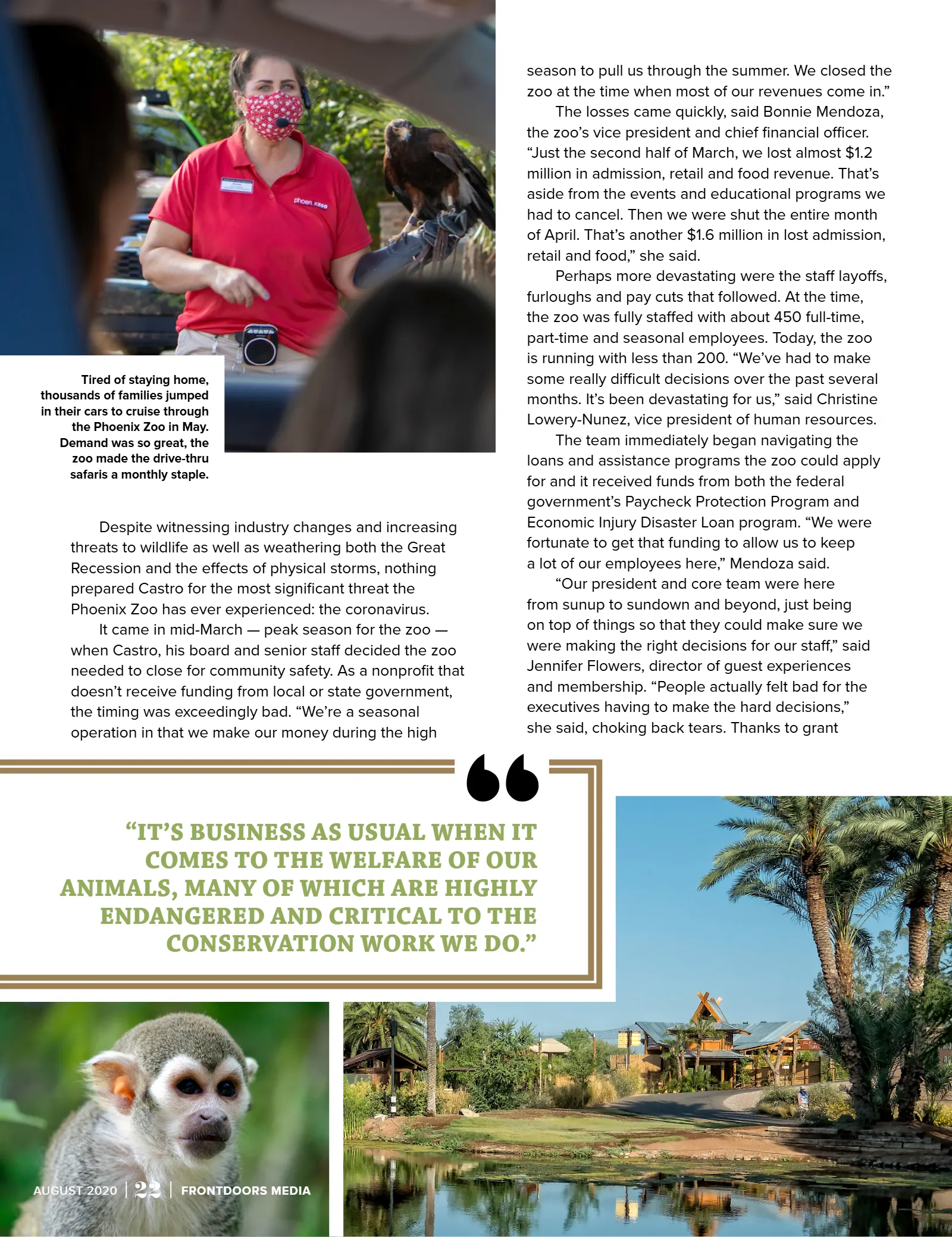
“IT’S BUSINESS AS USUAL WHEN IT COMES TO THE WELFARE OF OUR ANIMALS, MANY OF WHICH ARE HIGHLY ENDANGERED AND CRITICAL TO THE CONSERVATION WORK WE DO.” Despite witnessing industry changes and increasing threats to wildlife as well as weathering both the Great Recession and the effects of physical storms, nothing prepared Castro for the most significant threat the Phoenix Zoo has ever experienced: the coronavirus. It came in mid-March — peak season for the zoo — when Castro, his board and senior staff decided the zoo needed to close for community safety. As a nonprofit that doesn’t receive funding from local or state government, the timing was exceedingly bad. “We’re a seasonal operation in that we make our money during the high Tired of staying home, thousands of families jumped in their cars to cruise through the Phoenix Zoo in May. Demand was so great, the zoo made the drive-thru safaris a monthly staple. season to pull us through the summer. We closed the zoo at the time when most of our revenues come in.” The losses came quickly, said Bonnie Mendoza, the zoo’s vice president and chief financial officer. “Just the second half of March, we lost almost $1.2 million in admission, retail and food revenue. That’s aside from the events and educational programs we had to cancel. Then we were shut the entire month of April. That’s another $1.6 million in lost admission, retail and food,” she said. Perhaps more devastating were the staff layoffs, furloughs and pay cuts that followed. At the time, the zoo was fully staffed with about 450 full-time, part-time and seasonal employees. Today, the zoo is running with less than 200. “We’ve had to make some really difficult decisions over the past several months. It’s been devastating for us,” said Christine Lowery-Nunez, vice president of human resources. The team immediately began navigating the loans and assistance programs the zoo could apply for and it received funds from both the federal government’s Paycheck Protection Program and Economic Injury Disaster Loan program. “We were fortunate to get that funding to allow us to keep a lot of our employees here,” Mendoza said. “Our president and core team were here from sunup to sundown and beyond, just being on top of things so that they could make sure we were making the right decisions for our staff,” said Jennifer Flowers, director of guest experiences and membership. “People actually felt bad for the executives having to make the hard decisions,” she said, choking back tears. Thanks to grant AUGUST 2020 | 22 | FRONTDOORS MEDIA
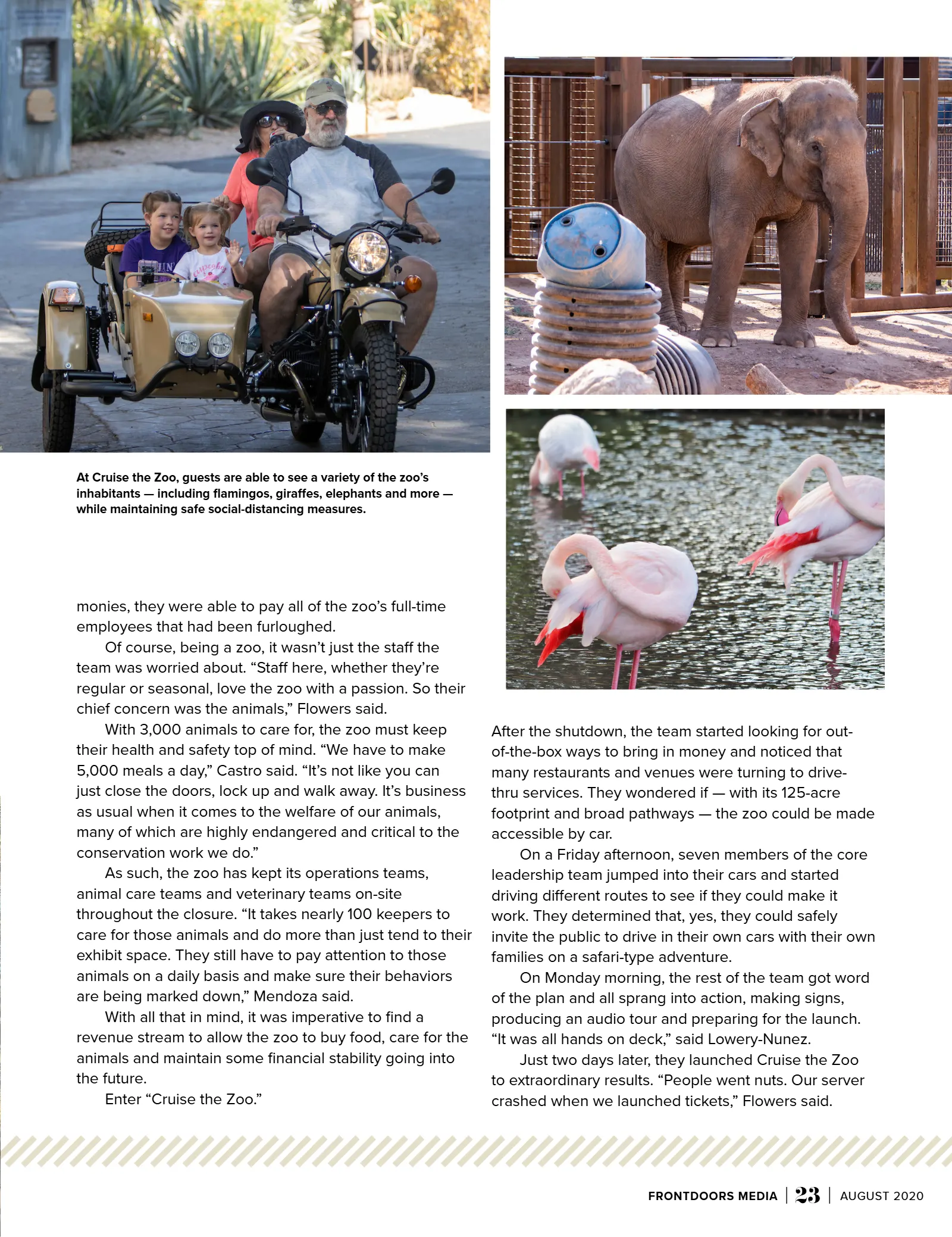
monies, they were able to pay all of the zoo’s full-time employees that had been furloughed. Of course, being a zoo, it wasn’t just the staff the team was worried about. “Staff here, whether they’re regular or seasonal, love the zoo with a passion. So their chief concern was the animals,” Flowers said. With 3,000 animals to care for, the zoo must keep their health and safety top of mind. “We have to make 5,000 meals a day,” Castro said. “It’s not like you can just close the doors, lock up and walk away. It’s business as usual when it comes to the welfare of our animals, many of which are highly endangered and critical to the conservation work we do.” As such, the zoo has kept its operations teams, animal care teams and veterinary teams on-site throughout the closure. “It takes nearly 100 keepers to care for those animals and do more than just tend to their exhibit space. They still have to pay attention to those animals on a daily basis and make sure their behaviors are being marked down,” Mendoza said. With all that in mind, it was imperative to find a revenue stream to allow the zoo to buy food, care for the animals and maintain some financial stability going into the future. Enter “Cruise the Zoo.” After the shutdown, the team started looking for out- of-the-box ways to bring in money and noticed that many restaurants and venues were turning to drive- thru services. They wondered if — with its 125-acre footprint and broad pathways — the zoo could be made accessible by car. On a Friday afternoon, seven members of the core leadership team jumped into their cars and started driving different routes to see if they could make it work. They determined that, yes, they could safely invite the public to drive in their own cars with their own families on a safari-type adventure. On Monday morning, the rest of the team got word of the plan and all sprang into action, making signs, producing an audio tour and preparing for the launch. “It was all hands on deck,” said Lowery-Nunez. Just two days later, they launched Cruise the Zoo to extraordinary results. “People went nuts. Our server crashed when we launched tickets,” Flowers said. At Cruise the Zoo, guests are able to see a variety of the zoo’s inhabitants — including flamingos, giraffes, elephants and more — while maintaining safe social-distancing measures. FRONTDOORS MEDIA | 23 | AUGUST 2020