
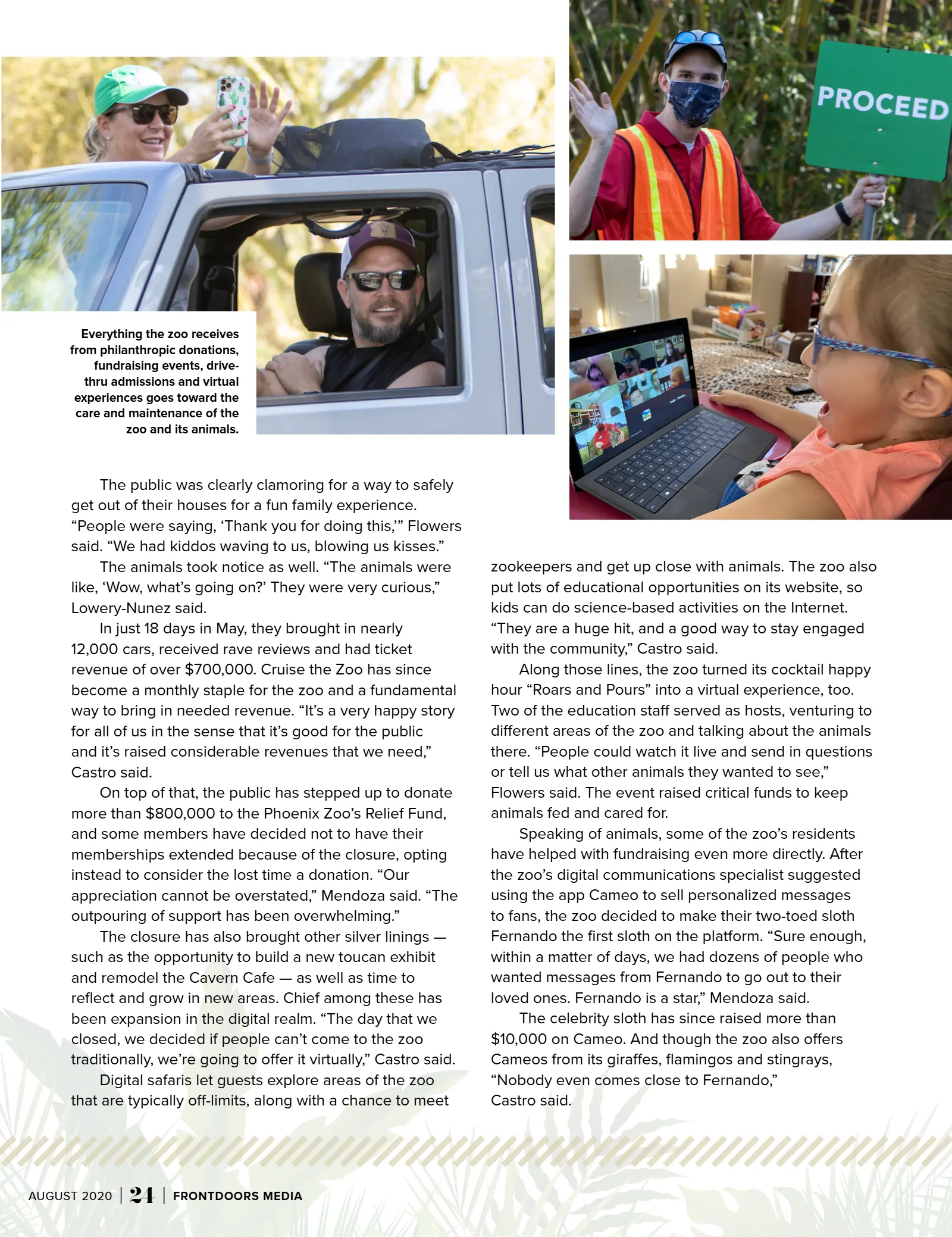
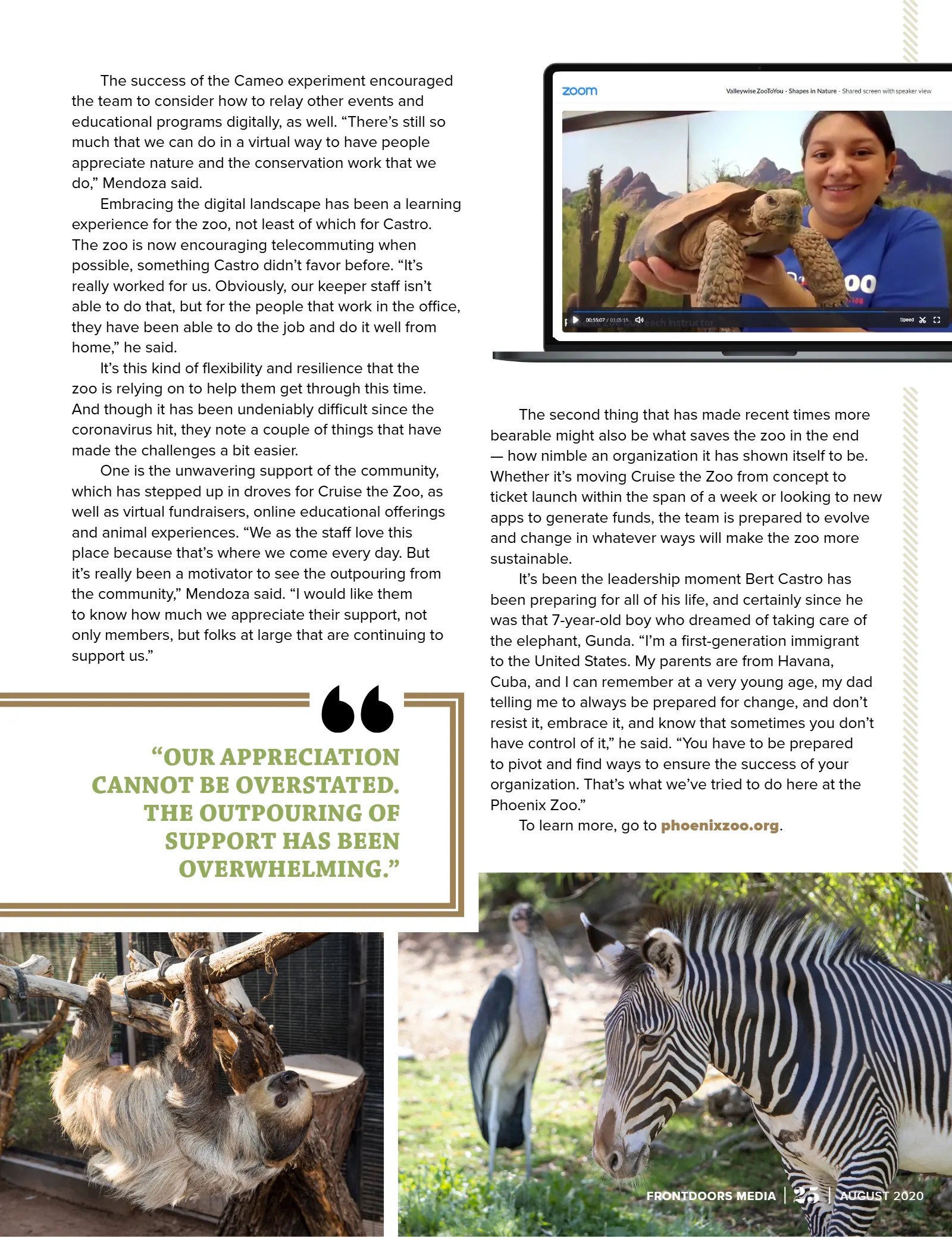
The public was clearly clamoring for a way to safely get out of their houses for a fun family experience. “People were saying, ‘Thank you for doing this,’” Flowers said. “We had kiddos waving to us, blowing us kisses.” The animals took notice as well. “The animals were like, ‘Wow, what’s going on?’ They were very curious,” Lowery-Nunez said. In just 18 days in May, they brought in nearly 12,000 cars, received rave reviews and had ticket revenue of over $700,000. Cruise the Zoo has since become a monthly staple for the zoo and a fundamental way to bring in needed revenue. “It’s a very happy story for all of us in the sense that it’s good for the public and it’s raised considerable revenues that we need,” Castro said. On top of that, the public has stepped up to donate more than $800,000 to the Phoenix Zoo’s Relief Fund, and some members have decided not to have their memberships extended because of the closure, opting instead to consider the lost time a donation. “Our appreciation cannot be overstated,” Mendoza said. “The outpouring of support has been overwhelming.” The closure has also brought other silver linings — such as the opportunity to build a new toucan exhibit and remodel the Cavern Cafe — as well as time to reflect and grow in new areas. Chief among these has been expansion in the digital realm. “The day that we closed, we decided if people can’t come to the zoo traditionally, we’re going to offer it virtually,” Castro said. Digital safaris let guests explore areas of the zoo that are typically off-limits, along with a chance to meet zookeepers and get up close with animals. The zoo also put lots of educational opportunities on its website, so kids can do science-based activities on the Internet. “They are a huge hit, and a good way to stay engaged with the community,” Castro said. Along those lines, the zoo turned its cocktail happy hour “Roars and Pours” into a virtual experience, too. Two of the education staff served as hosts, venturing to different areas of the zoo and talking about the animals there. “People could watch it live and send in questions or tell us what other animals they wanted to see,” Flowers said. The event raised critical funds to keep animals fed and cared for. Speaking of animals, some of the zoo’s residents have helped with fundraising even more directly. After the zoo’s digital communications specialist suggested using the app Cameo to sell personalized messages to fans, the zoo decided to make their two-toed sloth Fernando the first sloth on the platform. “Sure enough, within a matter of days, we had dozens of people who wanted messages from Fernando to go out to their loved ones. Fernando is a star,” Mendoza said. The celebrity sloth has since raised more than $10,000 on Cameo. And though the zoo also offers Cameos from its giraffes, flamingos and stingrays, “Nobody even comes close to Fernando,” Castro said. Everything the zoo receives from philanthropic donations, fundraising events, drive- thru admissions and virtual experiences goes toward the care and maintenance of the zoo and its animals. AUGUST 2020 | 24 | FRONTDOORS MEDIA
The success of the Cameo experiment encouraged the team to consider how to relay other events and educational programs digitally, as well. “There’s still so much that we can do in a virtual way to have people appreciate nature and the conservation work that we do,” Mendoza said. Embracing the digital landscape has been a learning experience for the zoo, not least of which for Castro. The zoo is now encouraging telecommuting when possible, something Castro didn’t favor before. “It’s really worked for us. Obviously, our keeper staff isn’t able to do that, but for the people that work in the office, they have been able to do the job and do it well from home,” he said. It’s this kind of flexibility and resilience that the zoo is relying on to help them get through this time. And though it has been undeniably difficult since the coronavirus hit, they note a couple of things that have made the challenges a bit easier. One is the unwavering support of the community, which has stepped up in droves for Cruise the Zoo, as well as virtual fundraisers, online educational offerings and animal experiences. “We as the staff love this place because that’s where we come every day. But it’s really been a motivator to see the outpouring from the community,” Mendoza said. “I would like them to know how much we appreciate their support, not only members, but folks at large that are continuing to support us.” The second thing that has made recent times more bearable might also be what saves the zoo in the end — how nimble an organization it has shown itself to be. Whether it’s moving Cruise the Zoo from concept to ticket launch within the span of a week or looking to new apps to generate funds, the team is prepared to evolve and change in whatever ways will make the zoo more sustainable. It’s been the leadership moment Bert Castro has been preparing for all of his life, and certainly since he was that 7-year-old boy who dreamed of taking care of the elephant, Gunda. “I’m a first-generation immigrant to the United States. My parents are from Havana, Cuba, and I can remember at a very young age, my dad telling me to always be prepared for change, and don’t resist it, embrace it, and know that sometimes you don’t have control of it,” he said. “You have to be prepared to pivot and find ways to ensure the success of your organization. That’s what we’ve tried to do here at the Phoenix Zoo.” To learn more, go to phoenixzoo.org . “OUR APPRECIATION CANNOT BE OVERSTATED. THE OUTPOURING OF SUPPORT HAS BEEN OVERWHELMING.” FRONTDOORS MEDIA | 25 | AUGUST 2020