
D avid M. Roche, director and CEO of the Heard Museum, has been guided by his love for American Indian art since he was a boy growing up in Kenilworth, a suburb of Chicago. When he was 8, his parents took a trip to the Southwest and brought back Zuni fetishes and Hopi kachinas. He was hooked. “I had never seen anything like it, and it sparked my imagination. It opened up the world to me and made me aware of other points of view, cultures and histories,” Roche said. “I was fascinated by American Indian art, history and culture. And now I’m the director of the Heard Museum, which is the largest private museum for American Indian art. Unbeknownst to my parents, they were opening up a gateway that’s been an inspiration to me for my entire life.” As a boy, Roche would mow the lawn, shovel snow and stash birthday money to save up to buy Zuni fetishes from the Indian Tree Gallery in downtown Chicago, run by legendary dealer Marti Hopkins Struever. “It was a first of its kind because she was presenting American Indian art as classic art in a white-wall gallery space. It didn’t have the feel of a trading post. Marti treated me very well,” Roche said. One Saturday, when he was 9 or 10, with money burning a hole in his pocket, Roche hopped on a train into the city by himself to visit Indian Tree Gallery. “I was that desperate to see what she had and to buy a fetish. When I walked into the gallery, she asked, ‘Do THE COLLECTION OF A LIFETIME Catie Richman I Contributing Writer Marion Rhoades I Photographer From Zuni fetishes to a Matisse, David M. Roche shares stories behind his awe-inspiring art 4 2 KEY TO THE GOOD LIFE { style unlocked } AUG/SEPT 2021 | 36 | FRONTDOORS MEDIA
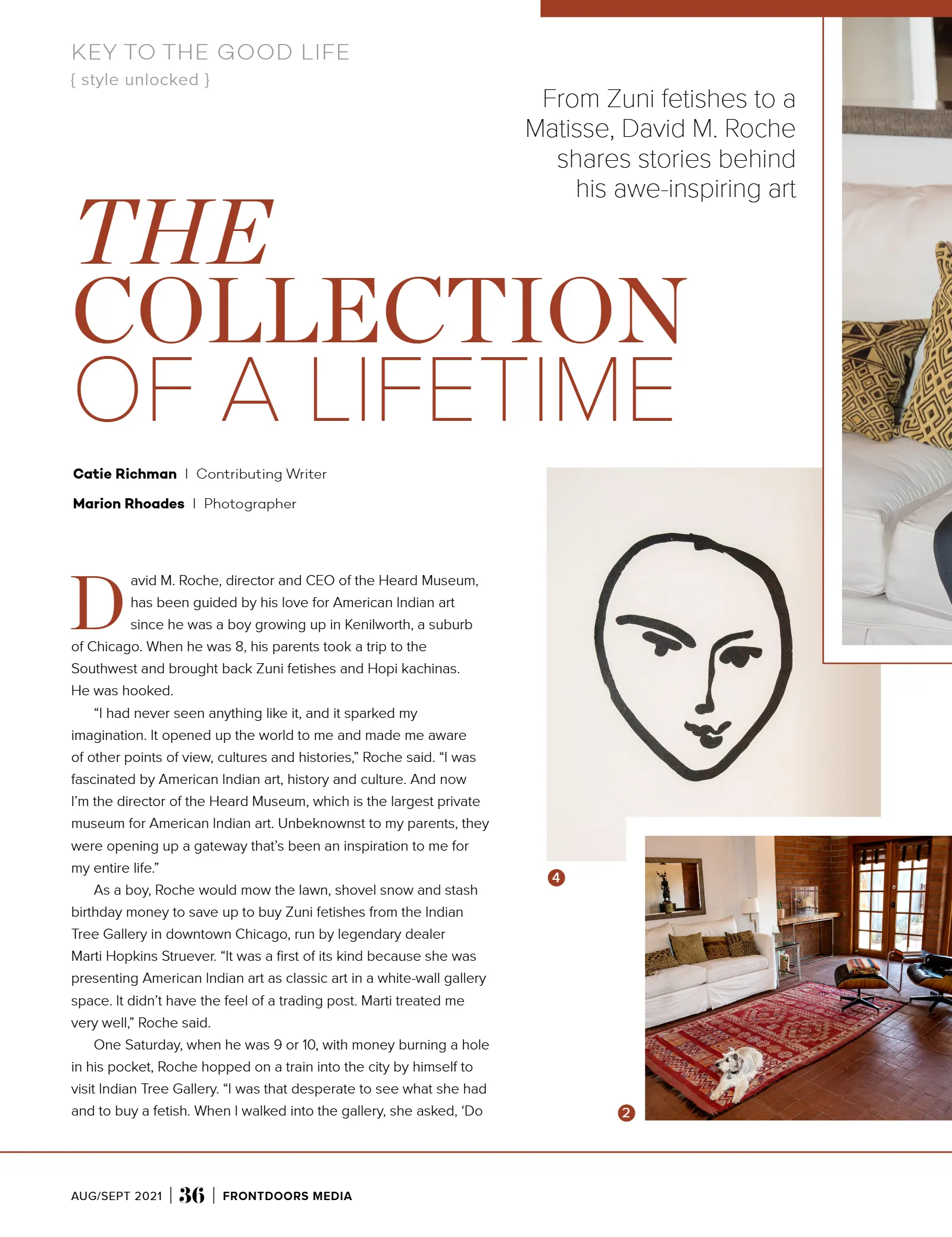
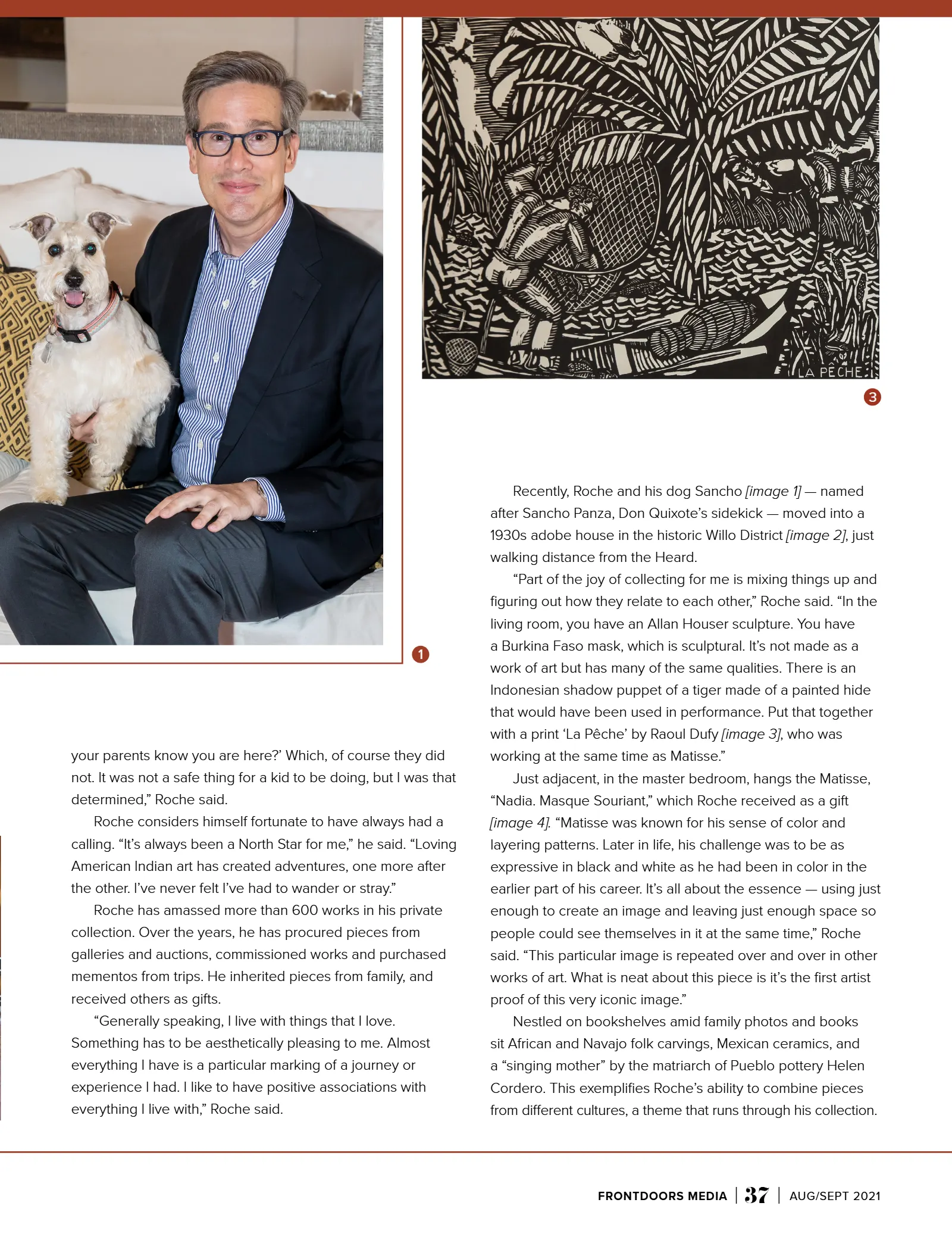
your parents know you are here?’ Which, of course they did not. It was not a safe thing for a kid to be doing, but I was that determined,” Roche said. Roche considers himself fortunate to have always had a calling. “It’s always been a North Star for me,” he said. “Loving American Indian art has created adventures, one more after the other. I’ve never felt I’ve had to wander or stray.” Roche has amassed more than 600 works in his private collection. Over the years, he has procured pieces from galleries and auctions, commissioned works and purchased mementos from trips. He inherited pieces from family, and received others as gifts. “Generally speaking, I live with things that I love. Something has to be aesthetically pleasing to me. Almost everything I have is a particular marking of a journey or experience I had. I like to have positive associations with everything I live with,” Roche said. Recently, Roche and his dog Sancho [image 1] — named after Sancho Panza, Don Quixote’s sidekick — moved into a 1930s adobe house in the historic Willo District [image 2] , just walking distance from the Heard. “Part of the joy of collecting for me is mixing things up and figuring out how they relate to each other,” Roche said. “In the living room, you have an Allan Houser sculpture. You have a Burkina Faso mask, which is sculptural. It’s not made as a work of art but has many of the same qualities. There is an Indonesian shadow puppet of a tiger made of a painted hide that would have been used in performance. Put that together with a print ‘La Pêche’ by Raoul Dufy [image 3] , who was working at the same time as Matisse.” Just adjacent, in the master bedroom, hangs the Matisse, “Nadia. Masque Souriant,” which Roche received as a gift [image 4]. “Matisse was known for his sense of color and layering patterns. Later in life, his challenge was to be as expressive in black and white as he had been in color in the earlier part of his career. It’s all about the essence — using just enough to create an image and leaving just enough space so people could see themselves in it at the same time,” Roche said. “This particular image is repeated over and over in other works of art. What is neat about this piece is it’s the first artist proof of this very iconic image.” Nestled on bookshelves amid family photos and books sit African and Navajo folk carvings, Mexican ceramics, and a “singing mother” by the matriarch of Pueblo pottery Helen Cordero. This exemplifies Roche’s ability to combine pieces from different cultures, a theme that runs through his collection. 3 1 FRONTDOORS MEDIA | 37 | AUG/SEPT 2021