
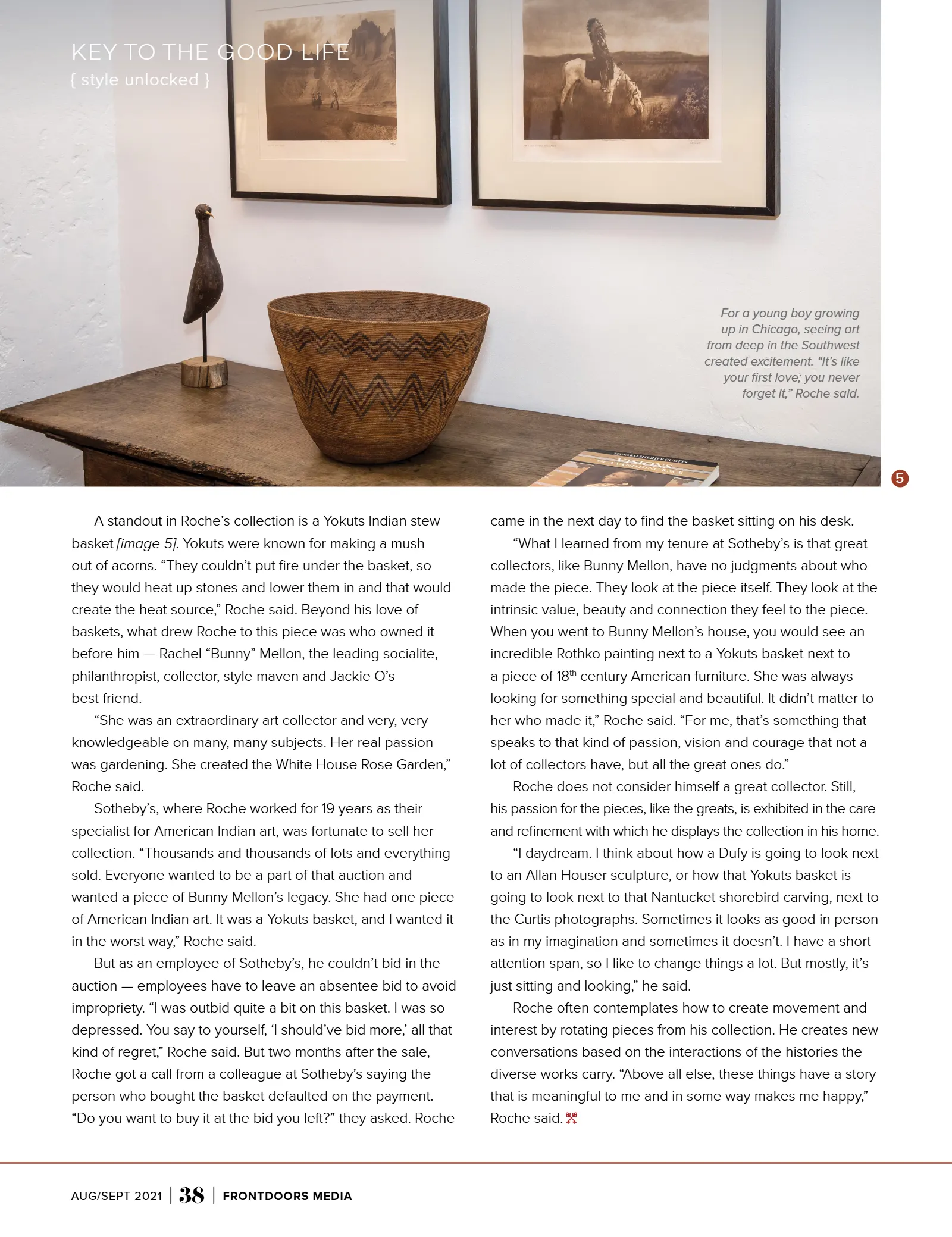
A standout in Roche’s collection is a Yokuts Indian stew basket [image 5] . Yokuts were known for making a mush out of acorns. “They couldn’t put fire under the basket, so they would heat up stones and lower them in and that would create the heat source,” Roche said. Beyond his love of baskets, what drew Roche to this piece was who owned it before him — Rachel “Bunny” Mellon, the leading socialite, philanthropist, collector, style maven and Jackie O’s best friend. “She was an extraordinary art collector and very, very knowledgeable on many, many subjects. Her real passion was gardening. She created the White House Rose Garden,” Roche said. Sotheby’s, where Roche worked for 19 years as their specialist for American Indian art, was fortunate to sell her collection. “Thousands and thousands of lots and everything sold. Everyone wanted to be a part of that auction and wanted a piece of Bunny Mellon’s legacy. She had one piece of American Indian art. It was a Yokuts basket, and I wanted it in the worst way,” Roche said. But as an employee of Sotheby’s, he couldn’t bid in the auction — employees have to leave an absentee bid to avoid impropriety. “I was outbid quite a bit on this basket. I was so depressed. You say to yourself, ‘I should’ve bid more,’ all that kind of regret,” Roche said. But two months after the sale, Roche got a call from a colleague at Sotheby’s saying the person who bought the basket defaulted on the payment. “Do you want to buy it at the bid you left?” they asked. Roche came in the next day to find the basket sitting on his desk. “What I learned from my tenure at Sotheby’s is that great collectors, like Bunny Mellon, have no judgments about who made the piece. They look at the piece itself. They look at the intrinsic value, beauty and connection they feel to the piece. When you went to Bunny Mellon’s house, you would see an incredible Rothko painting next to a Yokuts basket next to a piece of 18 th century American furniture. She was always looking for something special and beautiful. It didn’t matter to her who made it,” Roche said. “For me, that’s something that speaks to that kind of passion, vision and courage that not a lot of collectors have, but all the great ones do.” Roche does not consider himself a great collector. Still, his passion for the pieces, like the greats, is exhibited in the care and refinement with which he displays the collection in his home. “I daydream. I think about how a Dufy is going to look next to an Allan Houser sculpture, or how that Yokuts basket is going to look next to that Nantucket shorebird carving, next to the Curtis photographs. Sometimes it looks as good in person as in my imagination and sometimes it doesn’t. I have a short attention span, so I like to change things a lot. But mostly, it’s just sitting and looking,” he said. Roche often contemplates how to create movement and interest by rotating pieces from his collection. He creates new conversations based on the interactions of the histories the diverse works carry. “Above all else, these things have a story that is meaningful to me and in some way makes me happy,” Roche said. For a young boy growing up in Chicago, seeing art from deep in the Southwest created excitement. “It’s like your first love; you never forget it,” Roche said. 5 KEY TO THE GOOD LIFE { style unlocked } AUG/SEPT 2021 | 38 | FRONTDOORS MEDIA
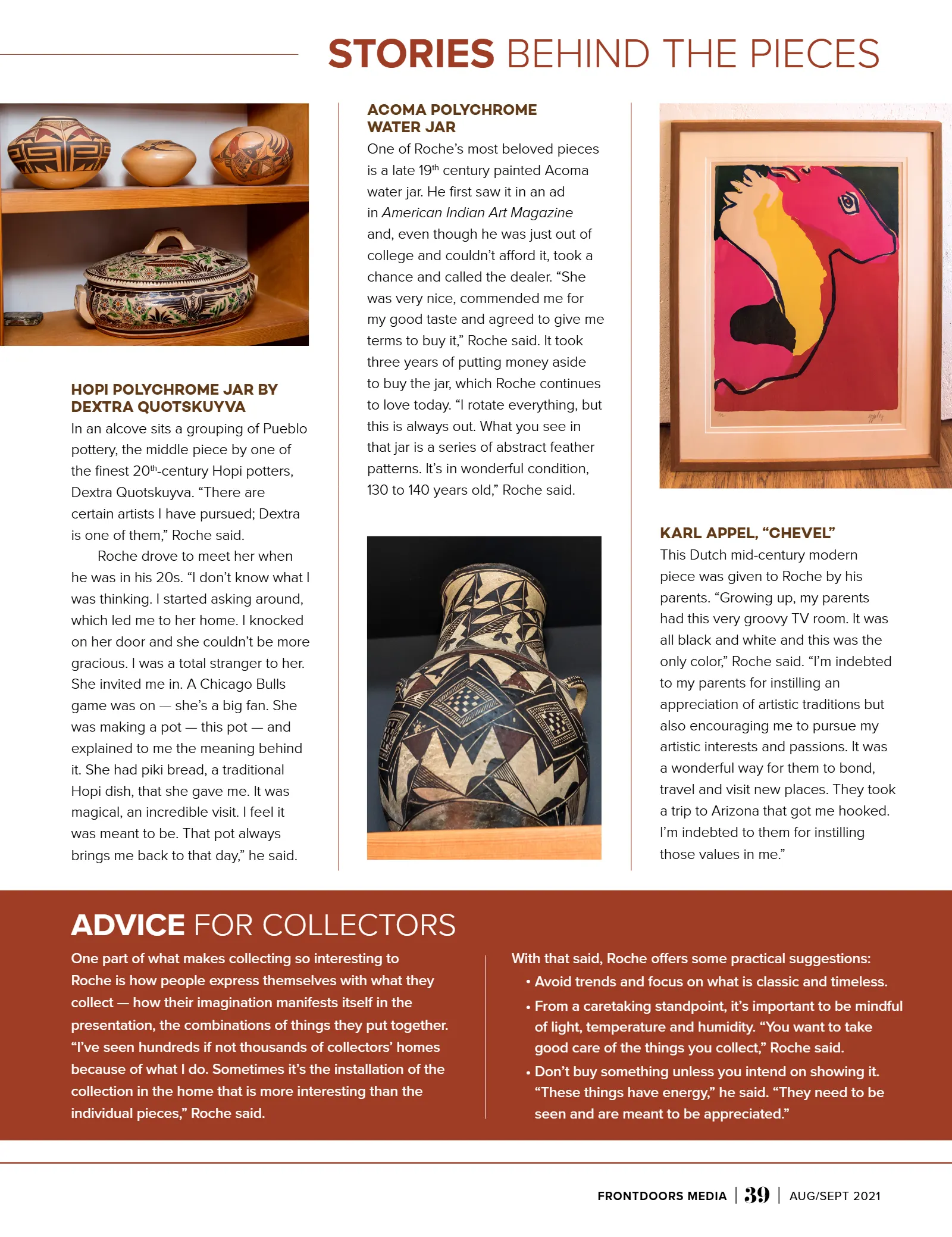
STORIES BEHIND THE PIECES One part of what makes collecting so interesting to Roche is how people express themselves with what they collect — how their imagination manifests itself in the presentation, the combinations of things they put together. “I’ve seen hundreds if not thousands of collectors’ homes because of what I do. Sometimes it’s the installation of the collection in the home that is more interesting than the individual pieces,” Roche said. KARL APPEL, “CHEVEL” This Dutch mid-century modern piece was given to Roche by his parents. “Growing up, my parents had this very groovy TV room. It was all black and white and this was the only color,” Roche said. “I’m indebted to my parents for instilling an appreciation of artistic traditions but also encouraging me to pursue my artistic interests and passions. It was a wonderful way for them to bond, travel and visit new places. They took a trip to Arizona that got me hooked. I’m indebted to them for instilling those values in me.” ACOMA POLYCHROME WATER JAR One of Roche’s most beloved pieces is a late 19 th century painted Acoma water jar. He first saw it in an ad in American Indian Art Magazine and, even though he was just out of college and couldn’t afford it, took a chance and called the dealer. “She was very nice, commended me for my good taste and agreed to give me terms to buy it,” Roche said. It took three years of putting money aside to buy the jar, which Roche continues to love today. “I rotate everything, but this is always out. What you see in that jar is a series of abstract feather patterns. It’s in wonderful condition, 130 to 140 years old,” Roche said. HOPI POLYCHROME JAR BY DEXTRA QUOTSKUYVA In an alcove sits a grouping of Pueblo pottery, the middle piece by one of the finest 20 th -century Hopi potters, Dextra Quotskuyva. “There are certain artists I have pursued; Dextra is one of them,” Roche said. Roche drove to meet her when he was in his 20s. “I don’t know what I was thinking. I started asking around, which led me to her home. I knocked on her door and she couldn’t be more gracious. I was a total stranger to her. She invited me in. A Chicago Bulls game was on — she’s a big fan. She was making a pot — this pot — and explained to me the meaning behind it. She had piki bread, a traditional Hopi dish, that she gave me. It was magical, an incredible visit. I feel it was meant to be. That pot always brings me back to that day,” he said. With that said, Roche offers some practical suggestions: • Avoid trends and focus on what is classic and timeless. • From a caretaking standpoint, it’s important to be mindful of light, temperature and humidity. “You want to take good care of the things you collect,” Roche said. • Don’t buy something unless you intend on showing it. “These things have energy,” he said. “They need to be seen and are meant to be appreciated.” ADVICE FOR COLLECTORS FRONTDOORS MEDIA | 39 | AUG/SEPT 2021