
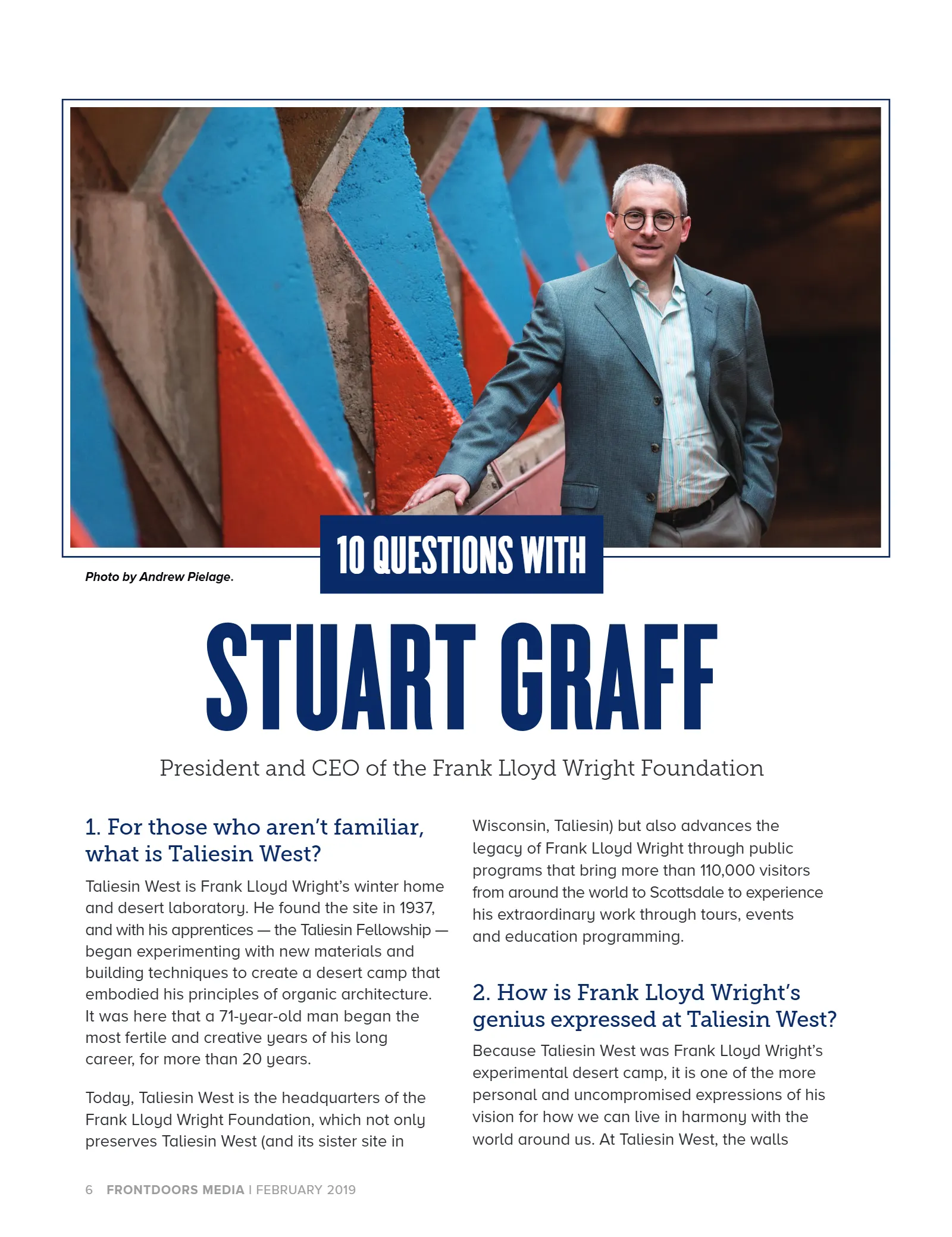
10 QUESTIONS WITH 1. For those who aren’t familiar, what is Taliesin West? Taliesin West is Frank Lloyd Wright’s winter home and desert laboratory. He found the site in 1937, and with his apprentices — the Taliesin Fellowship — began experimenting with new materials and building techniques to create a desert camp that embodied his principles of organic architecture. It was here that a 71-year-old man began the most fertile and creative years of his long career, for more than 20 years. Today, Taliesin West is the headquarters of the Frank Lloyd Wright Foundation, which not only preserves Taliesin West (and its sister site in Wisconsin, Taliesin) but also advances the legacy of Frank Lloyd Wright through public programs that bring more than 110,000 visitors from around the world to Scottsdale to experience his extraordinary work through tours, events and education programming. 2. How is Frank Lloyd Wright’s genius expressed at Taliesin West? Because Taliesin West was Frank Lloyd Wright’s experimental desert camp, it is one of the more personal and uncompromised expressions of his vision for how we can live in harmony with the world around us. At Taliesin West, the walls STUART GRAFF President and CEO of the Frank Lloyd Wright Foundation Photo by Andrew Pielage . 6 FRONTDOORS MEDIA | FEBRUARY 2019
appear to be ancient expressions of the desert itself, with lines that reflect the geometry of the McDowell Mountains east of the property. Through framed panoramas and vistas inside and out, the eye is always drawn beyond the buildings to embrace the landscape. You really get the sense of being at one with the world around you, inside and outside, part of a whole that connects buildings, landscape and people in a single ecosystem where everything and everyone can thrive. 3. How did you come to the Frank Lloyd Wright Foundation? I grew up in Chicago and experienced Wright’s work on school field trips — and found that his designs, his ideas, even his life story were inspiring. Understanding Wright’s constant experimentation and innovation influenced me to live my life by constantly exploring, learning, experimenting and growing. And though I’ve had successful careers in law and business with Fortune 500 companies, I always knew I would cap my working life in the nonprofit world. When I heard about the leadership opportunity at the foundation, I wanted to combine my experience as a strategic leader with my lifelong passion to help steward Wright’s legacy, so that future generations could be inspired by his work as I have been through my whole life. 4. What are your goals for the foundation? We’re working hard to make it a resource for our community, and the world, by teaching Wright’s ideas about living in harmony with the world around us. Wright’s ideas ladder up to modern notions of sustainability, so that his work is more relevant today than ever, and we hope that our visitors leave with new ideas about how they can bring sustainability and beauty into their lives and their communities. We’ve been doing a lot of work — and more to come — to ensure that we have the financial stability and community support to preserve Wright’s homes and undertake our programs for many years. 5. You’ve added lots of new tours and programs; why have you done that? Frank Lloyd Wright’s legacy and work are incredibly diverse, leaving us with a number of ways to share his timeless ideas with the community. We want the community to feel the life of this space and experience it as it was intended: through beautiful art, stunning performances, unique educational offerings and informative resources. 6. You recently received several grants to fund technology updates. What are your plans? We’re very excited that our new approach to sharing Wright’s legacy of beauty and sustainability is winning the support of our community. These grants will allow Taliesin West to continue its evolution from a traditional house museum to an engaging site infused with interactive, technology- enhanced experiences. For example, a grant from the Virginia G. Piper Charitable Trust has modernized our Internet systems, allowing the foundation the ability to create web-based programming on and off campus, with the installation of a fiber-optic cable and new IT hub at Taliesin West. Other grants from American Express, the Gila River Indian Community and a diverse group of funders build on the Piper grant to allow us to build interactive digital kiosks near the visitor entry court, iPads for field trips and summer camps, and many other initiatives that allow visitors to explore Wright’s legacy more fully than ever before. 7. What are some of the challenges that go along with running a National Historic Landmark? Perhaps our biggest challenge is funding the work to maintain these historic buildings. Because they were experimental architecture, they require constant attention and intervention. Our water distribution system and electric systems are outdated by decades — and it’s not FEBRUARY 2019 | FRONTDOORS MEDIA 7