
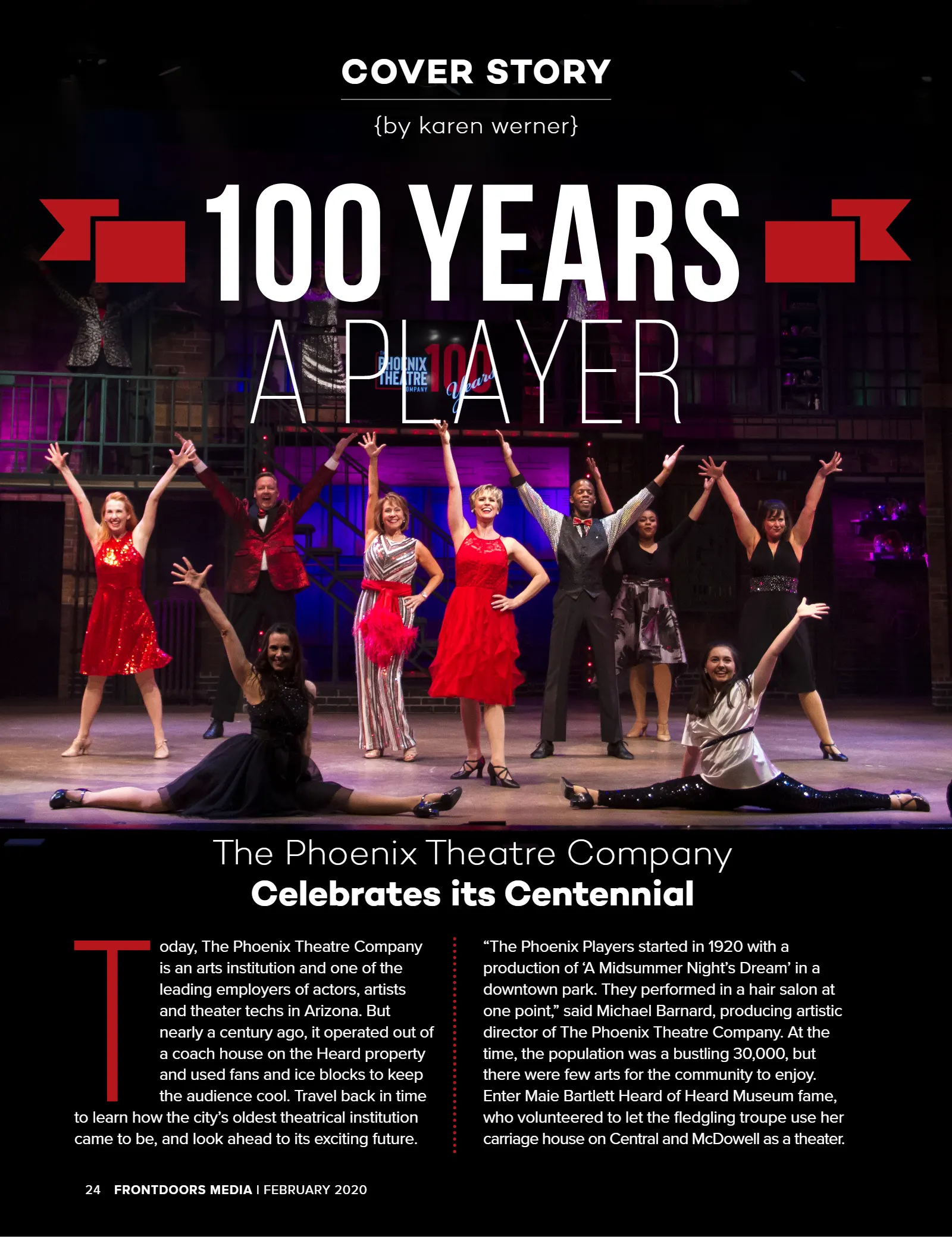
100 Years a Player The Phoenix Theatre Company Celebrates its Centennial T oday, The Phoenix Theatre Company is an arts institution and one of the leading employers of actors, artists and theater techs in Arizona. But nearly a century ago, it operated out of a coach house on the Heard property and used fans and ice blocks to keep the audience cool. Travel back in time to learn how the city’s oldest theatrical institution came to be, and look ahead to its exciting future. “The Phoenix Players started in 1920 with a production of ‘A Midsummer Night’s Dream’ in a downtown park. They performed in a hair salon at one point,” said Michael Barnard, producing artistic director of The Phoenix Theatre Company. At the time, the population was a bustling 30,000, but there were few arts for the community to enjoy. Enter Maie Bartlett Heard of Heard Museum fame, who volunteered to let the fledgling troupe use her carriage house on Central and McDowell as a theater. 24 FRONTDOORS MEDIA | FEBRUAR Y 2020 COVER STORY {by karen werner }
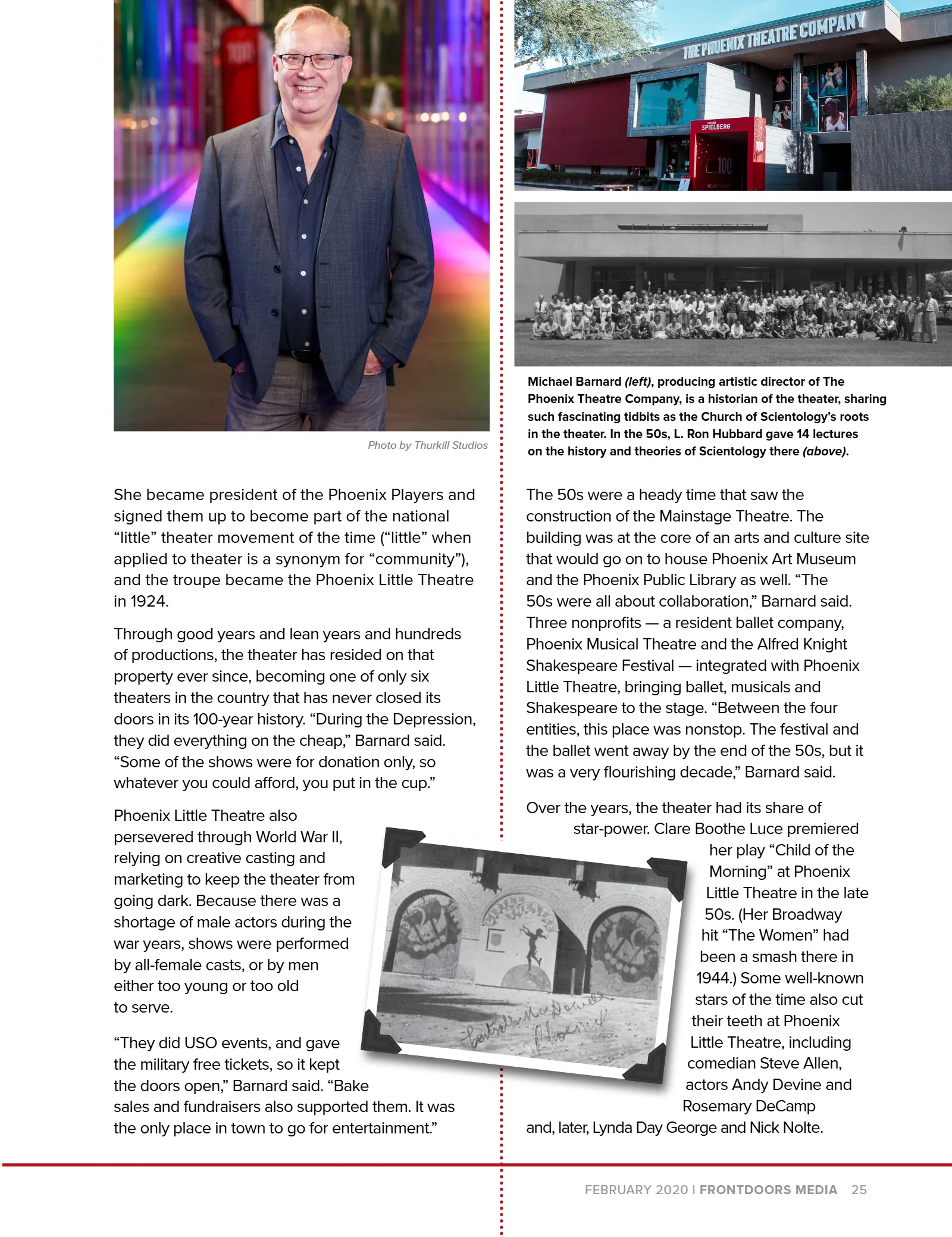
FEBRUAR Y 2020 | FRONTDOORS MEDIA 25 She became president of the Phoenix Players and signed them up to become part of the national “little” theater movement of the time (“little” when applied to theater is a synonym for “community”), and the troupe became the Phoenix Little Theatre in 1924. Through good years and lean years and hundreds of productions, the theater has resided on that property ever since, becoming one of only six theaters in the country that has never closed its doors in its 100-year history. “During the Depression, they did everything on the cheap,” Barnard said. “Some of the shows were for donation only, so whatever you could afford, you put in the cup.” Phoenix Little Theatre also persevered through World War II, relying on creative casting and marketing to keep the theater from going dark. Because there was a shortage of male actors during the war years, shows were performed by all-female casts, or by men either too young or too old to serve. “They did USO events, and gave the military free tickets, so it kept the doors open,” Barnard said. “Bake sales and fundraisers also supported them. It was the only place in town to go for entertainment.” The 50s were a heady time that saw the construction of the Mainstage Theatre. The building was at the core of an arts and culture site that would go on to house Phoenix Art Museum and the Phoenix Public Library as well. “The 50s were all about collaboration,” Barnard said. Three nonprofits — a resident ballet company, Phoenix Musical Theatre and the Alfred Knight Shakespeare Festival — integrated with Phoenix Little Theatre, bringing ballet, musicals and Shakespeare to the stage. “Between the four entities, this place was nonstop. The festival and the ballet went away by the end of the 50s, but it was a very flourishing decade,” Barnard said. Over the years, the theater had its share of star-power. Clare Boothe Luce premiered her play “Child of the Morning” at Phoenix Little Theatre in the late 50s. (Her Broadway hit “The Women” had been a smash there in 1944.) Some well-known stars of the time also cut their teeth at Phoenix Little Theatre, including comedian Steve Allen, actors Andy Devine and Rosemary DeCamp and, later, Lynda Day George and Nick Nolte. Michael Barnard (left) , producing artistic director of The Phoenix Theatre Company, is a historian of the theater, sharing such fascinating tidbits as the Church of Scientology’s roots in the theater. In the 50s, L. Ron Hubbard gave 14 lectures on the history and theories of Scientology there (above) . Photo by Thurkill Studios