
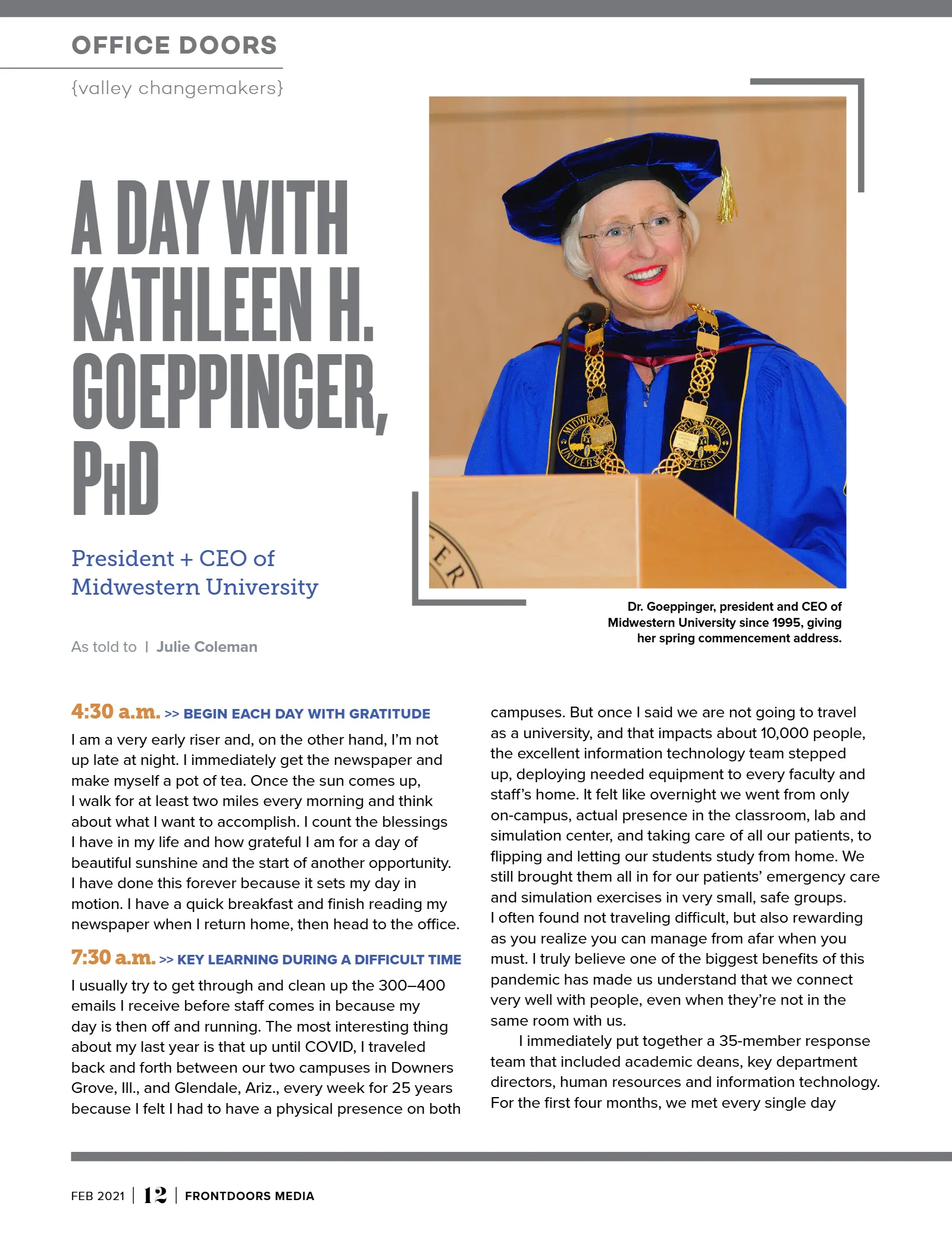
4:30 a.m. >> BEGIN EACH DAY WITH GRATITUDE I am a very early riser and, on the other hand, I’m not up late at night. I immediately get the newspaper and make myself a pot of tea. Once the sun comes up, I walk for at least two miles every morning and think about what I want to accomplish. I count the blessings I have in my life and how grateful I am for a day of beautiful sunshine and the start of another opportunity. I have done this forever because it sets my day in motion. I have a quick breakfast and finish reading my newspaper when I return home, then head to the office. 7:30 a.m. >> KEY LEARNING DURING A DIFFICULT TIME I usually try to get through and clean up the 300–400 emails I receive before staff comes in because my day is then off and running. The most interesting thing about my last year is that up until COVID, I traveled back and forth between our two campuses in Downers Grove, Ill., and Glendale, Ariz., every week for 25 years because I felt I had to have a physical presence on both campuses. But once I said we are not going to travel as a university, and that impacts about 10,000 people, the excellent information technology team stepped up, deploying needed equipment to every faculty and staff’s home. It felt like overnight we went from only on-campus, actual presence in the classroom, lab and simulation center, and taking care of all our patients, to flipping and letting our students study from home. We still brought them all in for our patients’ emergency care and simulation exercises in very small, safe groups. I often found not traveling difficult, but also rewarding as you realize you can manage from afar when you must. I truly believe one of the biggest benefits of this pandemic has made us understand that we connect very well with people, even when they’re not in the same room with us. I immediately put together a 35-member response team that included academic deans, key department directors, human resources and information technology. For the first four months, we met every single day Dr. Goeppinger, president and CEO of Midwestern University since 1995, giving her spring commencement address. President + CEO of Midwestern University A DAY WITH KATHLEEN H. GOEPPINGER, P h D As told to | Julie Coleman FEB 2021 | 12 | FRONTDOORS MEDIA OFFICE DOORS {valley changemakers}
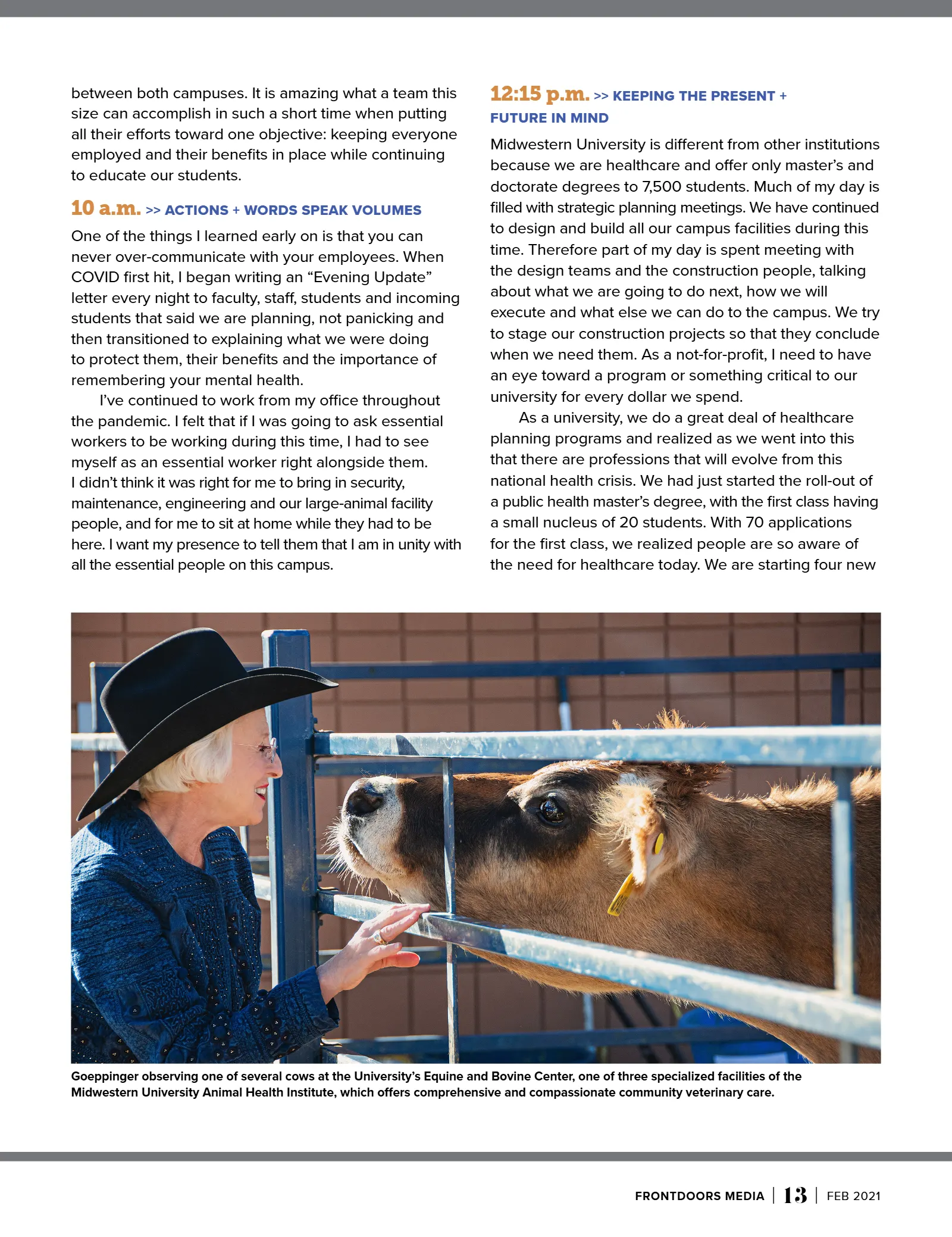
between both campuses. It is amazing what a team this size can accomplish in such a short time when putting all their efforts toward one objective: keeping everyone employed and their benefits in place while continuing to educate our students. 10 a.m. >> ACTIONS + WORDS SPEAK VOLUMES One of the things I learned early on is that you can never over-communicate with your employees. When COVID first hit, I began writing an “Evening Update” letter every night to faculty, staff, students and incoming students that said we are planning, not panicking and then transitioned to explaining what we were doing to protect them, their benefits and the importance of remembering your mental health. I’ve continued to work from my office throughout the pandemic. I felt that if I was going to ask essential workers to be working during this time, I had to see myself as an essential worker right alongside them. I didn’t think it was right for me to bring in security, maintenance, engineering and our large-animal facility people, and for me to sit at home while they had to be here. I want my presence to tell them that I am in unity with all the essential people on this campus. 12:15 p.m . >> KEEPING THE PRESENT + FUTURE IN MIND Midwestern Unive rsity is different from other institutions because we are healthcare and offer only master’s and doctorate degrees to 7,500 students. Much of my day is filled with strategic planning meetings. We have continued to design and build all our campus facilities during this time. Therefore part of my day is spent meeting with the design teams and the construction people, talking about what we are going to do next, how we will execute and what else we can do to the campus. We try to stage our construction projects so that they conclude when we need them. As a not-for-profit, I need to have an eye toward a program or something critical to our university for every dollar we spend. As a university, we do a great deal of healthcare planning programs and realized as we went into this that there are professions that will evolve from this national health crisis. We had just started the roll-out of a public health master’s degree, with the first class having a small nucleus of 20 students. With 70 applications for the first class, we realized people are so aware of the need for healthcare today. We are starting four new Goeppinger observing one of several cows at the University’s Equine and Bovine Center, one of three specialized facilities of the Midwestern University Animal Health Institute, which offers comprehensive and compassionate community veterinary care. FRONTDOORS MEDIA | 13 | FEB 2021