
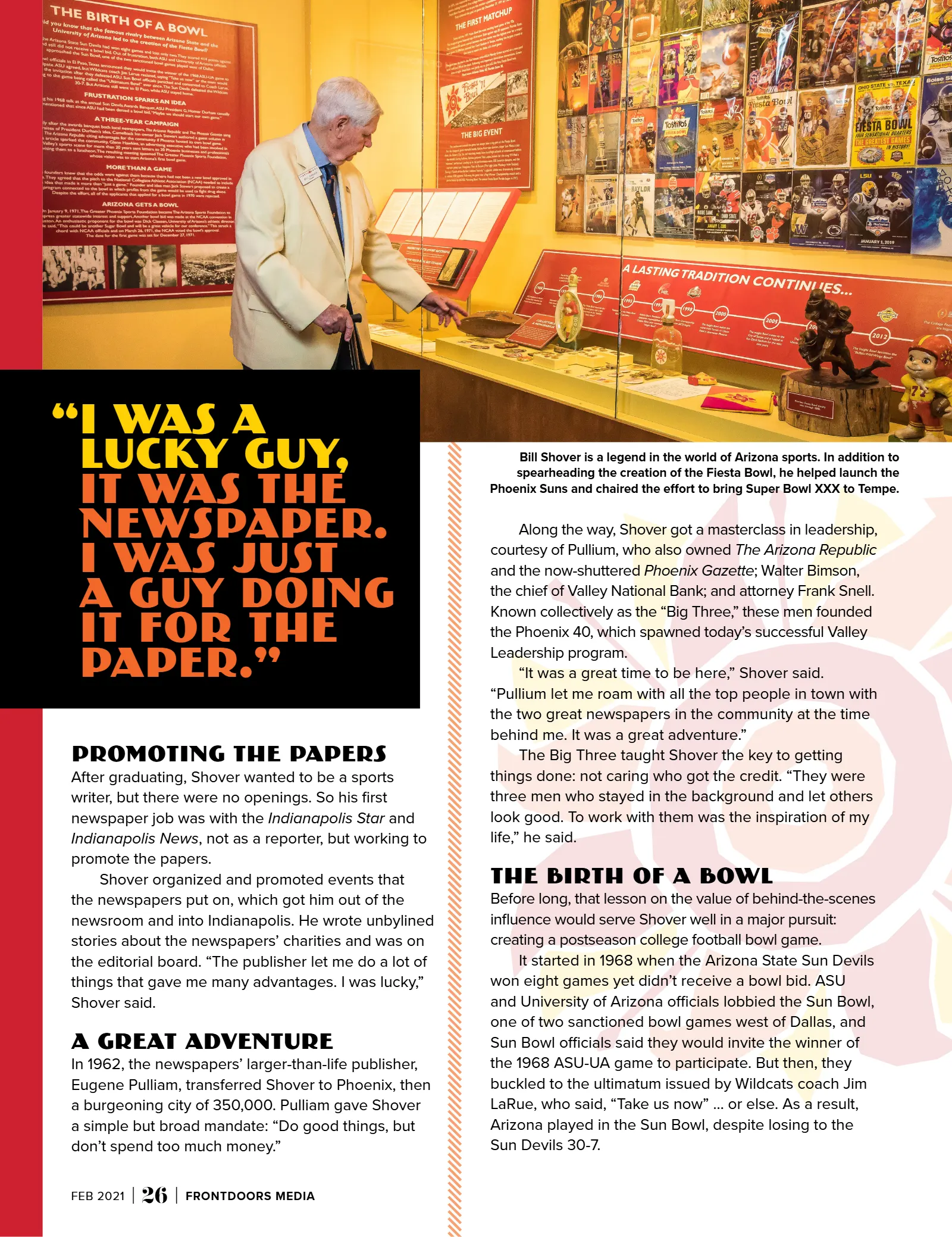
Promoting the Papers After graduating, Shover wanted to be a sports writer, but there were no openings. So his first newspaper job was with the Indianapolis Star and Indianapolis News , not as a reporter, but working to promote the papers. Shover organized and promoted events that the newspapers put on, which got him out of the newsroom and into Indianapolis. He wrote unbylined stories about the newspapers’ charities and was on the editorial board. “The publisher let me do a lot of things that gave me many advantages. I was lucky,” Shover said. A Great Adventure In 1962, the newspapers’ larger-than-life publisher, Eugene Pulliam, transferred Shover to Phoenix, then a burgeoning city of 350,000. Pulliam gave Shover a simple but broad mandate: “Do good things, but don’t spend too much money.” Along the way, Shover got a masterclass in leadership, courtesy of Pullium, who also owned The Arizona Republic and the now-shuttered Phoenix Gazette ; Walter Bimson, the chief of Valley National Bank; and attorney Frank Snell. Known collectively as the “Big Three,” these men founded the Phoenix 40, which spawned today’s successful Valley Leadership program. “It was a great time to be here,” Shover said. “Pullium let me roam with all the top people in town with the two great newspapers in the community at the time behind me. It was a great adventure.” The Big Three taught Shover the key to getting things done: not caring who got the credit. “They were three men who stayed in the background and let others look good. To work with them was the inspiration of my life,” he said. The Birth of a Bowl Before long, that lesson on the value of behind-the-scenes influence would serve Shover well in a major pursuit: creating a postseason college football bowl game. It started in 1968 when the Arizona State Sun Devils won eight games yet didn’t receive a bowl bid. ASU and University of Arizona officials lobbied the Sun Bowl, one of two sanctioned bowl games west of Dallas, and Sun Bowl officials said they would invite the winner of the 1968 ASU-UA game to participate. But then, they buckled to the ultimatum issued by Wildcats coach Jim LaRue, who said, “Take us now” … or else. As a result, Arizona played in the Sun Bowl, despite losing to the Sun Devils 30-7. “ I was a lucky guy, It was the newspaper. I was just a guy doing it for the paper.” Bill Shover is a legend in the world of Arizona sports. In addition to spearheading the creation of the Fiesta Bowl, he helped launch the Phoenix Suns and chaired the effort to bring Super Bowl XXX to Tempe. FEB 2021 | 26 | FRONTDOORS MEDIA
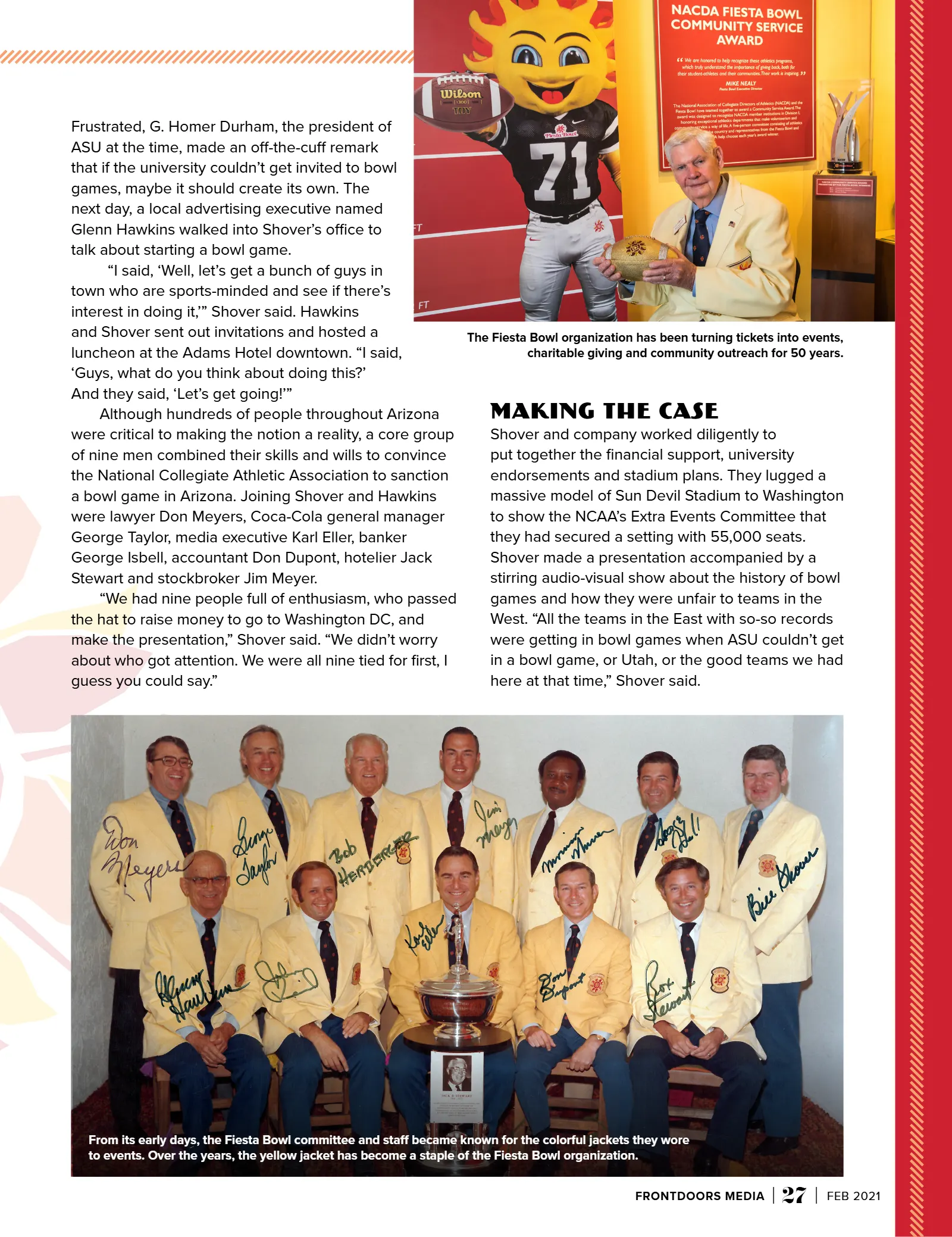
Frustrated, G. Homer Durham, the president of ASU at the time, made an off-the-cuff remark that if the university couldn’t get invited to bowl games, maybe it should create its own. The next day, a local advertising executive named Glenn Hawkins walked into Shover’s office to talk about starting a bowl game. “I said, ‘Well, let’s get a bunch of guys in town who are sports-minded and see if there’s interest in doing it,’” Shover said. Hawkins and Shover sent out invitations and hosted a luncheon at the Adams Hotel downtown. “I said, ‘Guys, what do you think about doing this?’ And they said, ‘Let’s get going!’” Although hundreds of people throughout Arizona were critical to making the notion a reality, a core group of nine men combined their skills and wills to convince the National Collegiate Athletic Association to sanction a bowl game in Arizona. Joining Shover and Hawkins were lawyer Don Meyers, Coca-Cola general manager George Taylor, media executive Karl Eller, banker George Isbell, accountant Don Dupont, hotelier Jack Stewart and stockbroker Jim Meyer. “We had nine people full of enthusiasm, who passed the hat to raise money to go to Washington DC, and make the presentation,” Shover said. “We didn’t worry about who got attention. We were all nine tied for first, I guess you could say.” Making the Case Shover and company worked diligently to put together the financial support, university endorsements and stadium plans. They lugged a massive model of Sun Devil Stadium to Washington to show the NCAA’s Extra Events Committee that they had secured a setting with 55,000 seats. Shover made a presentation accompanied by a stirring audio-visual show about the history of bowl games and how they were unfair to teams in the West. “All the teams in the East with so-so records were getting in bowl games when ASU couldn’t get in a bowl game, or Utah, or the good teams we had here at that time,” Shover said. From its early days, the Fiesta Bowl committee and staff became known for the colorful jackets they wore to events. Over the years, the yellow jacket has become a staple of the Fiesta Bowl organization. FRONTDOORS MEDIA | 27 | FEB 2021 The Fiesta Bowl organization has been turning tickets into events, charitable giving and community outreach for 50 years.