
Community spirit has always been what sets the Fiesta Bowl apart. Central to the pitch was the idea that this bowl would be “more than a game.” Profits would go to community efforts, including a program to fight drug abuse. With drug use on campuses on the rise, U.S. Attorney General John Mitchell came to the presentation and let it be known that the administration wanted this game. “All the schools wanted to have programs about drugs at the time, and Mitchell came in with his heavy hand from Richard Nixon and told the committee, ‘We want this game,’” Shover said. With the Western Athletic Conference and the federal government backing the effort, prospects for a bowl game in Arizona looked good. The NCAA accepted the proposal in early 1971. The Inaugural Game Community spirit was high on Dec. 27, 1971, when more than 51,000 fans packed into Sun Devil Stadium to watch the first Fiesta Bowl. Mariachi bands, Native American dancers, a jazz choir, and marching bands from local high schools entertained the excited crowd before kickoff. The game itself featured top-10 Arizona State against top-20 Florida State. Arizona’s first college football bowl game was a nail-biter, decided in the final minute when ASU’s Woody Green dove straight into the end zone from two yards out to give ASU the first Fiesta Bowl win. The final score — ASU Sun Devils 45, Florida State 38. Community Spirit Is Key Today, the Fiesta Bowl hosts a variety of events every year, in addition to two elite football bowl games. Key to the operation’s success is the team of nearly 3,000 who volunteer their time and skills to the cause. Community spirit has always been what sets the Fiesta Bowl apart. From the beginning, they were looking for a way to differentiate themselves from other bowls, like the Rose Bowl. “We said, ‘We’ll do something the Rose Bowl doesn’t do, we’ll have hospitality,’” Shover said. The group rolled out the red carpet for visiting teams, meeting them at their planes in their signature yellow jackets, taking them to their hotels and remaining at their beck and call. “We didn’t have a lot of money, but we had a lot of hospitality. No one had ever done that before.” The teams, fans and families loved it. Doctors, dentists and babysitters were on call for whatever the teams needed while guest cars transported them around town. “We even had arrangements to fly them over the Grand Canyon,” Shover said. “We had so many opportunities that other bowls didn’t have because we had Arizona.” FEB 2021 | 28 | FRONTDOORS MEDIA
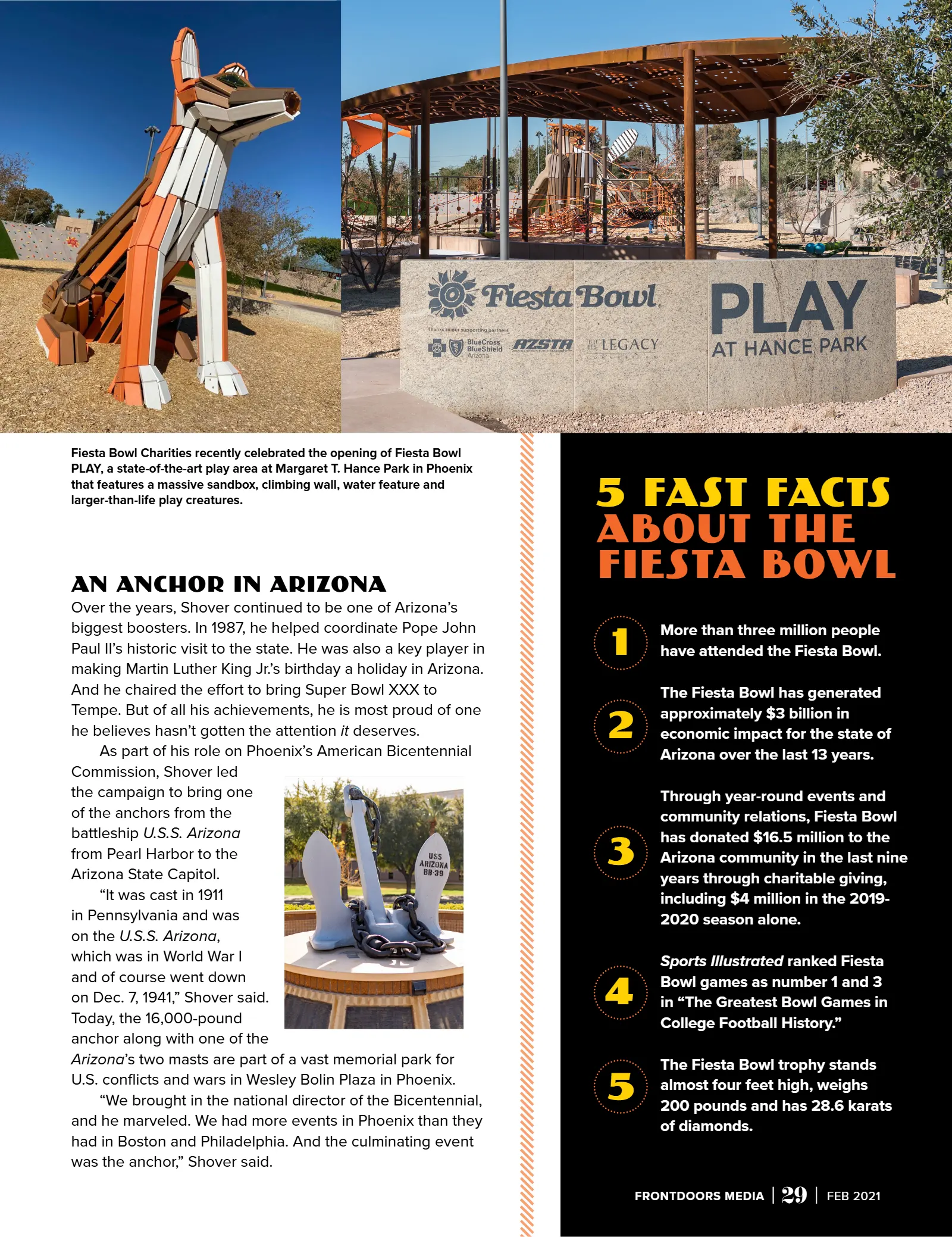
More than three million people have attended the Fiesta Bowl. The Fiesta Bowl has generated approximately $3 billion in economic impact for the state of Arizona over the last 13 years. Through year-round events and community relations, Fiesta Bowl has donated $16.5 million to the Arizona community in the last nine years through charitable giving, including $4 million in the 2019- 2020 season alone. Sports Illustrated ranked Fiesta Bowl games as number 1 and 3 in “The Greatest Bowl Games in College Football History.” The Fiesta Bowl trophy stands almost four feet high, weighs 200 pounds and has 28.6 karats of diamonds. 5 Fast Facts About the Fiesta Bowl 1 2 3 4 5 An Anchor in Arizona Over the years, Shover continued to be one of Arizona’s biggest boosters. In 1987, he helped coordinate Pope John Paul II’s historic visit to the state. He was also a key player in making Martin Luther King Jr.’s birthday a holiday in Arizona. And he chaired the effort to bring Super Bowl XXX to Tempe. But of all his achievements, he is most proud of one he believes hasn’t gotten the attention it deserves. As part of his role on Phoenix’s American Bicentennial Commission, Shover led the campaign to bring one of the anchors from the battleship U.S.S. Arizona from Pearl Harbor to the Arizona State Capitol. “It was cast in 1911 in Pennsylvania and was on the U.S.S. Arizona , which was in World War I and of course went down on Dec. 7, 1941,” Shover said. Today, the 16,000-pound anchor along with one of the Arizona ’s two masts are part of a vast memorial park for U.S. conflicts and wars in Wesley Bolin Plaza in Phoenix. “We brought in the national director of the Bicentennial, and he marveled. We had more events in Phoenix than they had in Boston and Philadelphia. And the culminating event was the anchor,” Shover said. Fiesta Bowl Charities recently celebrated the opening of Fiesta Bowl PLAY, a state-of-the-art play area at Margaret T. Hance Park in Phoenix that features a massive sandbox, climbing wall, water feature and larger-than-life play creatures. FRONTDOORS MEDIA | 29 | FEB 2021