
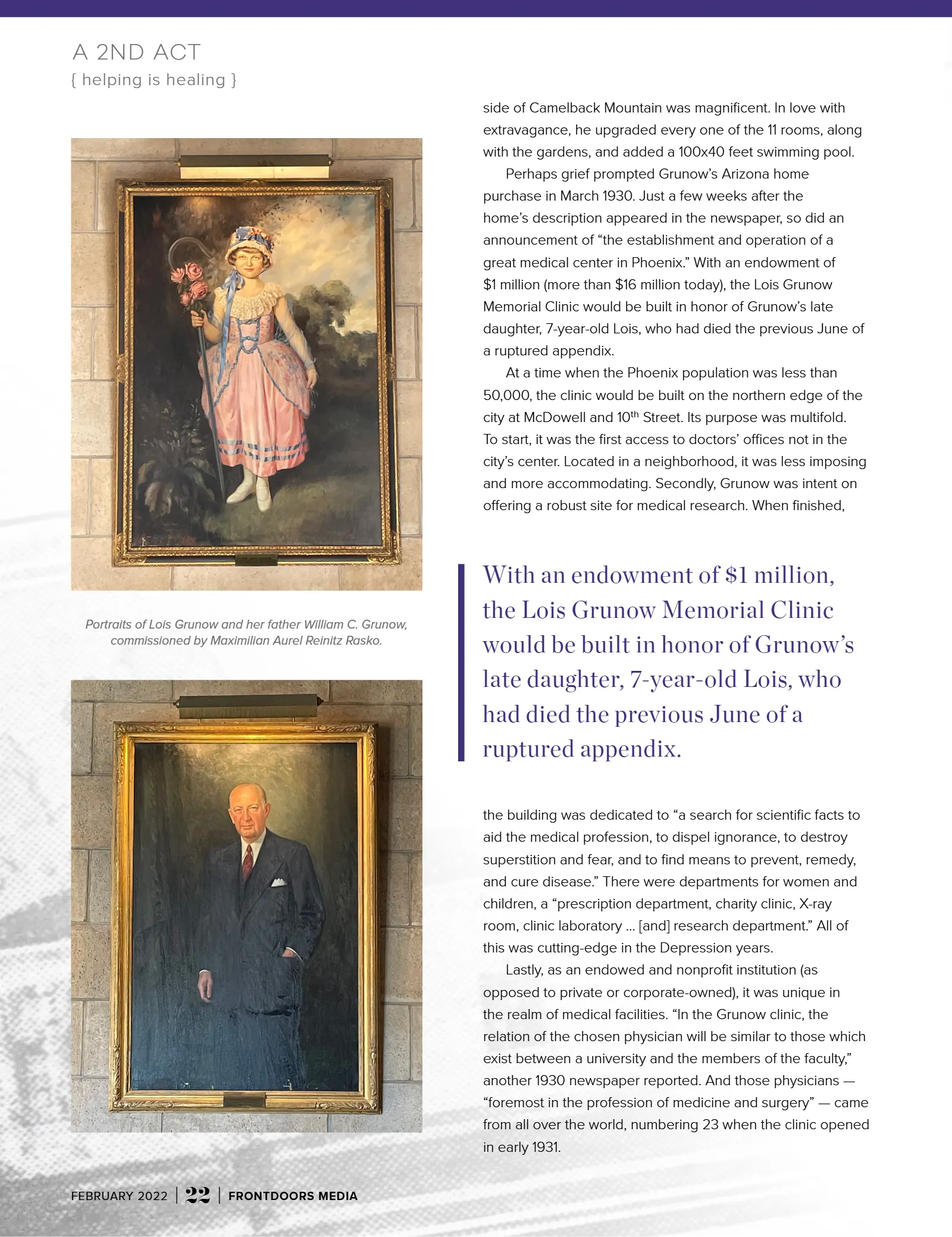
side of Camelback Mountain was magnificent. In love with extravagance, he upgraded every one of the 11 rooms, along with the gardens, and added a 100x40 feet swimming pool. Perhaps grief prompted Grunow’s Arizona home purchase in March 1930. Just a few weeks after the home’s description appeared in the newspaper, so did an announcement of “the establishment and operation of a great medical center in Phoenix.” With an endowment of $1 million (more than $16 million today), the Lois Grunow Memorial Clinic would be built in honor of Grunow’s late daughter, 7-year-old Lois, who had died the previous June of a ruptured appendix. At a time when the Phoenix population was less than 50,000, the clinic would be built on the northern edge of the city at McDowell and 10th Street. Its purpose was multifold. To start, it was the first access to doctors’ offices not in the city’s center. Located in a neighborhood, it was less imposing and more accommodating. Secondly, Grunow was intent on offering a robust site for medical research. When finished, the building was dedicated to “a search for scientific facts to aid the medical profession, to dispel ignorance, to destroy superstition and fear, and to find means to prevent, remedy, and cure disease.” There were departments for women and children, a “prescription department, charity clinic, X-ray room, clinic laboratory … [and] research department.” All of this was cutting-edge in the Depression years. Lastly, as an endowed and nonprofit institution (as opposed to private or corporate-owned), it was unique in the realm of medical facilities. “In the Grunow clinic, the relation of the chosen physician will be similar to those which exist between a university and the members of the faculty,” another 1930 newspaper reported. And those physicians — “foremost in the profession of medicine and surgery” — came from all over the world, numbering 23 when the clinic opened in early 1931. With an endowment of $1 million, the Lois Grunow Memorial Clinic would be built in honor of Grunow’s late daughter, 7-year-old Lois, who had died the previous June of a ruptured appendix. A 2ND ACT { helping is healing } Portraits of Lois Grunow and her father William C. Grunow, commissioned by Maximilian Aurel Reinitz Rasko. FEBRUARY 2022 | 22 | FRONTDOORS MEDIA
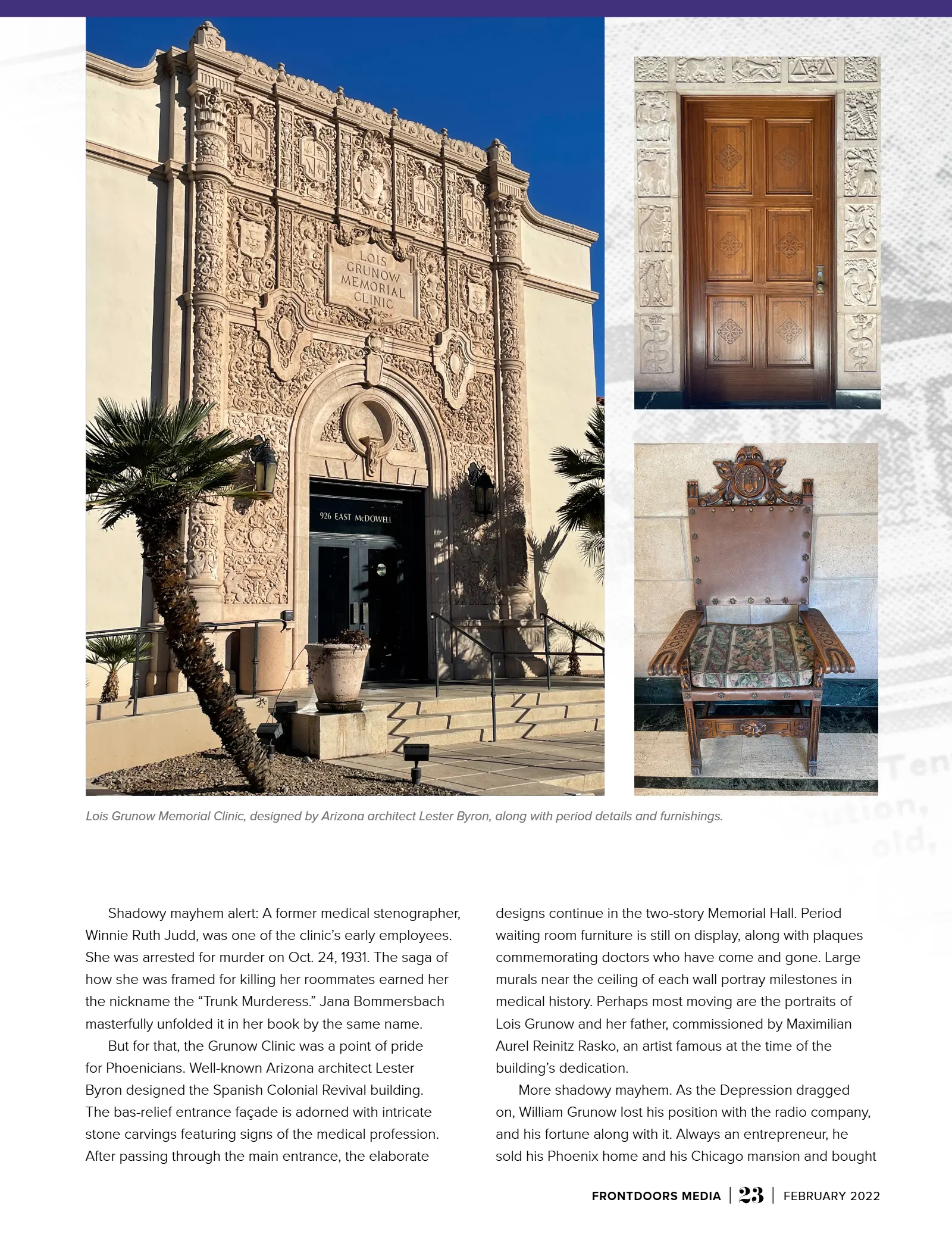
Shadowy mayhem alert: A former medical stenographer, Winnie Ruth Judd, was one of the clinic’s early employees. She was arrested for murder on Oct. 24, 1931. The saga of how she was framed for killing her roommates earned her the nickname the “Trunk Murderess.” Jana Bommersbach masterfully unfolded it in her book by the same name. But for that, the Grunow Clinic was a point of pride for Phoenicians. Well-known Arizona architect Lester Byron designed the Spanish Colonial Revival building. The bas-relief entrance façade is adorned with intricate stone carvings featuring signs of the medical profession. After passing through the main entrance, the elaborate designs continue in the two-story Memorial Hall. Period waiting room furniture is still on display, along with plaques commemorating doctors who have come and gone. Large murals near the ceiling of each wall portray milestones in medical history. Perhaps most moving are the portraits of Lois Grunow and her father, commissioned by Maximilian Aurel Reinitz Rasko, an artist famous at the time of the building’s dedication. More shadowy mayhem. As the Depression dragged on, William Grunow lost his position with the radio company, and his fortune along with it. Always an entrepreneur, he sold his Phoenix home and his Chicago mansion and bought Lois Grunow Memorial Clinic, designed by Arizona architect Lester Byron, along with period details and furnishings. FRONTDOORS MEDIA | 23 | FEBRUARY 2022