
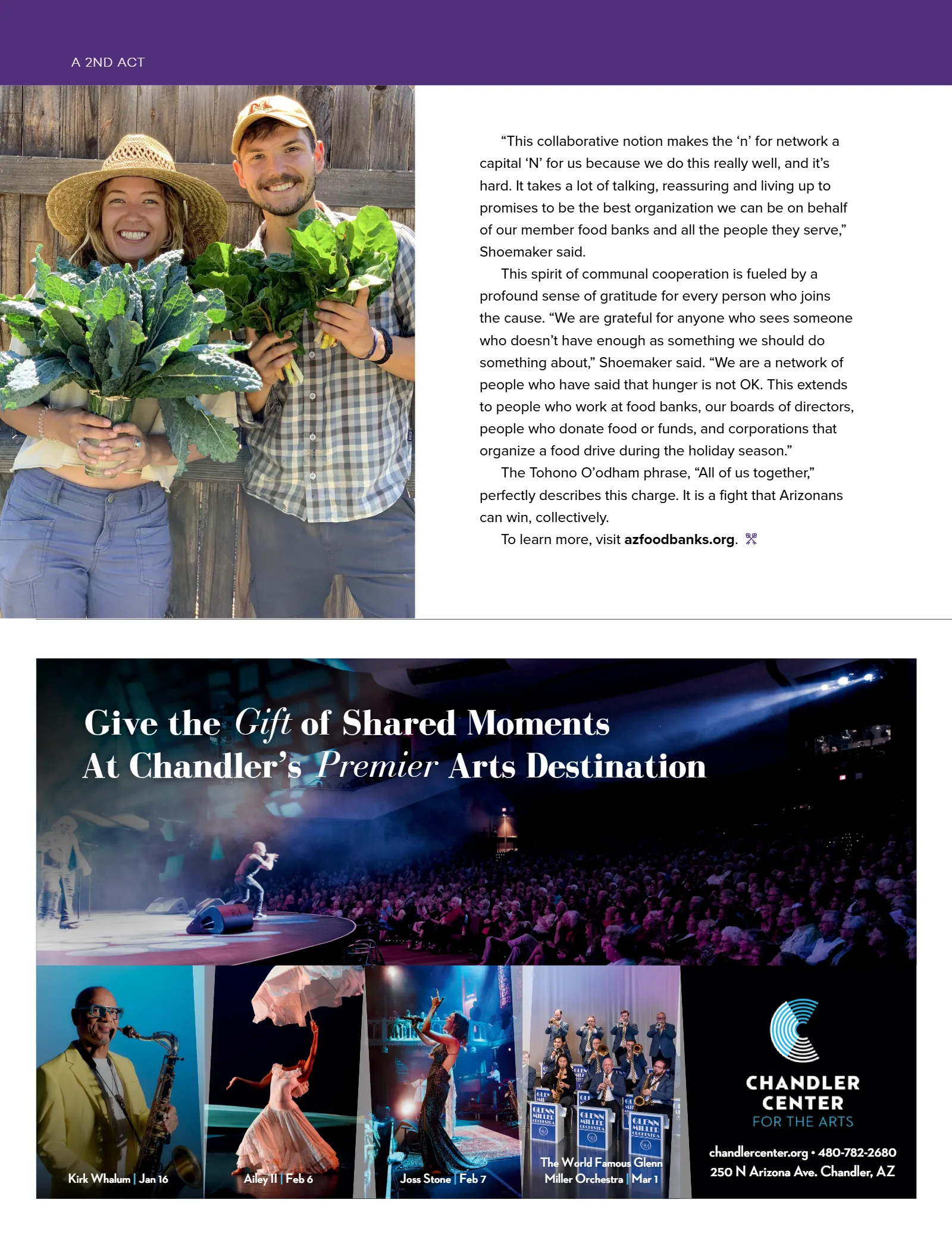
“This collaborative notion makes the ‘n’ for network a capital ‘N’ for us because we do this really well, and it’s hard. It takes a lot of talking, reassuring and living up to promises to be the best organization we can be on behalf of our member food banks and all the people they serve,” Shoemaker said. This spirit of communal cooperation is fueled by a profound sense of gratitude for every person who joins the cause. “We are grateful for anyone who sees someone who doesn’t have enough as something we should do something about,” Shoemaker said. “We are a network of people who have said that hunger is not OK. This extends to people who work at food banks, our boards of directors, people who donate food or funds, and corporations that organize a food drive during the holiday season.” The Tohono O’odham phrase, “All of us together,” perfectly describes this charge. It is a fight that Arizonans can win, collectively. To learn more, visit azfoodbanks.org . At Chandler’s Premier Arts Destination chandlercenter.org • 480-782-2680 250 N Arizona Ave. Chandler, AZ Give the of Shared Moments Gift Kirk Whalum | Jan 16 Ailey II | Feb 6 Joss Stone | Feb 7 The World Famous Glenn Miller Orchestra | Mar 1 A 2ND ACT
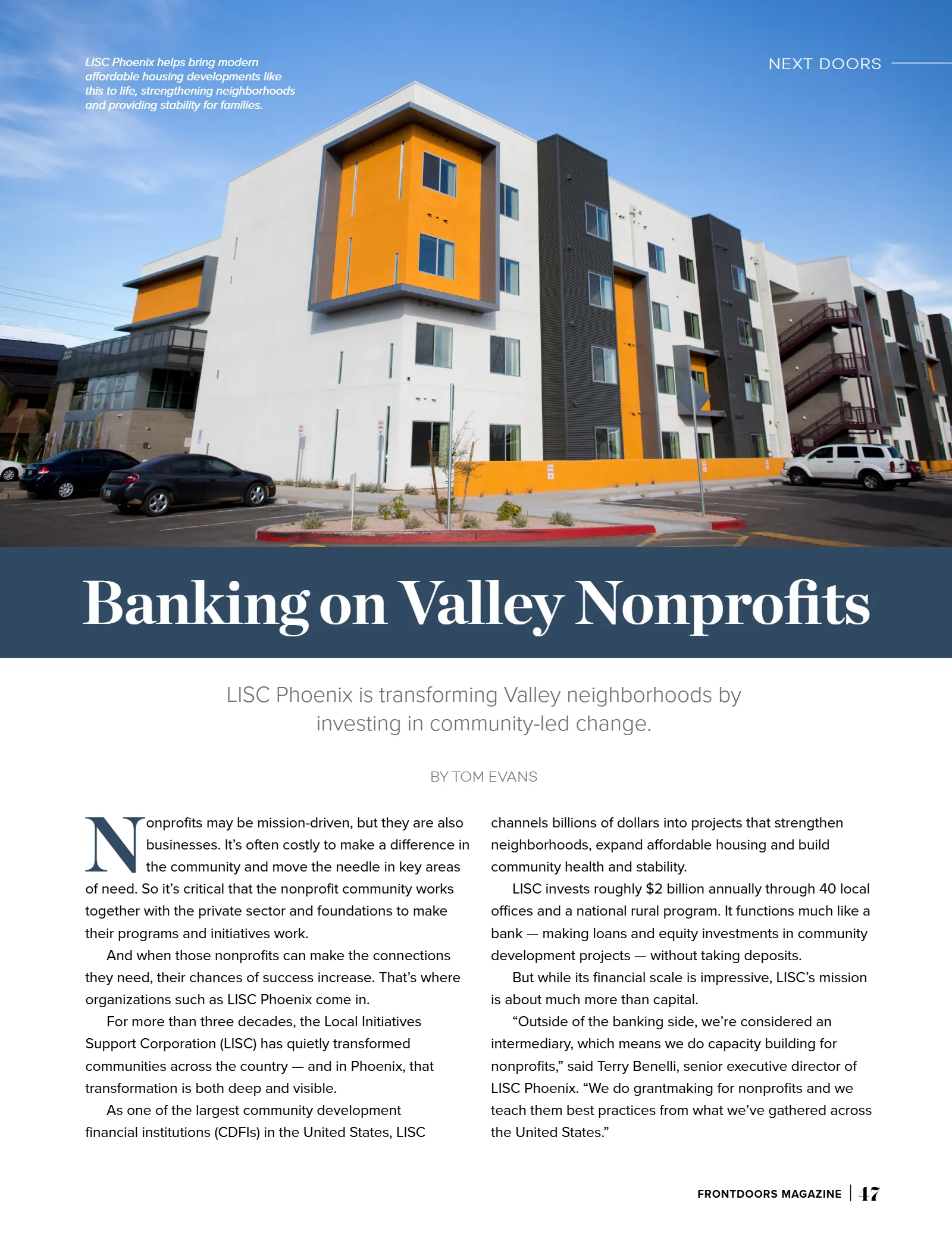
FRONTDOORS MAGAZINE | 47 BY TOM EVANS Banking on Valley Nonprofits LISC Phoenix is transforming Valley neighborhoods by investing in community-led change. N onprofits may be mission-driven, but they are also businesses. It’s often costly to make a difference in the community and move the needle in key areas of need. So it’s critical that the nonprofit community works together with the private sector and foundations to make their programs and initiatives work. And when those nonprofits can make the connections they need, their chances of success increase. That’s where organizations such as LISC Phoenix come in. For more than three decades, the Local Initiatives Support Corporation (LISC) has quietly transformed communities across the country — and in Phoenix, that transformation is both deep and visible. As one of the largest community development financial institutions (CDFIs) in the United States, LISC channels billions of dollars into projects that strengthen neighborhoods, expand affordable housing and build community health and stability. LISC invests roughly $2 billion annually through 40 local offices and a national rural program. It functions much like a bank — making loans and equity investments in community development projects — without taking deposits. But while its financial scale is impressive, LISC’s mission is about much more than capital. “Outside of the banking side, we’re considered an intermediary, which means we do capacity building for nonprofits,” said Terry Benelli, senior executive director of LISC Phoenix. “We do grantmaking for nonprofits and we teach them best practices from what we’ve gathered across the United States.” NEXT DOORS LISC Phoenix helps bring modern affordable housing developments like this to life, strengthening neighborhoods and providing stability for families.