
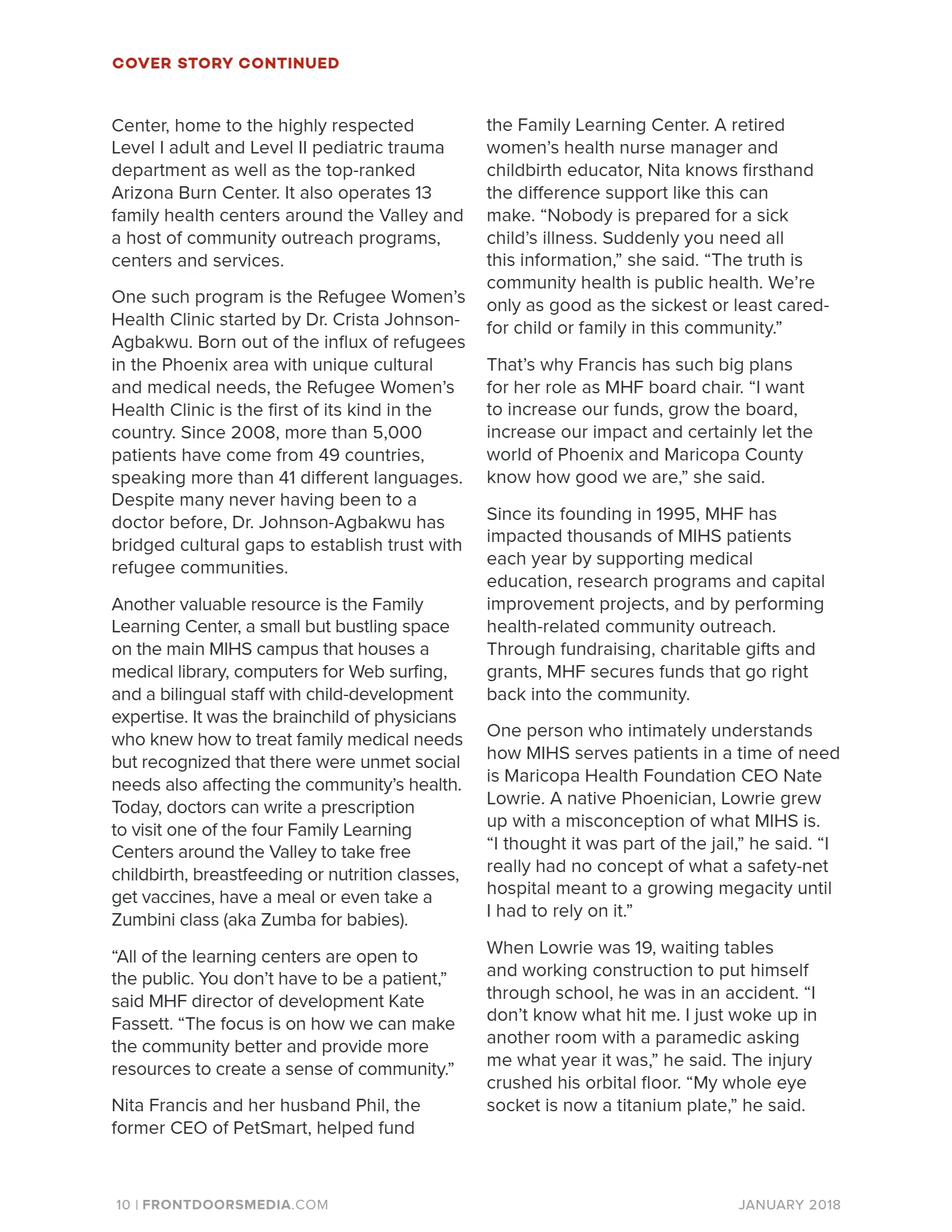
JANUARY 2018 10 | COVER STORY CONTINUED Center, home to the highly respected Level I adult and Level II pediatric trauma department as well as the top-ranked Arizona Burn Center. It also operates 13 family health centers around the Valley and a host of community outreach programs, centers and services. One such program is the Refugee Women’s Health Clinic started by Dr. Crista Johnson- Agbakwu. Born out of the influx of refugees in the Phoenix area with unique cultural and medical needs, the Refugee Women’s Health Clinic is the first of its kind in the country. Since 2008, more than 5,000 patients have come from 49 countries, speaking more than 41 different languages. Despite many never having been to a doctor before, Dr. Johnson-Agbakwu has bridged cultural gaps to establish trust with refugee communities. Another valuable resource is the Family Learning Center, a small but bustling space on the main MIHS campus that houses a medical library, computers for Web surfing, and a bilingual staff with child-development expertise. It was the brainchild of physicians who knew how to treat family medical needs but recognized that there were unmet social needs also affecting the community’s health. Today, doctors can write a prescription to visit one of the four Family Learning Centers around the Valley to take free childbirth, breastfeeding or nutrition classes, get vaccines, have a meal or even take a Zumbini class (aka Zumba for babies). “All of the learning centers are open to the public. You don’t have to be a patient,” said MHF director of development Kate Fassett. “The focus is on how we can make the community better and provide more resources to create a sense of community.” Nita Francis and her husband Phil, the former CEO of PetSmart, helped fund the Family Learning Center. A retired women’s health nurse manager and childbirth educator, Nita knows firsthand the difference support like this can make. “Nobody is prepared for a sick child’s illness. Suddenly you need all this information,” she said. “The truth is community health is public health. We’re only as good as the sickest or least cared- for child or family in this community.” That’s why Francis has such big plans for her role as MHF board chair. “I want to increase our funds, grow the board, increase our impact and certainly let the world of Phoenix and Maricopa County know how good we are,” she said. Since its founding in 1995, MHF has impacted thousands of MIHS patients each year by supporting medical education, research programs and capital improvement projects, and by performing health-related community outreach. Through fundraising, charitable gifts and grants, MHF secures funds that go right back into the community. One person who intimately understands how MIHS serves patients in a time of need is Maricopa Health Foundation CEO Nate Lowrie. A native Phoenician, Lowrie grew up with a misconception of what MIHS is. “I thought it was part of the jail,” he said. “I really had no concept of what a safety-net hospital meant to a growing megacity until I had to rely on it.” When Lowrie was 19, waiting tables and working construction to put himself through school, he was in an accident. “I don’t know what hit me. I just woke up in another room with a paramedic asking me what year it was,” he said. The injury crushed his orbital floor. “My whole eye socket is now a titanium plate,” he said.
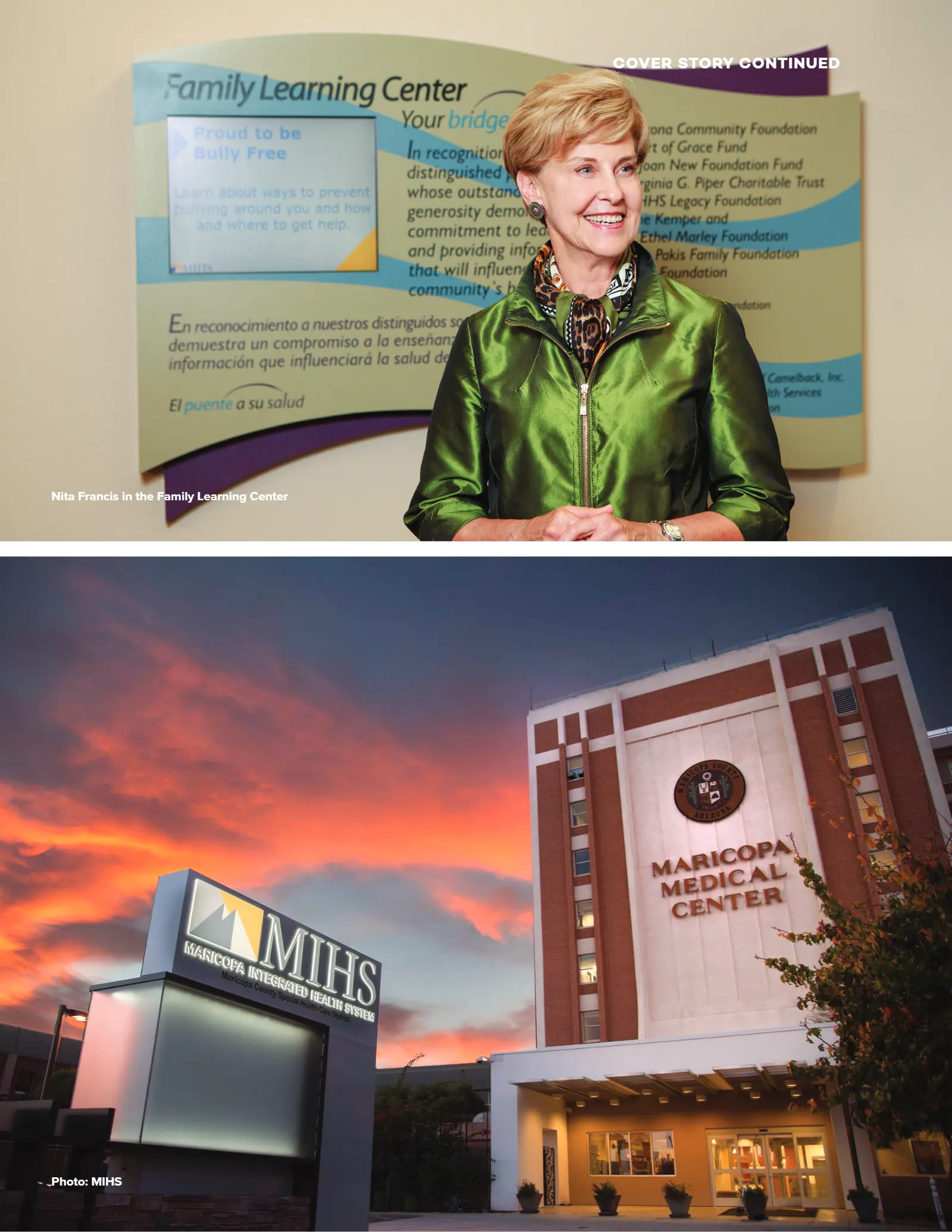
COVER STORY CONTINUED Nita Francis in the Family Learning Center Photo: MIHS