
JANUARY 2018 12 | Because of the care he received at MIHS, Lowrie was able to finish ASU and become an owner and investor in small Arizona businesses such as Zoe’s Kitchen in Phoenix and the Bicycle Haus in Scottsdale. With his success, he started giving back to the community and gaining a sense of what it takes to support a city. “This is the greatest investment vehicle I have an opportunity to be a part of to affect my hometown and the people who live here,” he said. As a teaching hospital, MIHS puts heavy emphasis on research, which means patients have access to medicine’s latest treatments. “That’s the kind of future I like to dream about — one where we’re all more capable and working together to better our community,” Lowrie said. That dream is about to take a big step forward with a rebuilding program that will help MIHS maintain its historic role as Maricopa County’s premier public teaching hospital and safety-net health system. In 2014, Maricopa County voters approved Proposition 480 to develop, improve and expand MIHS facilities for outpatient and behavioral health care throughout Maricopa County, and to expand its teaching hospital. Shovels will hit the ground this year to build a new $70 million multi-specialty health center in Peoria. With new facilities and new board members, it’s an exciting time for the foundation. “The public has supported this and generously allowed this money to be spent for facilities,” said Francis. “But unbelievably that money will not cover all the building, and it’s not to be used for staffing, programming and delivery of care. So the need will be bigger than ever.” As a result, MHF plans to ratchet up its operations in order to support what it sees as a community jewel. And from a business perspective, Lowrie said being known as a city that takes care of its people will make the Valley more competitive when it tries to attract top companies and high- quality talent. “This activity that we’re a part of redefines what, culturally, this town is known for. If we back that up with the community knowing MIHS as the medical field knows us, it becomes a point of pride.” Although many in the Valley aren’t aware of the exceptional care MIHS offers, it is common knowledge in the medical community. “When we meet doctors out in the world and we mention where we work, you should see them light up,” Lowrie said. Doctors from across the country and in some of the most prestigious local practices trained at MIHS. In fact, MIHS is Arizona’s only public teaching hospital, training more than 400 physicians each year. “It’s a badge of honor,” said Fasset. “For 14 residency spots in emergency medicine last year there were more than 1,500 applications from across the country.” Although MIHS has $935 million for capital needs thanks to Proposition 480, that money won’t go toward funding patient programs such as the Refugee Women’s Health Clinic or Family Learning Center. That’s where fundraising comes in. “We have a lot of education to do in the community to let people know about the amazing things going on here,” said Francis. “Philanthropy has to step up. I’ve seen this community — Phoenix and across the state — and it has a good heart.” Individual gifts can make a huge impact. In the Cancer Center, for instance, where the cost of chemotherapy, radiation and surgery can be extraordinary, donations COVER STORY CONTINUED
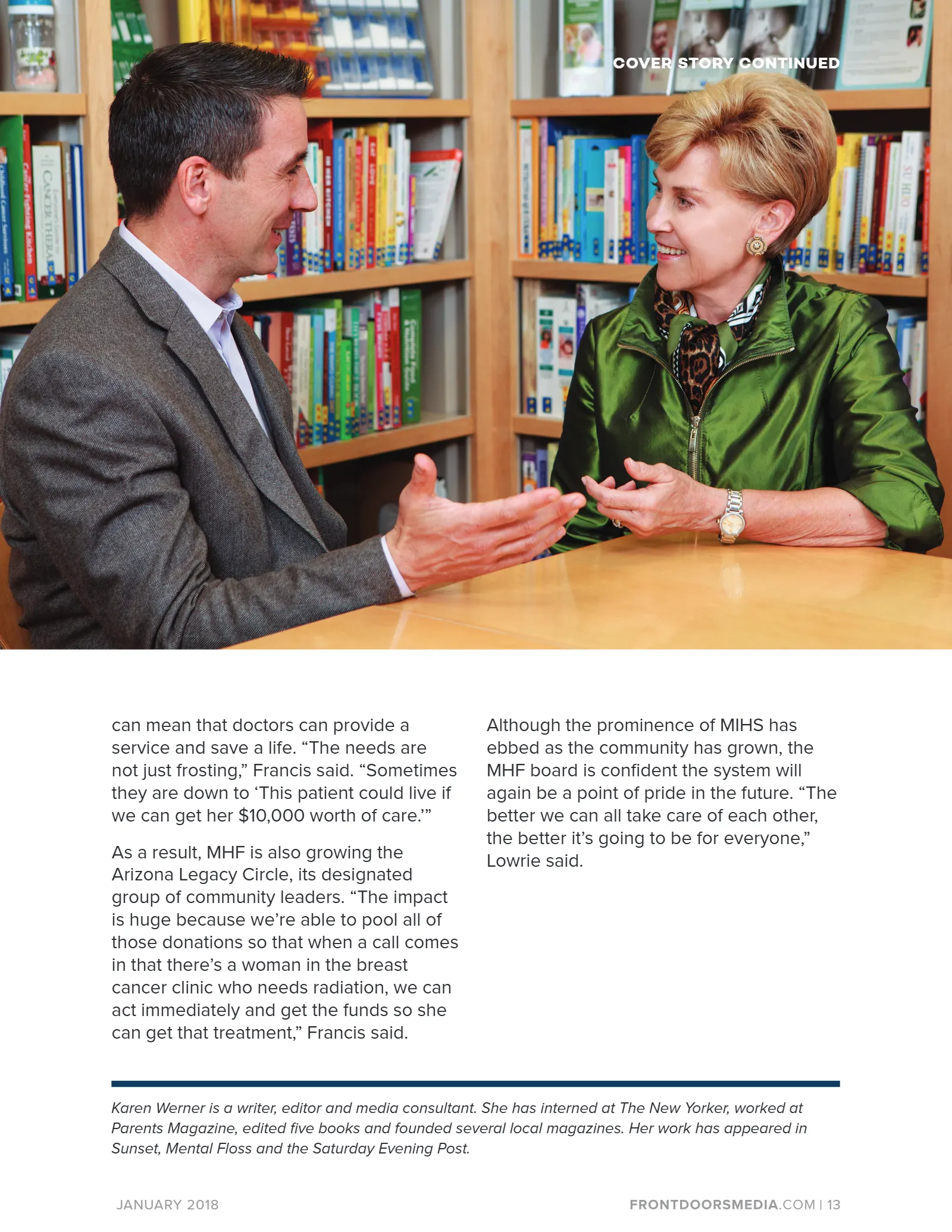
JANUARY 2018 | 13 can mean that doctors can provide a service and save a life. “The needs are not just frosting,” Francis said. “Sometimes they are down to ‘This patient could live if we can get her $10,000 worth of care.’” As a result, MHF is also growing the Arizona Legacy Circle, its designated group of community leaders. “The impact is huge because we’re able to pool all of those donations so that when a call comes in that there’s a woman in the breast cancer clinic who needs radiation, we can act immediately and get the funds so she can get that treatment,” Francis said. Although the prominence of MIHS has ebbed as the community has grown, the MHF board is confident the system will again be a point of pride in the future. “The better we can all take care of each other, the better it’s going to be for everyone,” Lowrie said. COVER STORY CONTINUED Karen Werner is a writer, editor and media consultant. She has interned at The New Yorker, worked at Parents Magazine, edited five books and founded several local magazines. Her work has appeared in Sunset, Mental Floss and the Saturday Evening Post.