
Walter, the World’s Largest VW bus. sets up portable dental-care stations to perform fillings, extractions and cleanings, and even to create custom-made dentures. Processes that normally take weeks are done in one visit. Even more impressive than the work being done is the compassion that Allen puts behind it. She readily admits that the patients — who include unemployed individuals, veterans, seniors and people experiencing homelessness — are not always ideal clients. “They smell, a lot of them have drug issues, you can’t understand many of them when they talk, but it’s about caring about each other,” she said. “If we start with being kind and taking care of each other, it makes our community stronger.” Strength is something Allen knows about. In the early 90s, she was a single parent of two small children when she decided to make a bold move. “I knew that if I wanted to send them to college, I needed to make a better income. So I decided to go to dental school after 10 years of being a hygienist,” she said. Allen left a stable job, took on debt and packed up her family to attend dental school in Kansas City. Along the way, Allen realized she liked getting people out of pain, so upon graduation, she enrolled in the endodontic program at the University of Minnesota. After graduating, she moved to Arizona to be closer to her parents and brothers, who had moved here during her time in school. Through her journey, Allen came to understand the vital link between teeth and overall well- being. “If you think about the mouth, it’s kind of the entryway to our world,” she said. “We not only communicate, we show affection, get nutrition and breathe through our mouths.” Beyond that, oral health is intricately tied to overall wellness. If you don’t have enough teeth to properly chew food, the work is done in the digestive system, creating more acid and ulcers. Increased risk of heart disease, dementia, respiratory and kidney infections — the ramifications of poor oral health go on and on. “And it’s not just a health issue,” Allen said. “It’s a psychological issue as well. When people live like that, they feel worse about themselves and maybe don’t take care of themselves.” Allen has special empathy for people struggling with psychological issues. Her son James fought a battle with mental health for years and took his own life in 2012 at the age of 23. “That’s really, personally, why we do this,” said Allen’s husband, Kevin Conroy, CADSF executive director. “James could have easily been one of these people.” So Allen, Conroy and their extended family gather for the event each December — traveling from Illinois, Texas, Florida, North Carolina and more — to support what has become a family tradition. “We don’t have time to decorate for Christmas, but we know that we’ve done this,” Conroy said. And though they realize AZMOM can only make a dent in the need for dental healthcare in Arizona, they recognize that, for the people receiving treatment, the work can be life-changing. Maria Arreola, a patient who received treatment, gushes about the event for “giving me back my smile that I was embarrassed to show off.” And she’s not alone; many patients sob when seeing their new dentures for the first time. Others come back in subsequent years, not as patients but as AZMOM volunteers. “I see the same people I’ve seen for seven years. They know me by name,” Conroy said. “They’ll tell me they got a job. Little things like that make a big difference in their lives.” “It’s very humbling,” Allen said. “They’re grateful because somebody has sat and listened to them and provided human contact.” Allen received a Health Care Heroes Award from Phoenix Business Journal last August for her steadfast commitment to the underserved. And she, Conroy and the other members of CADSF will continue to work free of charge to provide dental care to people throughout Arizona. 14 FRONTDOORS MEDIA | JANUARY 2019 OFFICE DOORS CONTINUED
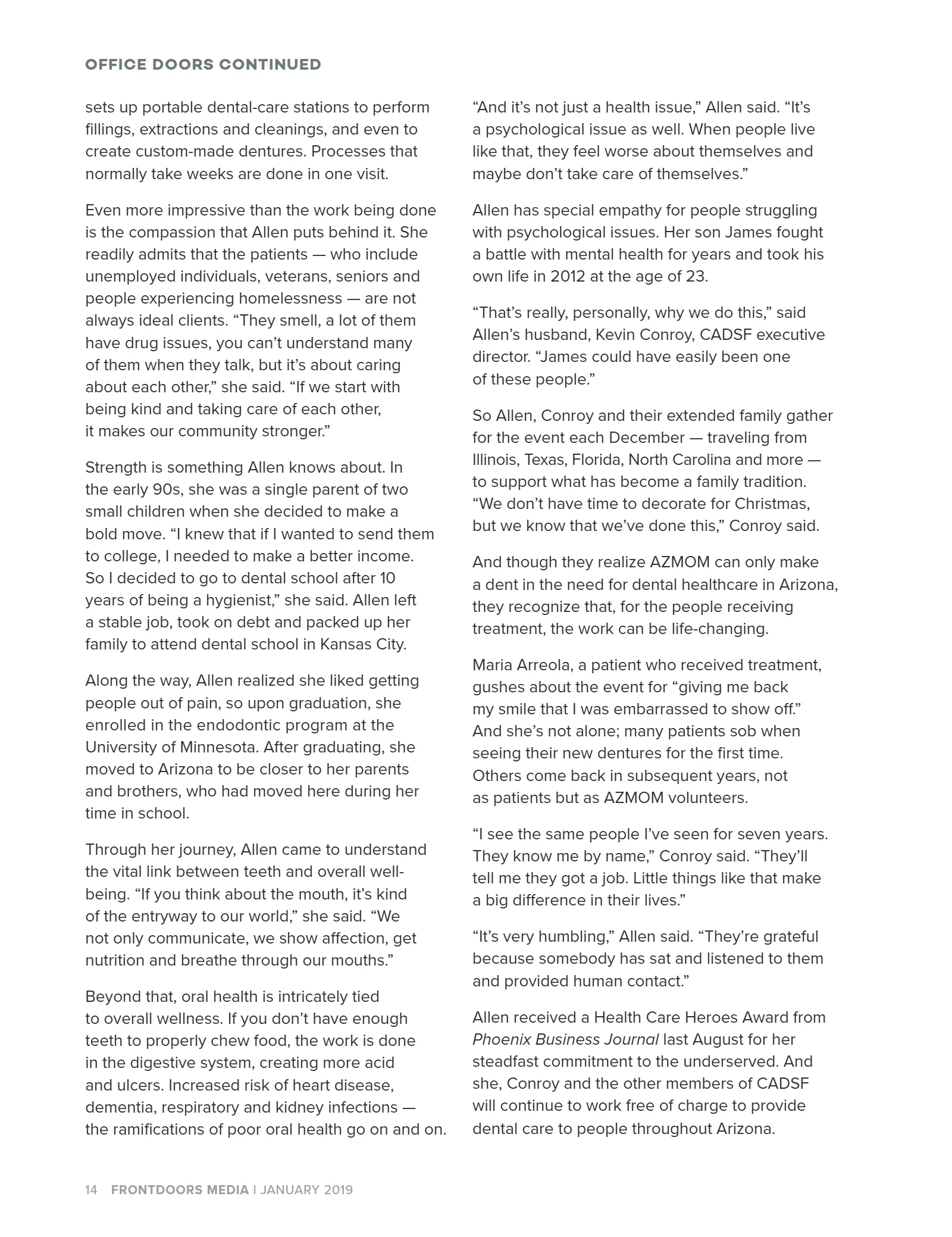
“There are forgotten people,” Allen said, “and they are around us all the time. Having my son in my life and the things that happened make me more acutely aware of that.” So Allen continues to raise funds and enlist volunteers to serve the dental needs of the underserved. She knows their problems are many and complex, but if she can help people feel better about themselves to a point where they’re not afraid to smile and that helps them get a job, it might make their lives easier. And that makes her life better, as well. “You have to consciously look for points of happiness and things to appreciate because life is hard for all of us, no matter how well people look like they’re coping,” she said. “We’re all human. And all of us need a helping hand.” To learn more, visit AZMOM.org . Dental professionals are able to give back to the community through Central Arizona Dental Society events. Photo: Karen Werner