
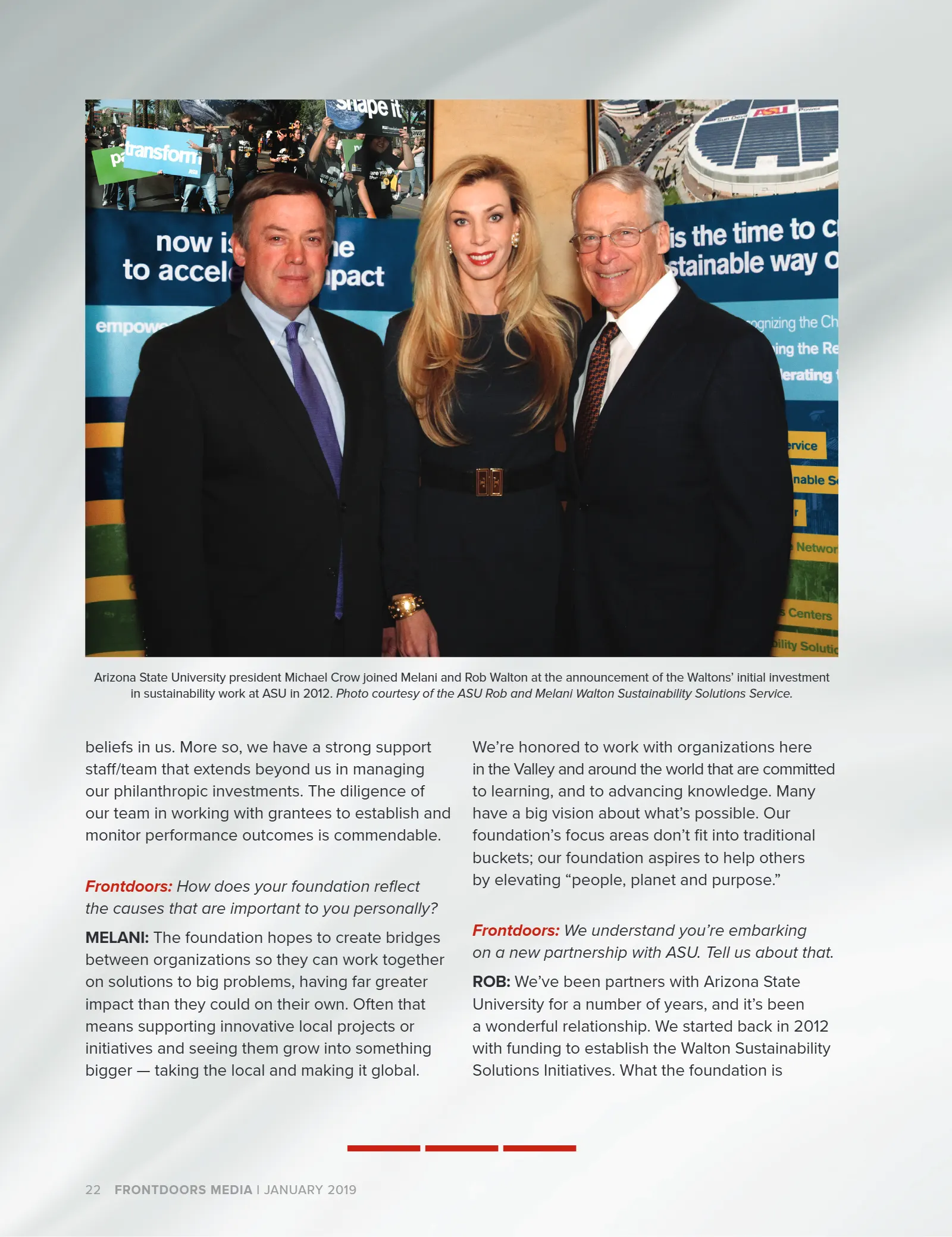
beliefs in us. More so, we have a strong support staff/team that extends beyond us in managing our philanthropic investments. The diligence of our team in working with grantees to establish and monitor performance outcomes is commendable. Frontdoors: How does your foundation reflect the causes that are important to you personally? MELANI: The foundation hopes to create bridges between organizations so they can work together on solutions to big problems, having far greater impact than they could on their own. Often that means supporting innovative local projects or initiatives and seeing them grow into something bigger — taking the local and making it global. We’re honored to work with organizations here in the Valley and around the world that are committed to learning, and to advancing knowledge. Many have a big vision about what’s possible. Our foundation’s focus areas don’t fit into traditional buckets; our foundation aspires to help others by elevating “people, planet and purpose.” Frontdoors: We understand you’re embarking on a new partnership with ASU. Tell us about that. ROB: We’ve been partners with Arizona State University for a number of years, and it’s been a wonderful relationship. We started back in 2012 with funding to establish the Walton Sustainability Solutions Initiatives. What the foundation is Arizona State University president Michael Crow joined Melani and Rob Walton at the announcement of the Waltonsʼ initial investment in sustainability work at ASU in 2012. Photo courtesy of the ASU Rob and Melani Walton Sustainability Solutions Service. 22 FRONTDOORS MEDIA | JANUARY 2019
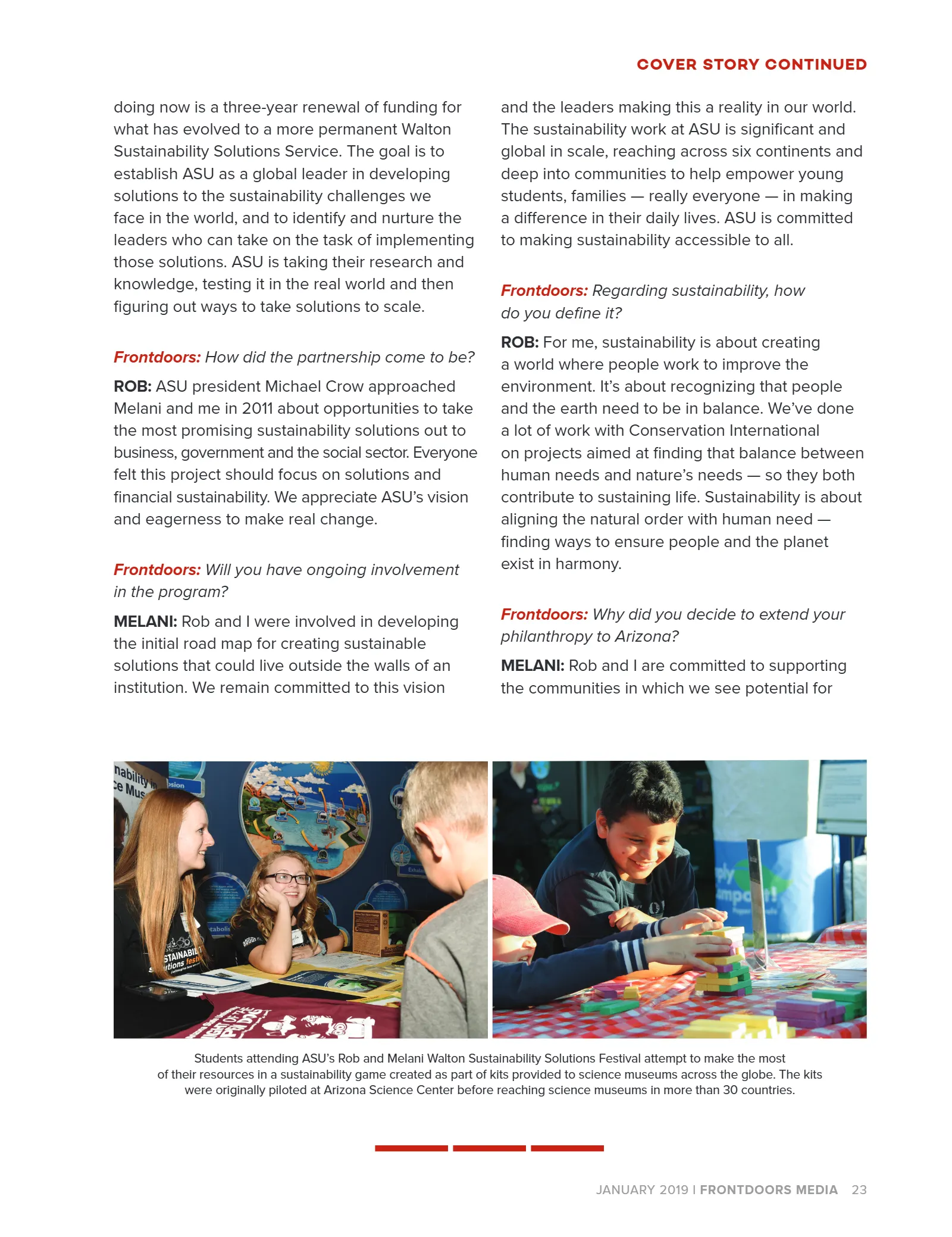
doing now is a three-year renewal of funding for what has evolved to a more permanent Walton Sustainability Solutions Service. The goal is to establish ASU as a global leader in developing solutions to the sustainability challenges we face in the world, and to identify and nurture the leaders who can take on the task of implementing those solutions. ASU is taking their research and knowledge, testing it in the real world and then figuring out ways to take solutions to scale. Frontdoors: How did the partnership come to be? ROB: ASU president Michael Crow approached Melani and me in 2011 about opportunities to take the most promising sustainability solutions out to business, government and the social sector. Everyone felt this project should focus on solutions and financial sustainability. We appreciate ASU’s vision and eagerness to make real change. Frontdoors: Will you have ongoing involvement in the program? MELANI: Rob and I were involved in developing the initial road map for creating sustainable solutions that could live outside the walls of an institution. We remain committed to this vision and the leaders making this a reality in our world. The sustainability work at ASU is significant and global in scale, reaching across six continents and deep into communities to help empower young students, families — really everyone — in making a difference in their daily lives. ASU is committed to making sustainability accessible to all. Frontdoors: Regarding sustainability, how do you define it? ROB: For me, sustainability is about creating a world where people work to improve the environment. It’s about recognizing that people and the earth need to be in balance. We’ve done a lot of work with Conservation International on projects aimed at finding that balance between human needs and nature’s needs — so they both contribute to sustaining life. Sustainability is about aligning the natural order with human need — finding ways to ensure people and the planet exist in harmony. Frontdoors: Why did you decide to extend your philanthropy to Arizona? MELANI: Rob and I are committed to supporting the communities in which we see potential for Students attending ASU’s Rob and Melani Walton Sustainability Solutions Festival attempt to make the most of their resources in a sustainability game created as part of kits provided to science museums across the globe. The kits were originally piloted at Arizona Science Center before reaching science museums in more than 30 countries. JANUARY 2019 | FRONTDOORS MEDIA 23 COVER STORY CONTINUED