
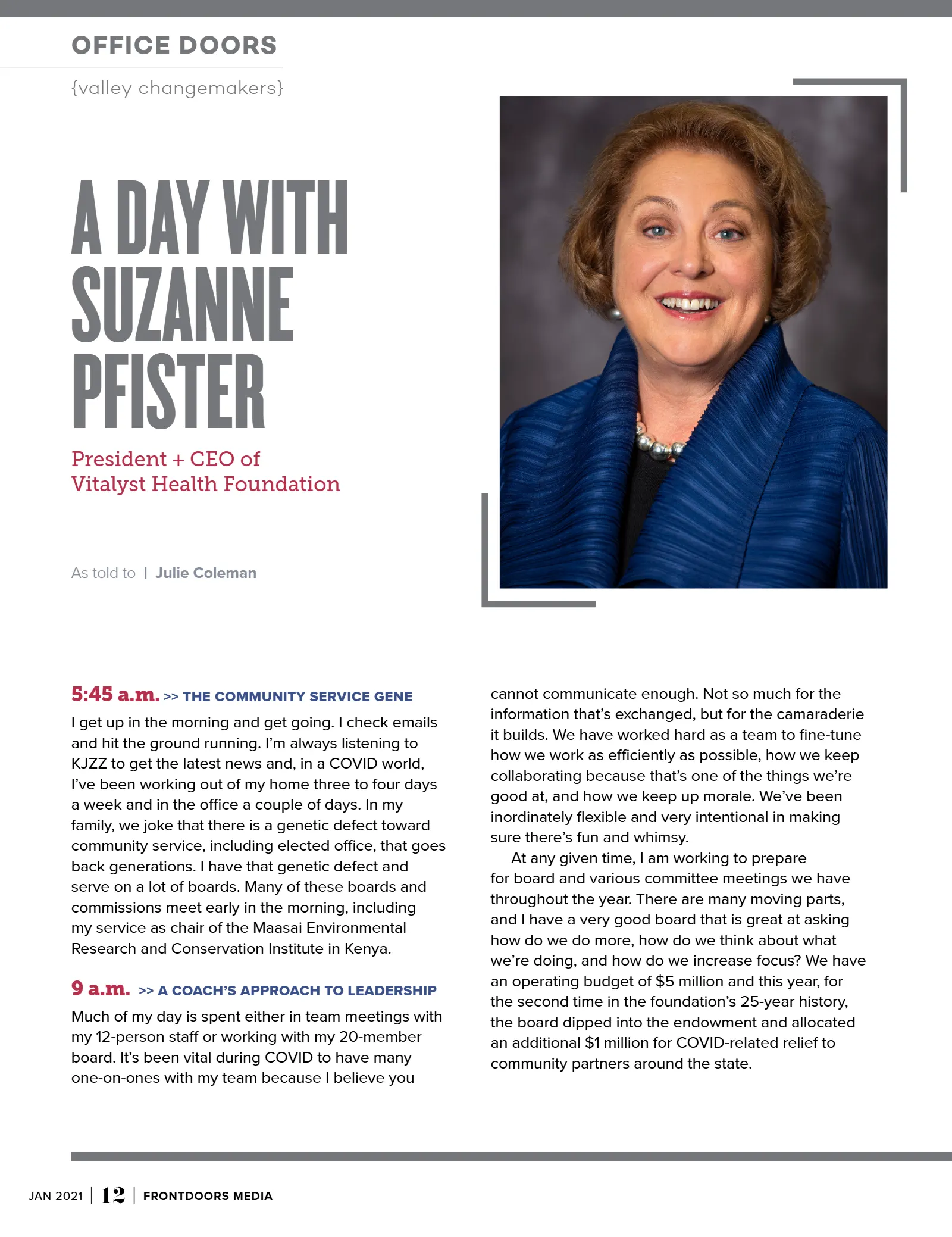
President + CEO of Vitalyst Health Foundation A DAY WITH SUZANNE PFISTER As told to | Julie Coleman 5:45 a.m. >> THE COMMUNITY SERVICE GENE I get up in the morning and get going. I check emails and hit the ground running. I’m always listening to KJZZ to get the latest news and, in a COVID world, I’ve been working out of my home three to four days a week and in the office a couple of days. In my family, we joke that there is a genetic defect toward community service, including elected office, that goes back generations. I have that genetic defect and serve on a lot of boards. Many of these boards and commissions meet early in the morning, including my service as chair of the Maasai Environmental Research and Conservation Institute in Kenya. 9 a.m. >> A COACH’S APPROACH TO LEADERSHIP Much of my day is spent either in team meetings with my 12-person staff or working with my 20-member board. It’s been vital during COVID to have many one-on-ones with my team because I believe you cannot communicate enough. Not so much for the information that’s exchanged, but for the camaraderie it builds. We have worked hard as a team to fine-tune how we work as efficiently as possible, how we keep collaborating because that’s one of the things we’re good at, and how we keep up morale. We’ve been inordinately flexible and very intentional in making sure there’s fun and whimsy. At any given time, I am working to prepare for board and various committee meetings we have throughout the year. There are many moving parts, and I have a very good board that is great at asking how do we do more, how do we think about what we’re doing, and how do we increase focus? We have an operating budget of $5 million and this year, for the second time in the foundation’s 25-year history, the board dipped into the endowment and allocated an additional $1 million for COVID-related relief to community partners around the state. JAN 2021 | 12 | FRONTDOORS MEDIA OFFICE DOORS {valley changemakers}
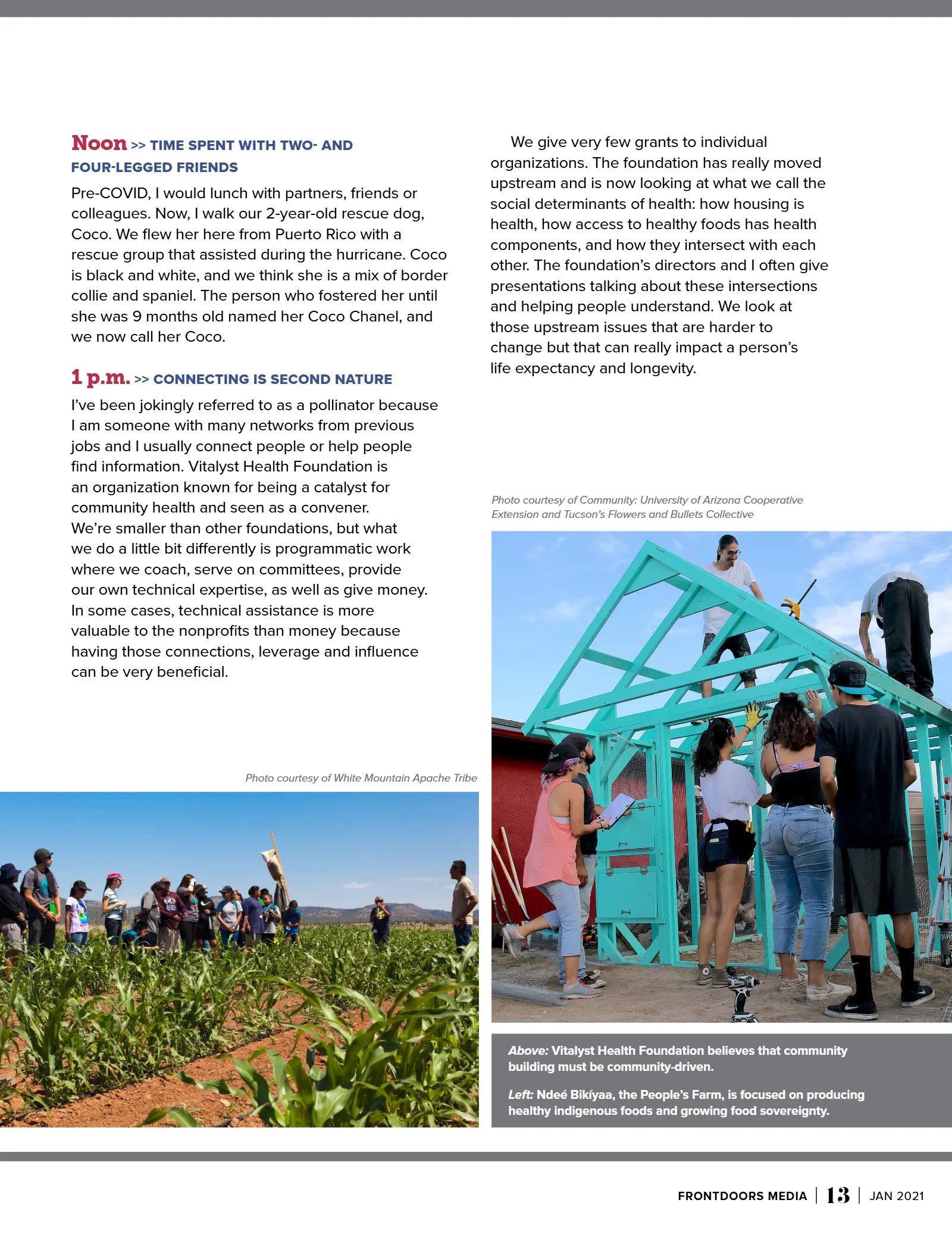
Noon >> TIME SPENT WITH TWO- AND FOUR-LEGGED FRIENDS Pre-COVID, I would lunch with partners, friends or colleagues. Now, I walk our 2-year-old rescue dog, Coco. We flew her here from Puerto Rico with a rescue group that assisted during the hurricane. Coco is black and white, and we think she is a mix of border collie and spaniel. The person who fostered her until she was 9 months old named her Coco Chanel, and we now call her Coco. 1 p.m. >> CONNECTING IS SECOND NATURE I’ve been jokingly referred to as a pollinator because I am someone with many networks from previous jobs and I usually connect people or help people find information. Vitalyst Health Foundation is an organization known for being a catalyst for community health and seen as a convener. We’re smaller than other foundations, but what we do a little bit differently is programmatic work where we coach, serve on committees, provide our own technical expertise, as well as give money. In some cases, technical assistance is more valuable to the nonprofits than money because having those connections, leverage and influence can be very beneficial. We give very few grants to individual organizations. The foundation has really moved upstream and is now looking at what we call the social determinants of health: how housing is health, how access to healthy foods has health components, and how they intersect with each other. The foundation’s directors and I often give presentations talking about these intersections and helping people understand. We look at those upstream issues that are harder to change but that can really impact a person’s life expectancy and longevity. Photo courtesy of White Mountain Apache Tribe Photo courtesy of Community : University of Arizona Cooperative Extension and Tucson’s Flowers and Bullets Collective Above: Vitalyst Health Foundation believes that community building must be community-driven. Left: Ndeé Bikíyaa, the P eople’s Farm, is focused on producing healthy indigenous foods and growing food sovereignty. FRONTDOORS MEDIA | 13 | JAN 2021