
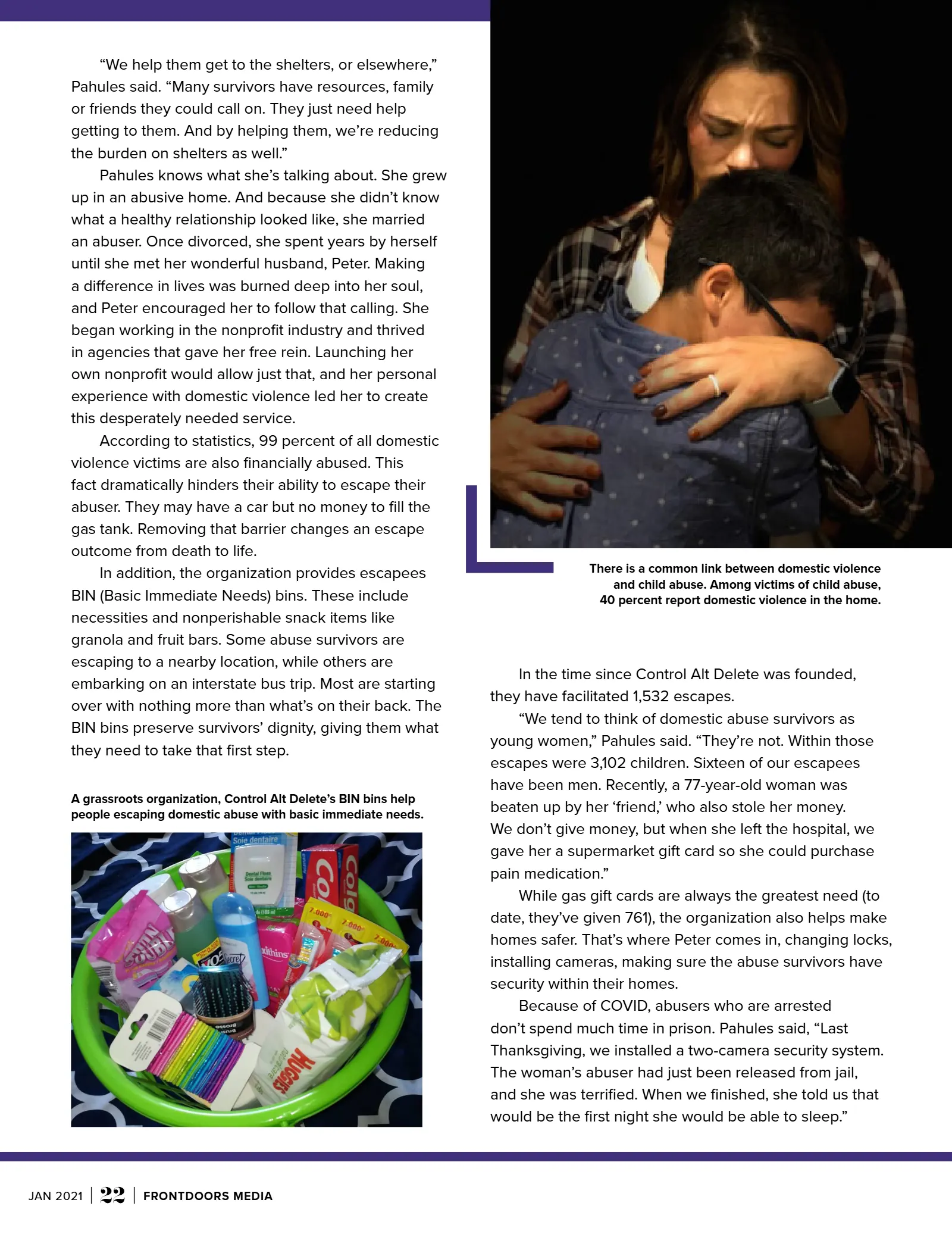
“We help them get to the shelters, or elsewhere,” Pahules said. “Many survivors have resources, family or friends they could call on. They just need help getting to them. And by helping them, we’re reducing the burden on shelters as well.” Pahules knows what she’s talking about. She grew up in an abusive home. And because she didn’t know what a healthy relationship looked like, she married an abuser. Once divorced, she spent years by herself until she met her wonderful husband, Peter. Making a difference in lives was burned deep into her soul, and Peter encouraged her to follow that calling. She began working in the nonprofit industry and thrived in agencies that gave her free rein. Launching her own nonprofit would allow just that, and her personal experience with domestic violence led her to create this desperately needed service. According to statistics, 99 percent of all domestic violence victims are also financially abused. This fact dramatically hinders their ability to escape their abuser. They may have a car but no money to fill the gas tank. Removing that barrier changes an escape outcome from death to life. In addition, the organization provides escapees BIN (Basic Immediate Needs) bins. These include necessities and nonperishable snack items like granola and fruit bars. Some abuse survivors are escaping to a nearby location, while others are embarking on an interstate bus trip. Most are starting over with nothing more than what’s on their back. The BIN bins preserve survivors’ dignity, giving them what they need to take that first step. In the time since Control Alt Delete was founded, they have facilitated 1,532 escapes. “We tend to think of domestic abuse survivors as young women,” Pahules said. “They’re not. Within those escapes were 3,102 children. Sixteen of our escapees have been men. Recently, a 77-year-old woman was beaten up by her ‘friend,’ who also stole her money. We don’t give money, but when she left the hospital, we gave her a supermarket gift card so she could purchase pain medication.” While gas gift cards are always the greatest need (to date, they’ve given 761), the organization also helps make homes safer. That’s where Peter comes in, changing locks, installing cameras, making sure the abuse survivors have security within their homes. Because of COVID, abusers who are arrested don’t spend much time in prison. Pahules said, “Last Thanksgiving, we installed a two-camera security system. The woman’s abuser had just been released from jail, and she was terrified. When we finished, she told us that would be the first night she would be able to sleep.” There is a common link between domestic violence and child abuse. Among victims of child abuse, 40 percent report domestic violence in the home. A grassroots organization, Control Alt Delete’s BIN bins help people escaping domestic abuse with basic immediate needs. JAN 2021 | 22 | FRONTDOORS MEDIA
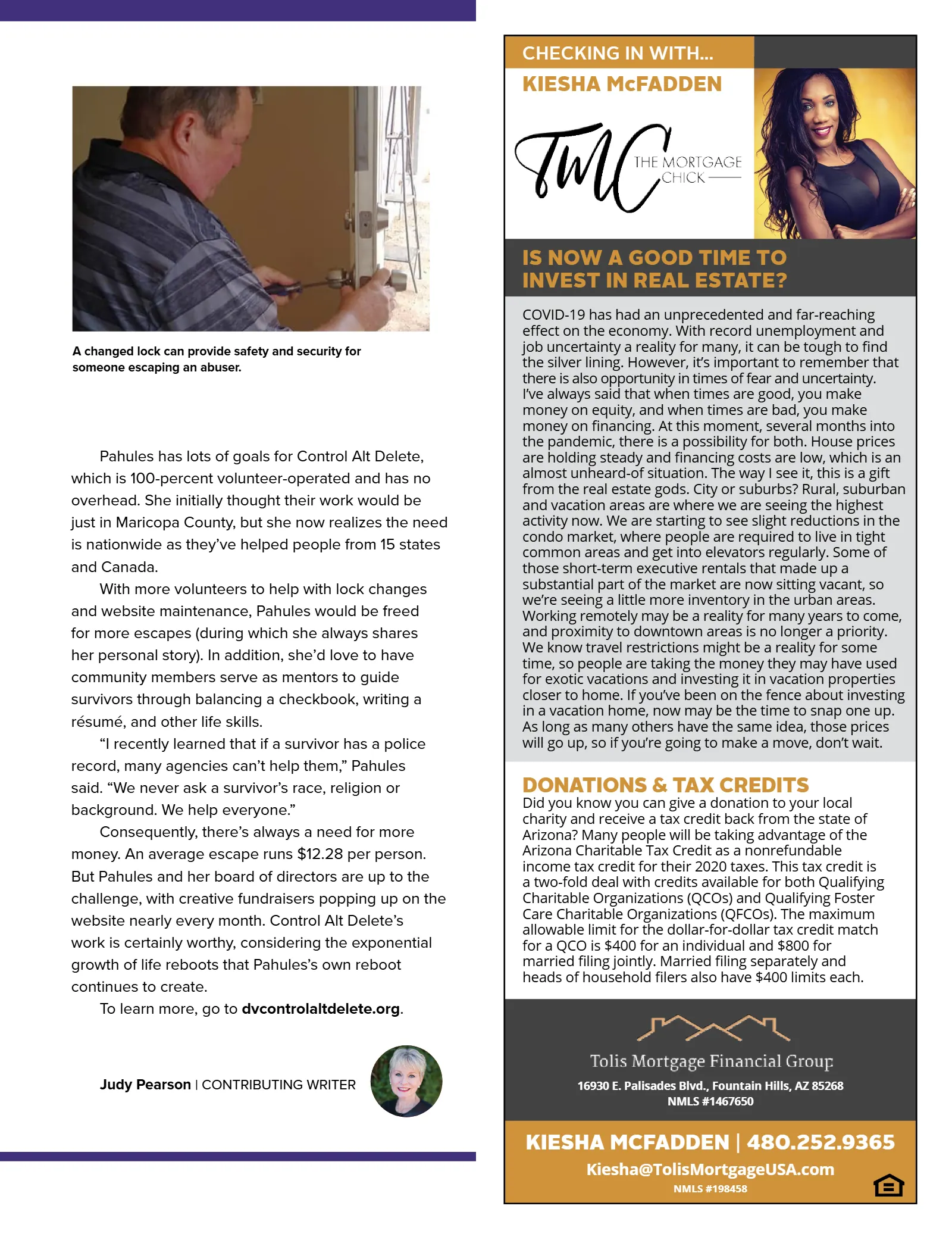
Pahules has lots of goals for Control Alt Delete, which is 100-percent volunteer-operated and has no overhead. She initially thought their work would be just in Maricopa County, but she now realizes the need is nationwide as they’ve helped people from 15 states and Canada. With more volunteers to help with lock changes and website maintenance, Pahules would be freed for more escapes (during which she always shares her personal story). In addition, she’d love to have community members serve as mentors to guide survivors through balancing a checkbook, writing a résumé, and other life skills. “I recently learned that if a survivor has a police record, many agencies can’t help them,” Pahules said. “We never ask a survivor’s race, religion or background. We help everyone.” Consequently, there’s always a need for more money. An average escape runs $12.28 per person. But Pahules and her board of directors are up to the challenge, with creative fundraisers popping up on the website nearly every month. Control Alt Delete’s work is certainly worthy, considering the exponential growth of life reboots that Pahules’s own reboot continues to create. To learn more, go to dvcontrolaltdelete.org . Judy Pearson | CONTRIBUTING WRITER COVID-19 has had an unprecedented and far-reaching effect on the economy. With record unemployment and job uncertainty a reality for many, it can be tough to find the silver lining. However, it’s important to remember that there is also opportunity in times of fear and uncertainty. I’ve always said that when times are good, you make money on equity, and when times are bad, you make money on financing. At this moment, several months into the pandemic, there is a possibility for both. House prices are holding steady and financing costs are low, which is an almost unheard-of situation. The way I see it, this is a gift from the real estate gods. City or suburbs? Rural, suburban and vacation areas are where we are seeing the highest activity now. We are starting to see slight reductions in the condo market, where people are required to live in tight common areas and get into elevators regularly. Some of those short-term executive rentals that made up a substantial part of the market are now sitting vacant, so we’re seeing a little more inventory in the urban areas. Working remotely may be a reality for many years to come, and proximity to downtown areas is no longer a priority. We know travel restrictions might be a reality for some time, so people are taking the money they may have used for exotic vacations and investing it in vacation properties closer to home. If you’ve been on the fence about investing in a vacation home, now may be the time to snap one up. As long as many others have the same idea, those prices will go up, so if you’re going to make a move, don’t wait. KIESHA McFADDEN CHECKING IN WITH... IS NOW A GOOD TIME TO INVEST IN REAL ESTATE? DONATIONS & TAX CREDITS Did you know you can give a donation to your local charity and receive a tax credit back from the state of Arizona? Many people will be taking advantage of the Arizona Charitable Tax Credit as a nonrefundable income tax credit for their 2020 taxes. This tax credit is a two-fold deal with credits available for both Qualifying Charitable Organizations (QCOs) and Qualifying Foster Care Charitable Organizations (QFCOs). The maximum allowable limit for the dollar-for-dollar tax credit match for a QCO is $400 for an individual and $800 for married filing jointly. Married filing separately and heads of household filers also have $400 limits each. 16930 E. Palisades Blvd., Fountain Hills, AZ 85268 NMLS #1467650 KIESHA MCFADDEN | 480.252.9365 Kiesha@TolisMortgageUSA.com NMLS #198458 A changed lock can provide safety and security for someone escaping an abuser.