
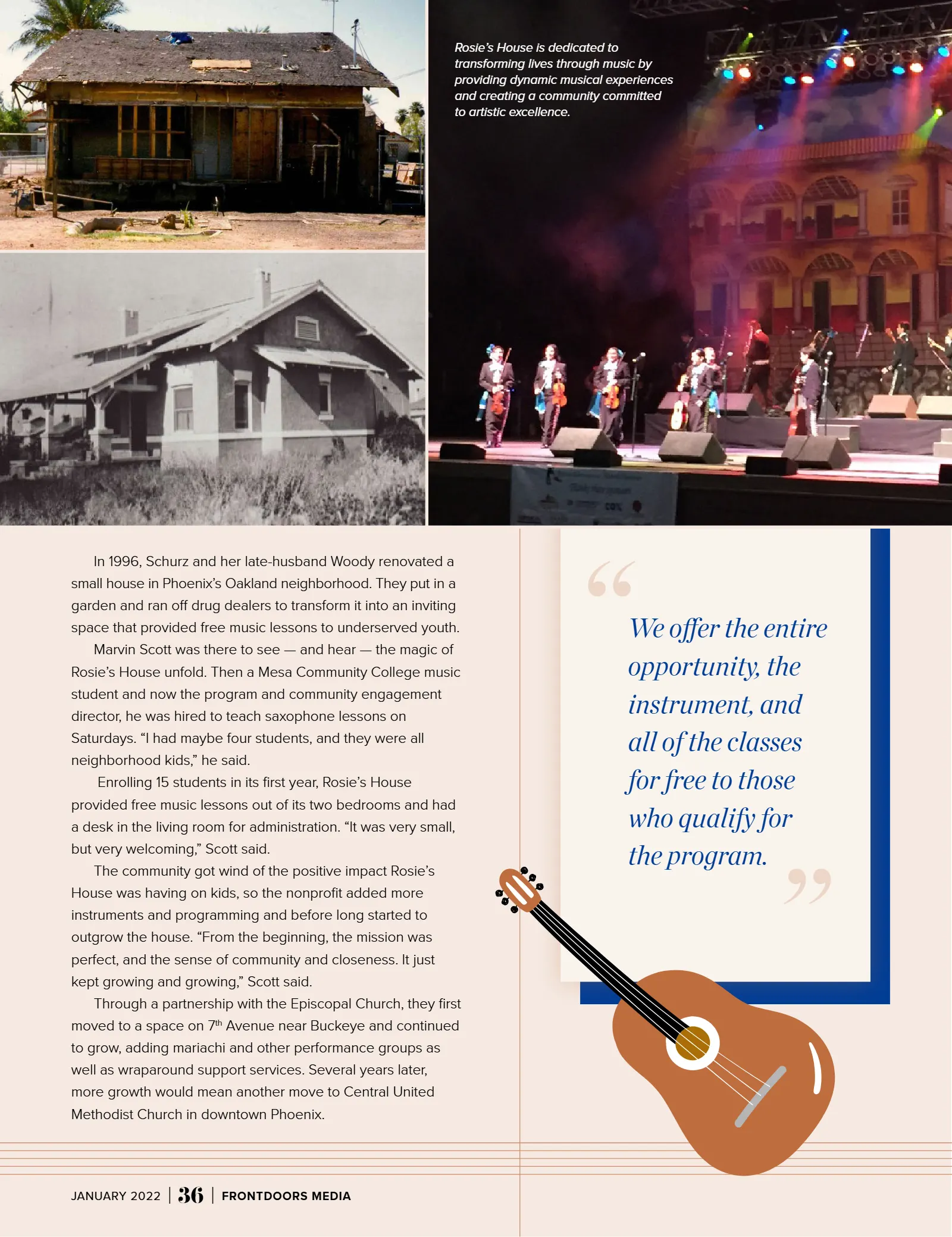
We offer the entire opportunity, the instrument, and all of the classes for free to those who qualify for the program. “ ” Rosie’s House is dedicated to transforming lives through music by providing dynamic musical experiences and creating a community committed to artistic excellence. JANUARY 2022 | 36 | FRONTDOORS MEDIA In 1996, Schurz and her late-husband Woody renovated a small house in Phoenix’s Oakland neighborhood. They put in a garden and ran off drug dealers to transform it into an inviting space that provided free music lessons to underserved youth. Marvin Scott was there to see — and hear — the magic of Rosie’s House unfold. Then a Mesa Community College music student and now the program and community engagement director, he was hired to teach saxophone lessons on Saturdays. “I had maybe four students, and they were all neighborhood kids,” he said. Enrolling 15 students in its first year, Rosie’s House provided free music lessons out of its two bedrooms and had a desk in the living room for administration. “It was very small, but very welcoming,” Scott said. The community got wind of the positive impact Rosie’s House was having on kids, so the nonprofit added more instruments and programming and before long started to outgrow the house. “From the beginning, the mission was perfect, and the sense of community and closeness. It just kept growing and growing,” Scott said. Through a partnership with the Episcopal Church, they first moved to a space on 7 th Avenue near Buckeye and continued to grow, adding mariachi and other performance groups as well as wraparound support services. Several years later, more growth would mean another move to Central United Methodist Church in downtown Phoenix.
FRONTDOORS MEDIA | 37 | JANUARY 2022 In 2008, Becky Bell Ballard was hired to lead the organization. A talented French horn player from the Midwest, Ballard came to Arizona for ASU’s renowned brass program and stayed to manage The Phoenix Symphony’s education and outreach programs. Through that work, she saw the disparity in arts education in Maricopa County. “I realized how meaningful it was to be on the ground and very much part of both system change and change for the kids,” she said. “When I had those opportunities, I knew this is the work I wanted to be doing.” Ask anyone involved with Rosie’s House and they will tell you: This place changes lives. “We offer the entire opportunity, the instrument, and all of the classes for free to those who qualify for the program,” Scott said. Kids literally grow up in Rosie’s House. “We are there every step of their journey as young people,” Ballard said. The average retention at Rosie’s House is a little over five years, and there are many alumni who started when they were 6 and graduated at 18. “So if you think about your own childhood, anything you did for that length of time is a significant part of your development as a young person,” Ballard said. Aldie Lopez, the assistant principal of Pastor Elementary School in Phoenix, saw this firsthand. Then the band teacher at Pastor, he pricked up his ears when he heard about this music program developed to target and support the students who need it most. Lopez saw two of his students — twin sisters who came to Pastor when they were in fifth grade — grow with their involvement at Rosie’s House. One sister played flute, the other played saxophone, and Lopez watched their trajectories change. “They were good musicians, but I really saw them take off when they joined Rosie’s House. To see them getting that quality instruction from music educators and musicians, and watching them make strides and grow and achieve, was incredible,” he said. Lopez now teaches clarinet at Rosie’s House while working as an administrator at Pastor. “It’s my outlet,” he said. “I don’t have to do it. I truly want to do it. One, because of the kids and, two, because Rosie’s House is so cool!” So why is music education the catalyst for changing children’s lives? “Because it’s hard,” Ballard laughed, before citing some of the reasons music education is so valuable to personal development. “You have to work through challenges. You have to have the dedication and discipline to set up a practice regimen. And the goals that you’re setting are small and gradual and take years to have something big come together.” Plus, music helps cognition and the brain. Scores of studies show that music training helps the brain learn to learn. And then there is the community that music creates. “That’s key to kids — having a place outside of school where there’s different relationships that can validate you and your identity,” Ballard said.