
12 FRONTDOORS MEDIA | JULY 2018 Foundation; and Frank Brady, a former audit partner with Ernst & Young, founded Arizona College Scholarship Foundation in 2005. “One thing they learned very early on was just because you handed a student a check, you were not really guaranteeing success at the higher-education level,” said Nickel, who came to the organization in 2012, shortly before it was rebranded as College Success Arizona. This year’s 132 scholarship recipients come from across the state, from communities such as Casa Grande, Holbrook, Winslow, Bullhead City, Avondale, Tucson, Gilbert, Cottonwood, Prescott, San Luis, Mohave Valley, Scottsdale, Kingman, Douglas and Phoenix. Most of them are the first in their families to attend college. And if the statistics hold, about 70 percent of them will graduate within six years — nearly double the rate of their peers who don’t have access to College Success Arizona’s services. Nickel attributes the large discrepancy to the organization’s focus on the daily habits of success. “Sometimes they haven’t had the kitchen table discussions around what it means to be successful,” he said. “What may be considered a nuisance to some families is a tremendous issue to other families. We literally have students who are a flat tire away from dropping out of school, only because of that, not because they’re not capable of doing the work.” Nickel points to tragic stories where students get into school, attend a few semesters, accumulate debt, drop out, and are worse off than if they never went. So College Success Arizona focuses on college success in addition to access . The organization does this through its success advisers, who connect students with the resources they need. They’re all professional advisers, most are bilingual, and they focus on building a mutually accountable relationship. They meet with the students on their campuses several times a semester and are otherwise available to them via electronic communication. Their focus is on helping students solve problems or overcome barriers that would otherwise keep them from continuing in school. One such student is 27-year-old Dawt Khun, who hails from Burma. After her father died in an accident, Khun was forced into child labor by the Burmese government. She arrived in the U.S. as a refugee in 2008, without her family, and was placed in foster care. At 17, she started her freshman year at Trevor G. Browne High School in Phoenix, knowing no English, only Chin, her native language. Despite this, she graduated four years later with a 3.9 grade point average and 20 units of community college credit. “I found out about College Success Arizona while I was in high school,” she said. “I wanted to go to college, so I worked hard to get help.” As a College Success Arizona scholar, Khun received $6,000 a year for all four years of college — money she used to help pay her tuition at Grand Canyon University. Khun graduated in 2016 and is making plans to attend graduate school, with the goal of becoming a pharmacist. She is grateful for the help she received from College Success Arizona and knows that it has been been ❝ ❝ We literally have students who are a flat tire away from dropping out of school. — Rich Nickel COVER STORY CONTINUED
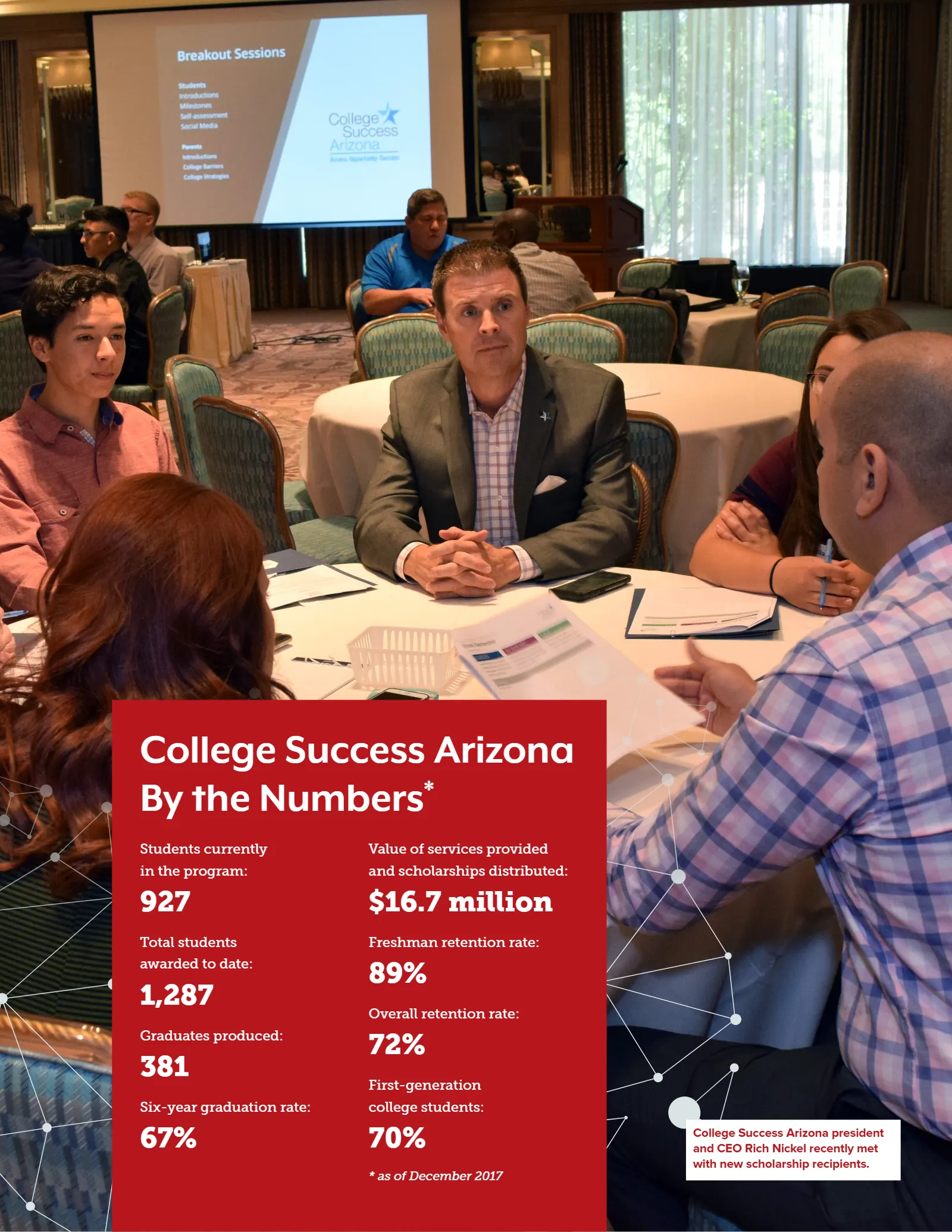
JULY 2018 | FRONTDOORS MEDIA 13 College Success Arizona By the Numbers * Students currently in the program: 927 Total students awarded to date: 1,287 Graduates produced: 381 Six-year graduation rate: 67% Value of services provided and scholarships distributed: $16.7 million Freshman retention rate: 89% Overall retention rate: 72% First-generation college students: 70% * as of December 2017 College Success Arizona president and CEO Rich Nickel recently met with new scholarship recipients.