
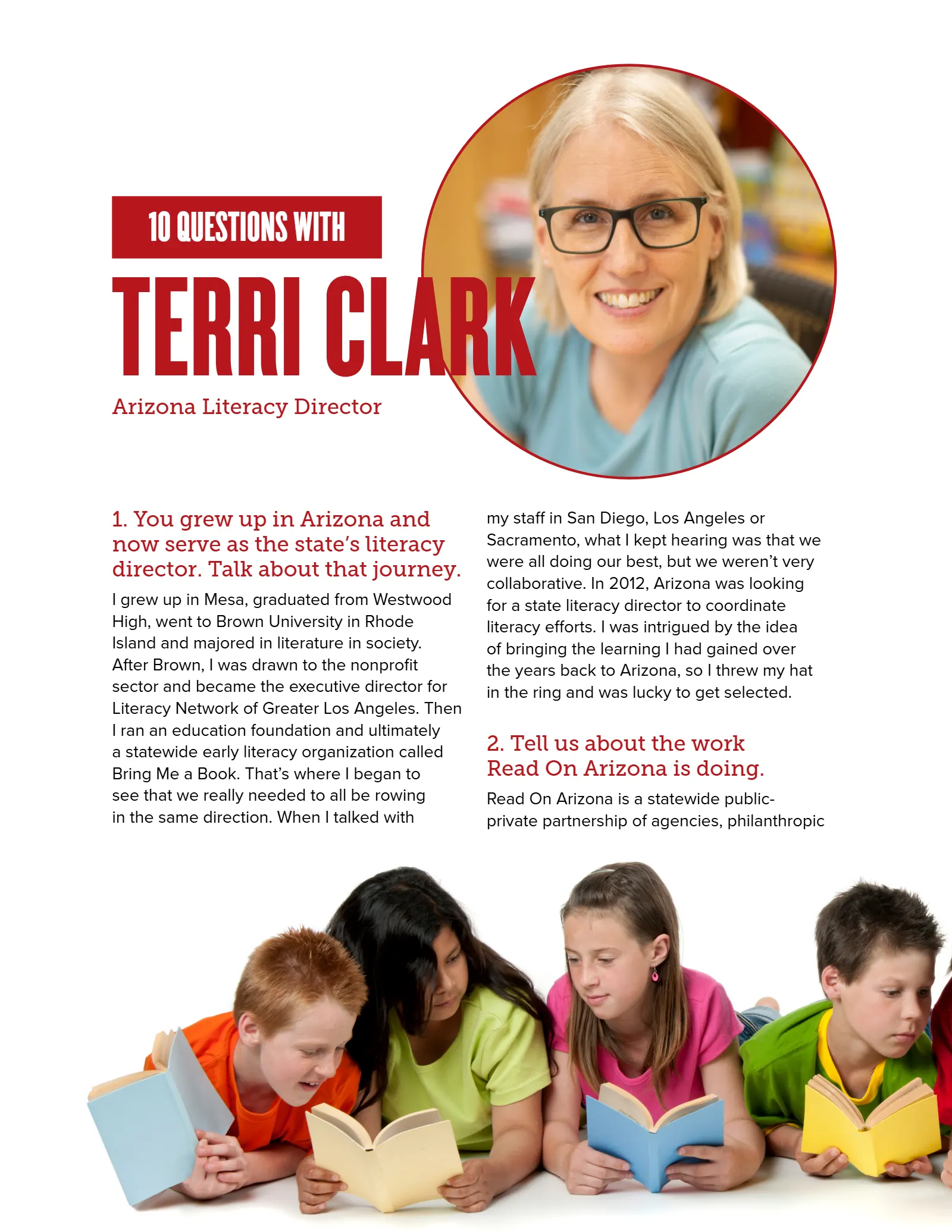
22 FRONTDOORS MEDIA | JULY 2018 1. You grew up in Arizona and now serve as the state’s literacy director. Talk about that journey. I grew up in Mesa, graduated from Westwood High, went to Brown University in Rhode Island and majored in literature in society. After Brown, I was drawn to the nonprofit sector and became the executive director for Literacy Network of Greater Los Angeles. Then I ran an education foundation and ultimately a statewide early literacy organization called Bring Me a Book. That’s where I began to see that we really needed to all be rowing in the same direction. When I talked with my staff in San Diego, Los Angeles or Sacramento, what I kept hearing was that we were all doing our best, but we weren’t very collaborative. In 2012, Arizona was looking for a state literacy director to coordinate literacy efforts. I was intrigued by the idea of bringing the learning I had gained over the years back to Arizona, so I threw my hat in the ring and was lucky to get selected. 2. Tell us about the work Read On Arizona is doing. Read On Arizona is a statewide public- private partnership of agencies, philanthropic 10 QUESTIONS WITH Arizona Literacy Director
JULY 2018 | FRONTDOORS MEDIA 23 organizations and community stakeholders that are all committed to improving early literacy outcomes for children from birth through the end of third grade. Through using data to determine gaps and identify solutions to help fill those gaps and implement an approach in a collaborative way, we are reducing duplication and doing what we know works. 3. Why is third-grade reading so important? Research has shown that third grade is an excellent checkpoint on the path to becoming not only a successful reader, but successful in school and in life. Early literacy is more than just reading. It’s communication, it’s speaking and listening, and especially critical thinking. If you think about all those essential skills for anyone as they go through school, college or whatever job they want to pursue, early language and literacy skills are part of the foundation for that learning. If students are on track at third grade, they’re mostly on track to graduate high school and be ready for whatever career they want to pursue. 4. Where does Arizona currently stand in regard to grade-level reading? I like to be an optimist. Over the last 10 years, when we look at what the country uses as a metric, which is the National Assessment for Educational Progress, Arizona is below the national standard. But over the last 10 years it is the third most-improved state in reading for fourth graders out of all states. I like to make sure we understand that context — that over the last 10 years we may have started further behind, but we’ve made a lot of progress. But when we look at where we’re at and where we need to be, we still have a lot of work to do. Arizona uses a state English language arts assessment called AzMERIT. When we measure our progress as a state, only 44 percent of third-grade students are passing that AzMERIT assessment for English language arts. The bigger issue — and why I say we have so much more work to do — is that an equal number of kids, 44 percent, are minimally proficient, meaning our lowest category of four categories. It breaks down that 44 percent are minimally proficient, 12 percent are partially proficient, and then the 44 percent that are passing are 31 percent proficient and 13 percent highly proficient. So we have to do much better for our most struggling readers. 5. Is the needle moving in the right direction? I’d say yes. It’s amazing we’ve made the reading progress we’ve made as a state during very economically challenging years. What we have to understand is that it takes eight