
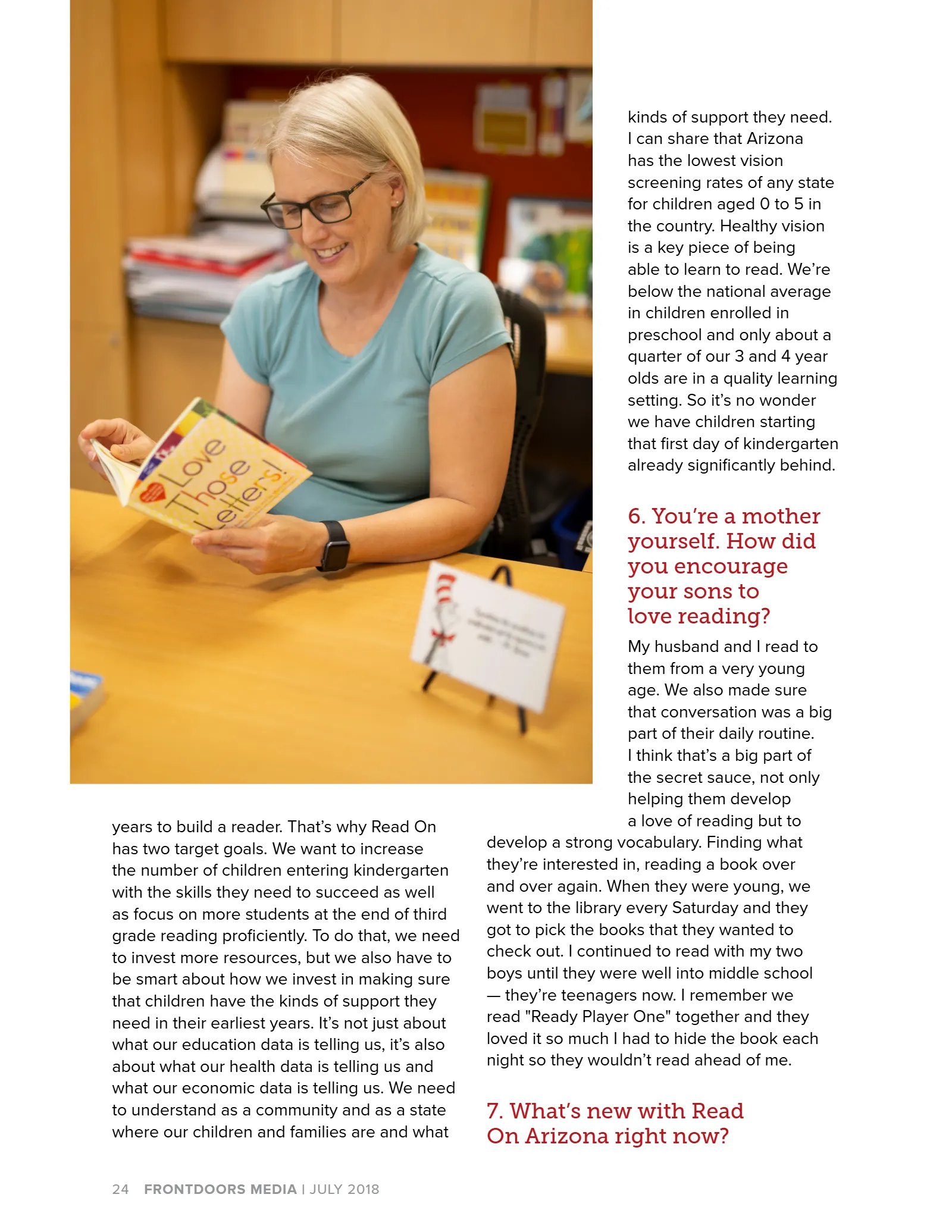
24 FRONTDOORS MEDIA | JULY 2018 years to build a reader. That’s why Read On has two target goals. We want to increase the number of children entering kindergarten with the skills they need to succeed as well as focus on more students at the end of third grade reading proficiently. To do that, we need to invest more resources, but we also have to be smart about how we invest in making sure that children have the kinds of support they need in their earliest years. It’s not just about what our education data is telling us, it’s also about what our health data is telling us and what our economic data is telling us. We need to understand as a community and as a state where our children and families are and what kinds of support they need. I can share that Arizona has the lowest vision screening rates of any state for children aged 0 to 5 in the country. Healthy vision is a key piece of being able to learn to read. We’re below the national average in children enrolled in preschool and only about a quarter of our 3 and 4 year olds are in a quality learning setting. So it’s no wonder we have children starting that first day of kindergarten already significantly behind. 6. You’re a mother yourself. How did you encourage your sons to love reading? My husband and I read to them from a very young age. We also made sure that conversation was a big part of their daily routine. I think that’s a big part of the secret sauce, not only helping them develop a love of reading but to develop a strong vocabulary. Finding what they’re interested in, reading a book over and over again. When they were young, we went to the library every Saturday and they got to pick the books that they wanted to check out. I continued to read with my two boys until they were well into middle school — they’re teenagers now. I remember we read "Ready Player One" together and they loved it so much I had to hide the book each night so they wouldn’t read ahead of me. 7. What’s new with Read On Arizona right now?
JULY 2018 | FRONTDOORS MEDIA 25 We’ve just updated our strategic plan and have five strategic focus areas. One of the key shifts is we’re going to be exploring the success that we’ve seen in some of our Read On communities and partners’ work. We just got funding to launch what we’re calling our acceleration zone project. The idea behind it is that those that have seen progress around school readiness or third- grade reading will unpack what they feel has caused their success, especially those that have been able to either minimize or almost eliminate the gap between how economically disadvantaged students are reading versus all students. We want to understand how they’re being successful and then ask what it would take to accelerate that work. 8. Any other highlights? One of the other things we’re excited about is our Smart Talk awareness campaign for language and literacy. We launched it because the data was showing us that we had to focus more on making sure families understood what they can do for their children in those very early 0 to 3 years. There’s a lot of research that shows that a child’s vocabulary by the time they are 3 is one of the best predictors of how successful a reader they’ll be. So we developed this campaign to raise awareness among parents and caregivers about talking and reading with young child starting from day one, and that it makes a big difference in how that child’s brain develops. We also wanted to stress that there are everyday opportunities to incorporate it. So we have five easy ways to incorporate Smart Talk: ASK questions, DESCRIBE and RESPOND to your child when they’re showing an interest, REPEAT what they’re saying and READ with them every day. We break it down and show examples of how they can try it. 9. If people want to support Read On Arizona, how they can help? The best way for community members to support Read On Arizona is to actively get involved in your local Read On community work, whether that’s donating or serving as a volunteer. You can make donations to Read On Arizona through our collaborative fund at the Arizona Community Foundation. That funding goes to support Read On work throughout the state. 10. Any final literacy tips for parents or caregivers? Make it fun at home! The decoding and comprehension will come at school. Find books they’re interested in — it doesn’t have to be chapter books. Graphic novels, comic books, Sports Illustrated for Kids , whatever it might be. Let them pick a book they’ll like and read with them and to them as much as you can, especially when they’re little. To learn more, visit readonarizona.org .