
36 FRONTDOORS MEDIA | JULY 2018 THE STORY When Casa was founded in 1973 by social work majors at ASU, it was known as the Center Against Sexual Assault. It reflected the women’s movement at the time and proved to be a much-needed support service for victims of sexual assault and domestic abuse. Support included a sophisticated crisis hotline and victim service in Valley emergency rooms. A few years later, the organization began offering abuse victim counseling and then sexual abuse prevention programs aimed at educating children. It also added dating violence prevention education for teens in 1985. In 1988, current CEO and president Stephanie Orr joined Casa as its director and much has changed since her arrival. “I came naively because I wanted to be the director of a licensed mental health center as I had my master’s in counseling,” Orr said. Thinking she was going to be working with women, she discovered that Casa was primarily assisting children. “I made it my goal that we were going to become the largest provider of prevention education in the country,” she said. In the mid-1990s, Casa added an anti-bullying program. Shortly after, it rolled out classes teaching social and emotional learning (SEL). The SEL programs have now become the cornerstone of a series of educational endeavors that have proven successful at local schools. Teaching effective methods of emotional and social competencies became Casa’s focus and in 2012, the nonprofit made a pivot with a name change that more accurately reflected its mission — Casa Center for Positive Social Change. Lynette Carrington | Contributing Writer The Casa Center Brings Social-Emotional Learning to the Classroom GIVING BACK {charity spotlight}
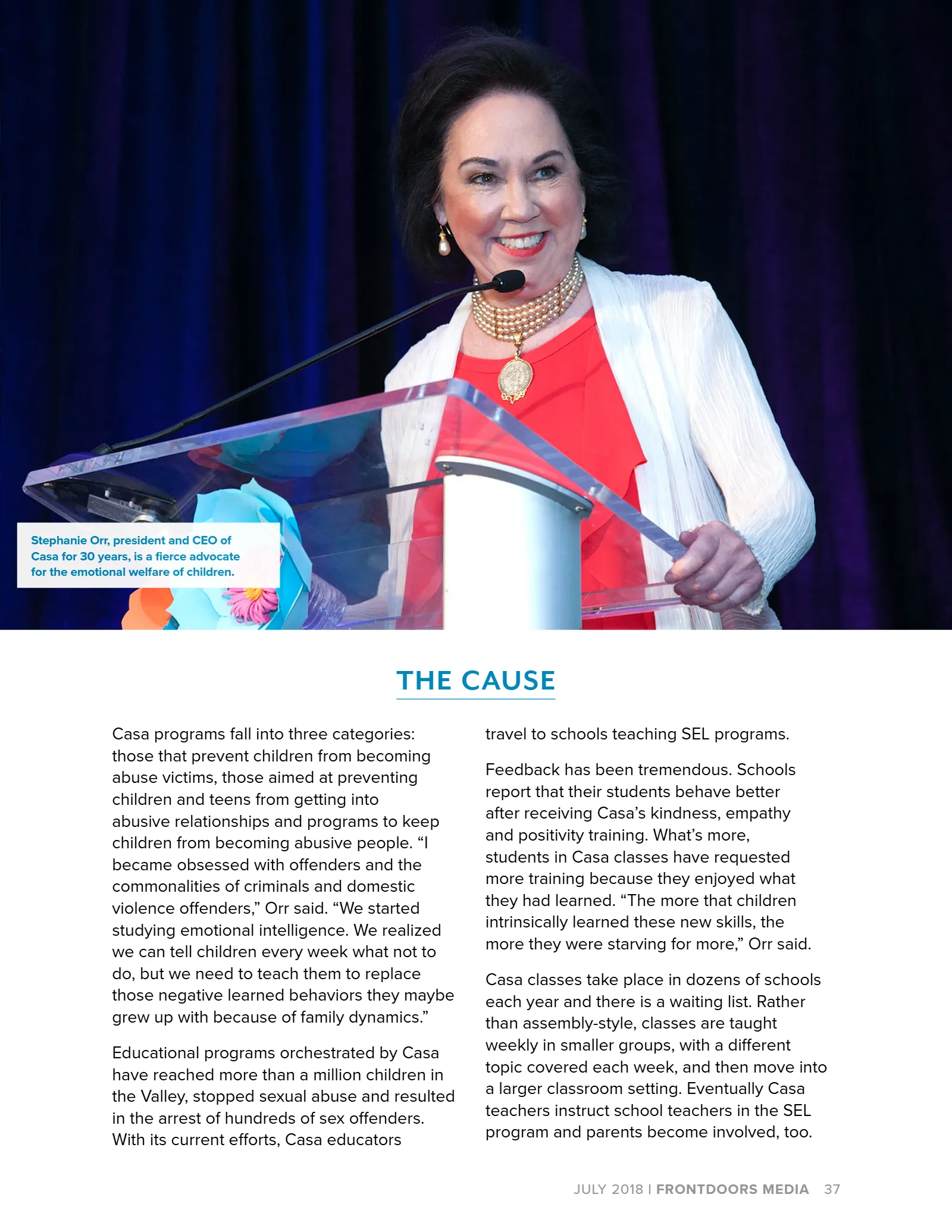
JULY 2018 | FRONTDOORS MEDIA 37 THE CAUSE Casa programs fall into three categories: those that prevent children from becoming abuse victims, those aimed at preventing children and teens from getting into abusive relationships and programs to keep children from becoming abusive people. “I became obsessed with offenders and the commonalities of criminals and domestic violence offenders,” Orr said. “We started studying emotional intelligence. We realized we can tell children every week what not to do, but we need to teach them to replace those negative learned behaviors they maybe grew up with because of family dynamics.” Educational programs orchestrated by Casa have reached more than a million children in the Valley, stopped sexual abuse and resulted in the arrest of hundreds of sex offenders. With its current efforts, Casa educators travel to schools teaching SEL programs. Feedback has been tremendous. Schools report that their students behave better after receiving Casa’s kindness, empathy and positivity training. What’s more, students in Casa classes have requested more training because they enjoyed what they had learned. “The more that children intrinsically learned these new skills, the more they were starving for more,” Orr said. Casa classes take place in dozens of schools each year and there is a waiting list. Rather than assembly-style, classes are taught weekly in smaller groups, with a different topic covered each week, and then move into a larger classroom setting. Eventually Casa teachers instruct school teachers in the SEL program and parents become involved, too. Stephanie Orr, president and CEO of Casa for 30 years, is a fierce advocate for the emotional welfare of children.