
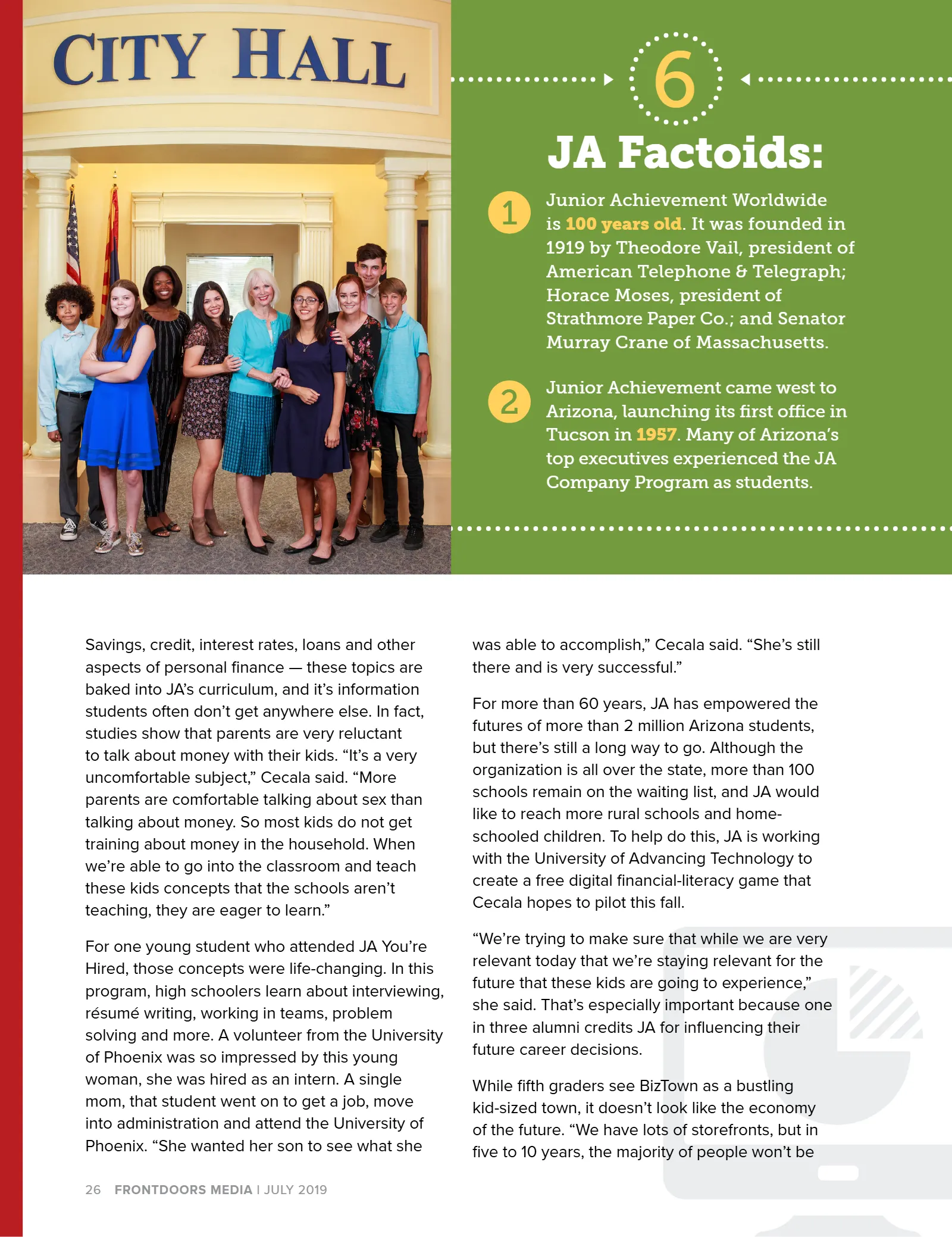
Savings, credit, interest rates, loans and other aspects of personal finance — these topics are baked into JA’s curriculum, and it’s information students often don’t get anywhere else. In fact, studies show that parents are very reluctant to talk about money with their kids. “It’s a very uncomfortable subject,” Cecala said. “More parents are comfortable talking about sex than talking about money. So most kids do not get training about money in the household. When we’re able to go into the classroom and teach these kids concepts that the schools aren’t teaching, they are eager to learn.” For one young student who attended JA You’re Hired, those concepts were life-changing. In this program, high schoolers learn about interviewing, résumé writing, working in teams, problem solving and more. A volunteer from the University of Phoenix was so impressed by this young woman, she was hired as an intern. A single mom, that student went on to get a job, move into administration and attend the University of Phoenix. “She wanted her son to see what she Junior Achievement Worldwide is 100 years old . It was founded in 1919 by Theodore Vail, president of American Telephone & Telegraph; Horace Moses, president of Strathmore Paper Co.; and Senator Murray Crane of Massachusetts. Junior Achievement came west to Arizona, launching its first office in Tucson in 1957 . Many of Arizona’s top executives experienced the JA Company Program as students. JA Factoids: 6 1 2 was able to accomplish,” Cecala said. “She’s still there and is very successful.” For more than 60 years, JA has empowered the futures of more than 2 million Arizona students, but there’s still a long way to go. Although the organization is all over the state, more than 100 schools remain on the waiting list, and JA would like to reach more rural schools and home- schooled children. To help do this, JA is working with the University of Advancing Technology to create a free digital financial-literacy game that Cecala hopes to pilot this fall. “We’re trying to make sure that while we are very relevant today that we’re staying relevant for the future that these kids are going to experience,” she said. That’s especially important because one in three alumni credits JA for influencing their future career decisions. While fifth graders see BizTown as a bustling kid-sized town, it doesn’t look like the economy of the future. “We have lots of storefronts, but in five to 10 years, the majority of people won’t be 26 FRONTDOORS MEDIA | JULY 2019
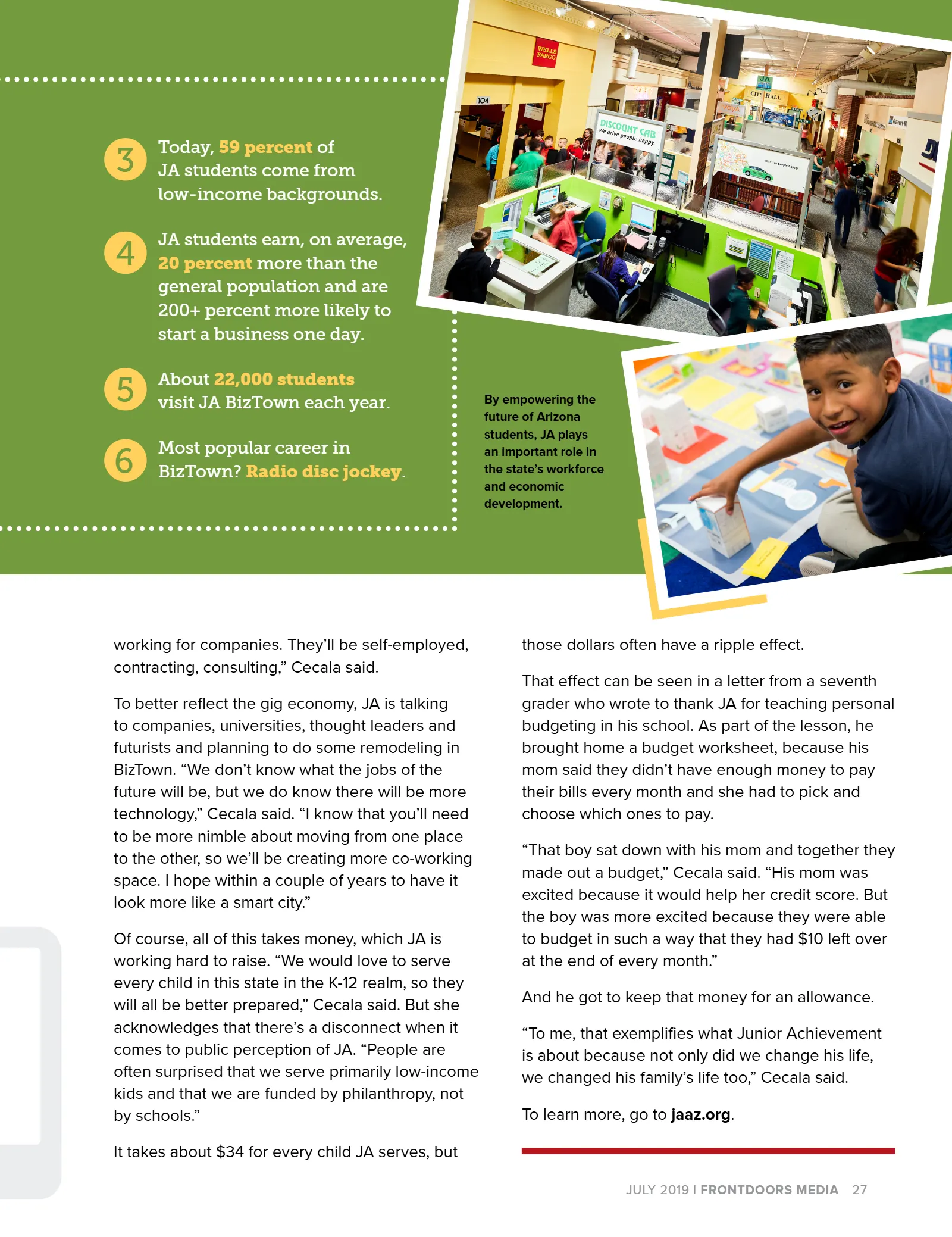
those dollars often have a ripple effect. That effect can be seen in a letter from a seventh grader who wrote to thank JA for teaching personal budgeting in his school. As part of the lesson, he brought home a budget worksheet, because his mom said they didn’t have enough money to pay their bills every month and she had to pick and choose which ones to pay. “That boy sat down with his mom and together they made out a budget,” Cecala said. “His mom was excited because it would help her credit score. But the boy was more excited because they were able to budget in such a way that they had $10 left over at the end of every month.” And he got to keep that money for an allowance. “To me, that exemplifies what Junior Achievement is about because not only did we change his life, we changed his family’s life too,” Cecala said. To learn more, go to jaaz.org . Today, 59 percent of JA students come from low-income backgrounds. JA students earn, on average, 20 percent more than the general population and are 200+ percent more likely to start a business one day. About 22,000 students visit JA BizTown each year. Most popular career in BizTown? Radio disc jockey . 3 4 5 6 working for companies. They’ll be self-employed, contracting, consulting,” Cecala said. To better reflect the gig economy, JA is talking to companies, universities, thought leaders and futurists and planning to do some remodeling in BizTown. “We don’t know what the jobs of the future will be, but we do know there will be more technology,” Cecala said. “I know that you’ll need to be more nimble about moving from one place to the other, so we’ll be creating more co-working space. I hope within a couple of years to have it look more like a smart city.” Of course, all of this takes money, which JA is working hard to raise. “We would love to serve every child in this state in the K-12 realm, so they will all be better prepared,” Cecala said. But she acknowledges that there’s a disconnect when it comes to public perception of JA. “People are often surprised that we serve primarily low-income kids and that we are funded by philanthropy, not by schools.” It takes about $34 for every child JA serves, but By empowering the future of Arizona students, JA plays an important role in the state’s workforce and economic development. JULY 2019 | FRONTDOORS MEDIA 27