
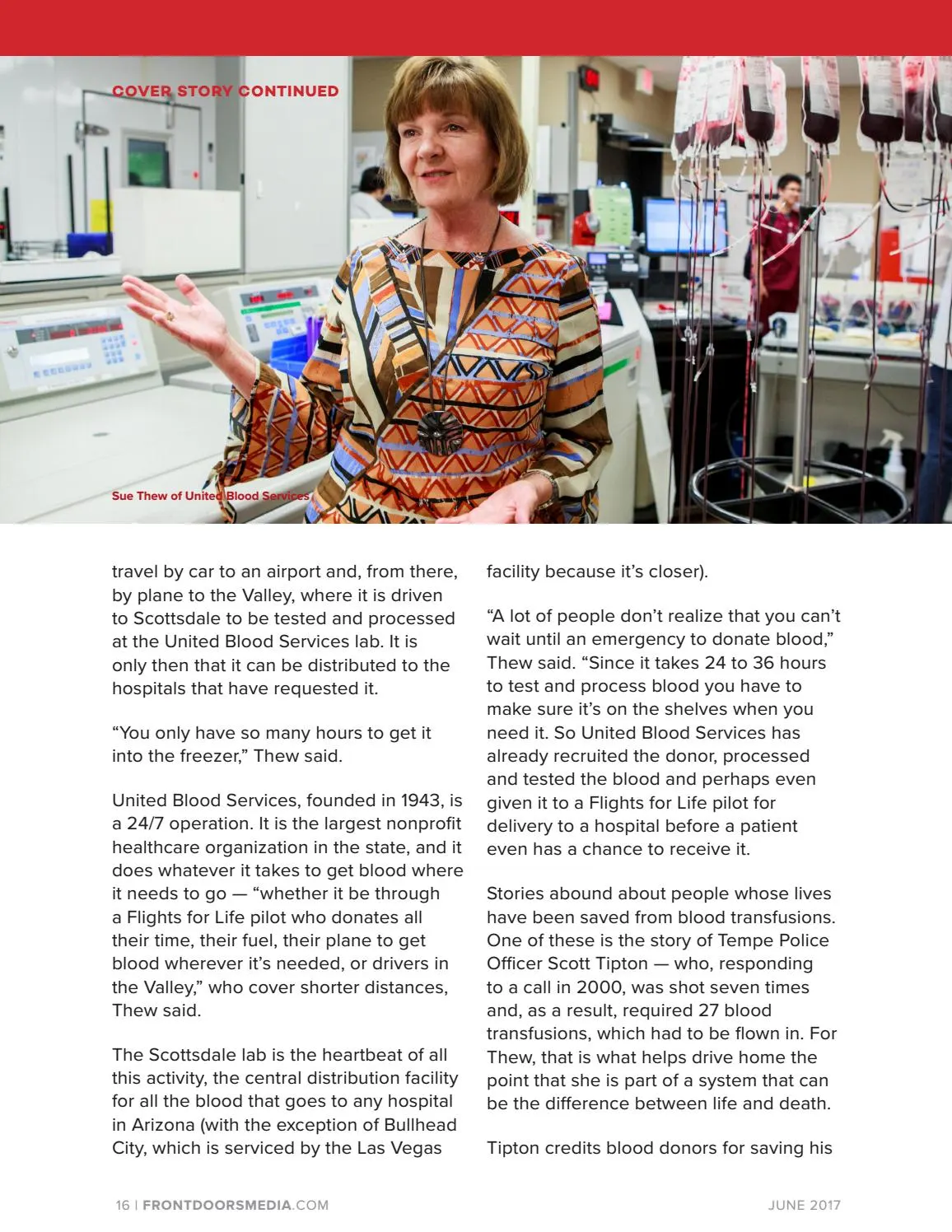
JUNE 2017 16 | FRONTDOORSMEDIA .COM travel by car to an airport and, from there, by plane to the Valley, where it is driven to Scottsdale to be tested and processed at the United Blood Services lab. It is only then that it can be distributed to the hospitals that have requested it. “You only have so many hours to get it into the freezer,” Thew said. United Blood Services, founded in 1943, is a 24/7 operation. It is the largest nonprofit healthcare organization in the state, and it does whatever it takes to get blood where it needs to go — “whether it be through a Flights for Life pilot who donates all their time, their fuel, their plane to get blood wherever it’s needed, or drivers in the Valley,” who cover shorter distances, Thew said. The Scottsdale lab is the heartbeat of all this activity, the central distribution facility for all the blood that goes to any hospital in Arizona (with the exception of Bullhead City, which is serviced by the Las Vegas facility because it’s closer). “A lot of people don’t realize that you can’t wait until an emergency to donate blood,” Thew said. “Since it takes 24 to 36 hours to test and process blood you have to make sure it’s on the shelves when you need it. So United Blood Services has already recruited the donor, processed and tested the blood and perhaps even given it to a Flights for Life pilot for delivery to a hospital before a patient even has a chance to receive it. Stories abound about people whose lives have been saved from blood transfusions. One of these is the story of Tempe Police Officer Scott Tipton — who, responding to a call in 2000, was shot seven times and, as a result, required 27 blood transfusions, which had to be flown in. For Thew, that is what helps drive home the point that she is part of a system that can be the difference between life and death. Tipton credits blood donors for saving his COVER STORY CONTINUED Sue Thew of United Blood Services
JUNE 2017 FRONTDOORSMEDIA .COM | 17 life and, 15 years later, speaks at Flights for Life events. Flights for Life has also delivered blood for United Blood Services during other emergencies, such as the deadly shooting at Northern Arizona University in 2015 and countless accidents that don’t often make headlines. Thew understands first hand the importance of a robust blood supply and well-run blood system. In October her brother had a hemorrhage and was rushed to the hospital. “Over the next 36 hours, he received more than two dozen transfusions. While the blood wasn’t enough to save his life, she said, “it gave him his only chance of survival and for that I’m truly grateful.” Back near Falcon Field, Smith is checking the gadgets on the dashboard as he’s about to land his Cirrus. He has dropped off the box of blood platelets at Flagstaff Pulliam Airport; the platelets are bound for patients at Flagstaff Medical Center and beyond. Flying around Arizona for Flights for Life has enabled him to see the state in ways not many get to see it — from above, in all its splendor —while also playing a part in saving lives. “Once I started getting to know United Blood Services and hearing the stories about the people who had their lives saved, people who had been in horrible accidents, and how United Blood Services and Flights for Life respond in an emergency and fly liters of blood up to a remote hospital and basically save a person’s life, you hear stories like that and then you feel you do have a personal connection, even though you don’t know the person,” Smith said. Plus, there’s the added bonus of meeting like-minded people. “I’ve developed a whole new group of friends,” Smith said. “That’s what’s been fun.” It’s not yet 10 in the morning and Smith has flown to Flagstaff and back. As an executive of an agency that specializes in moving people safely from point A to point B, it’s fitting that he has many more miles under his belt before noon than most people will have the entire day. BLOOD FACTS Who can give blood? A person can start donating at 16 years old. Boys who are at least 5 feet tall and weigh at least 110 pounds and girls who are at least 5’3” and weigh at least 124 pounds may donate. How long does it take to give blood? The whole procedure takes about an hour. The actual donation time is less than 10 minutes. How much blood is drawn? About one pint, or two cups, is donated. How soon will my body replace it? The fluid (plasma) is replaced within 24 hours; the red cells in three to four weeks. Who will get my blood? One pint of blood may be separated into different components so your donation can help save several lives. More info: UnitedBloodServicesAZ.org