
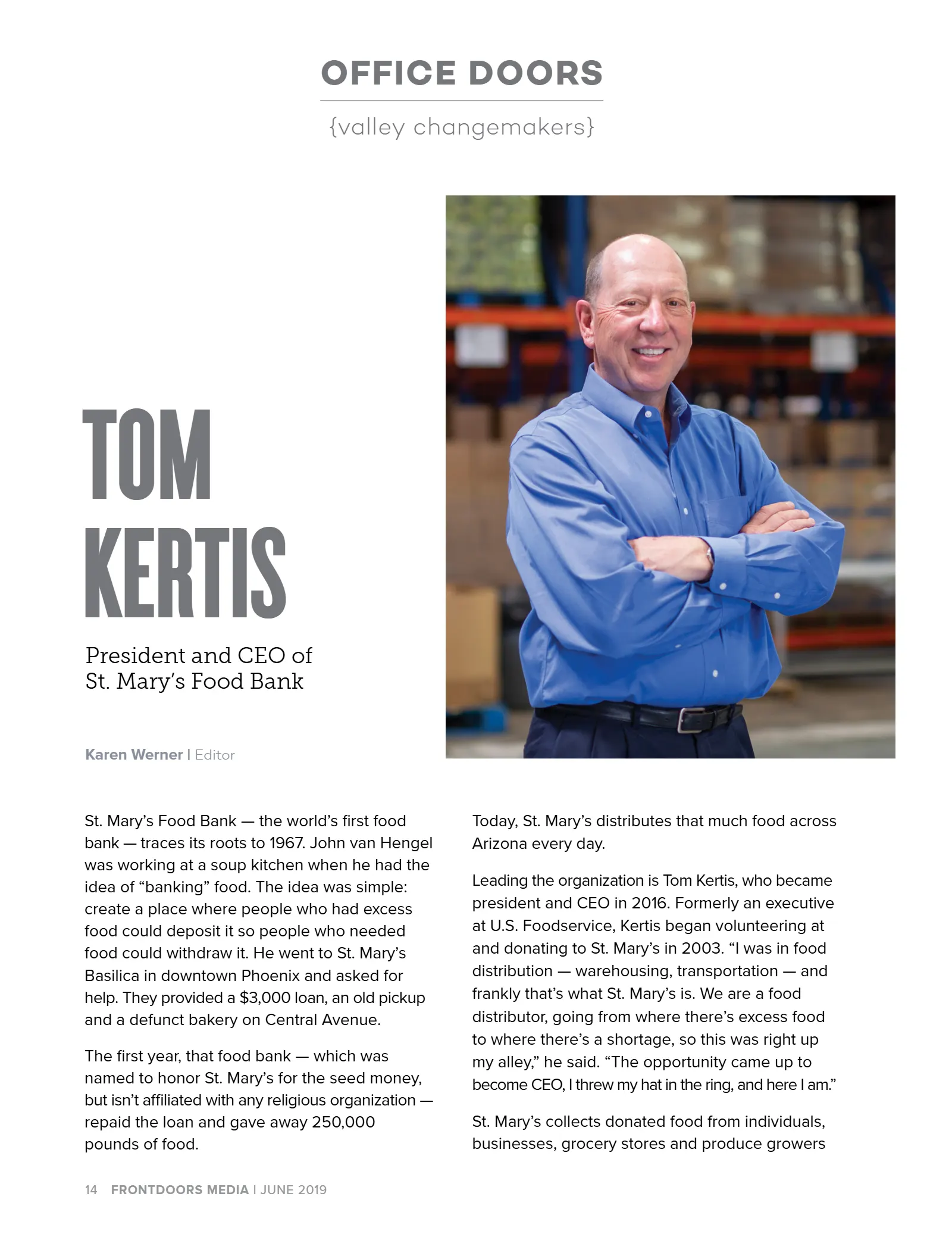
St. Mary’s Food Bank — the world’s first food bank — traces its roots to 1967. John van Hengel was working at a soup kitchen when he had the idea of “banking” food. The idea was simple: create a place where people who had excess food could deposit it so people who needed food could withdraw it. He went to St. Mary’s Basilica in downtown Phoenix and asked for help. They provided a $3,000 loan, an old pickup and a defunct bakery on Central Avenue. The first year, that food bank — which was named to honor St. Mary’s for the seed money, but isn’t affiliated with any religious organization — repaid the loan and gave away 250,000 pounds of food. Today, St. Mary’s distributes that much food across Arizona every day. Leading the organization is Tom Kertis, who became president and CEO in 2016. Formerly an executive at U.S. Foodservice, Kertis began volunteering at and donating to St. Mary’s in 2003. “I was in food distribution — warehousing, transportation — and frankly that’s what St. Mary’s is. We are a food distributor, going from where there’s excess food to where there’s a shortage, so this was right up my alley,” he said. “The opportunity came up to become CEO, I threw my hat in the ring, and here I am.” St. Mary’s collects donated food from individuals, businesses, grocery stores and produce growers President and CEO of St. Mary’s Food Bank TOM KERTIS Karen Werner | Editor 14 FRONTDOORS MEDIA | JUNE 2019 OFFICE DOORS {valley changemakers}
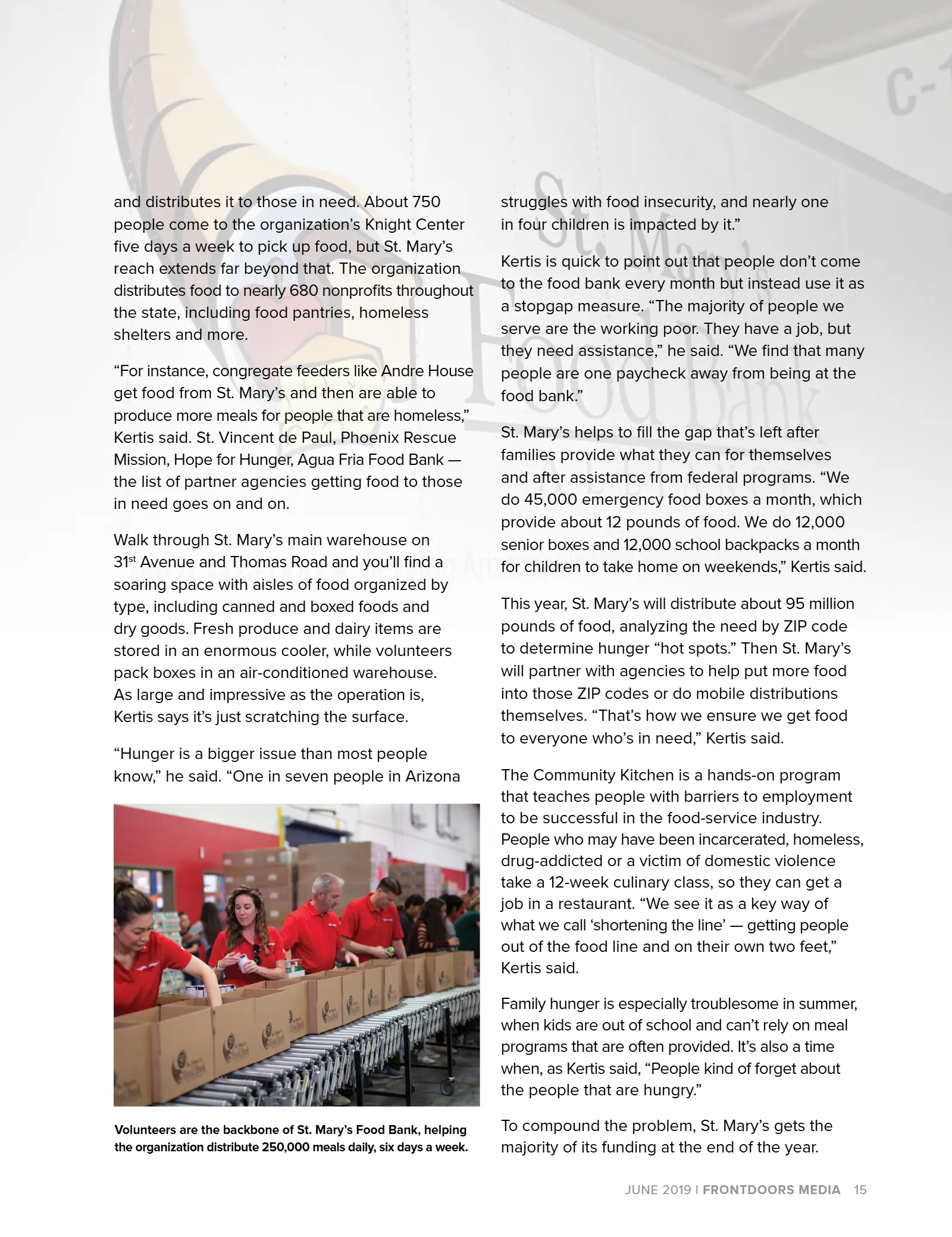
and distributes it to those in need. About 750 people come to the organization’s Knight Center five days a week to pick up food, but St. Mary’s reach extends far beyond that. The organization distributes food to nearly 680 nonprofits throughout the state, including food pantries, homeless shelters and more. “For instance, congregate feeders like Andre House get food from St. Mary’s and then are able to produce more meals for people that are homeless,” Kertis said. St. Vincent de Paul, Phoenix Rescue Mission, Hope for Hunger, Agua Fria Food Bank — the list of partner agencies getting food to those in need goes on and on. Walk through St. Mary’s main warehouse on 31 st Avenue and Thomas Road and you’ll find a soaring space with aisles of food organized by type, including canned and boxed foods and dry goods. Fresh produce and dairy items are stored in an enormous cooler, while volunteers pack boxes in an air-conditioned warehouse. As large and impressive as the operation is, Kertis says it’s just scratching the surface. “Hunger is a bigger issue than most people know,” he said. “One in seven people in Arizona struggles with food insecurity, and nearly one in four children is impacted by it.” Kertis is quick to point out that people don’t come to the food bank every month but instead use it as a stopgap measure. “The majority of people we serve are the working poor. They have a job, but they need assistance,” he said. “We find that many people are one paycheck away from being at the food bank.” St. Mary’s helps to fill the gap that’s left after families provide what they can for themselves and after assistance from federal programs. “We do 45,000 emergency food boxes a month, which provide about 12 pounds of food. We do 12,000 senior boxes and 12,000 school backpacks a month for children to take home on weekends,” Kertis said. This year, St. Mary’s will distribute about 95 million pounds of food, analyzing the need by ZIP code to determine hunger “hot spots.” Then St. Mary’s will partner with agencies to help put more food into those ZIP codes or do mobile distributions themselves. “That’s how we ensure we get food to everyone who’s in need,” Kertis said. The Community Kitchen is a hands-on program that teaches people with barriers to employment to be successful in the food-service industry. People who may have been incarcerated, homeless, drug-addicted or a victim of domestic violence take a 12-week culinary class, so they can get a job in a restaurant. “We see it as a key way of what we call ‘shortening the line’ — getting people out of the food line and on their own two feet,” Kertis said. Family hunger is especially troublesome in summer, when kids are out of school and can’t rely on meal programs that are often provided. It’s also a time when, as Kertis said, “People kind of forget about the people that are hungry.” To compound the problem, St. Mary’s gets the majority of its funding at the end of the year. Volunteers are the backbone of St. Mary’s Food Bank, helping the organization distribute 250,000 meals daily, six days a week. JUNE 2019 | FRONTDOORS MEDIA 15