
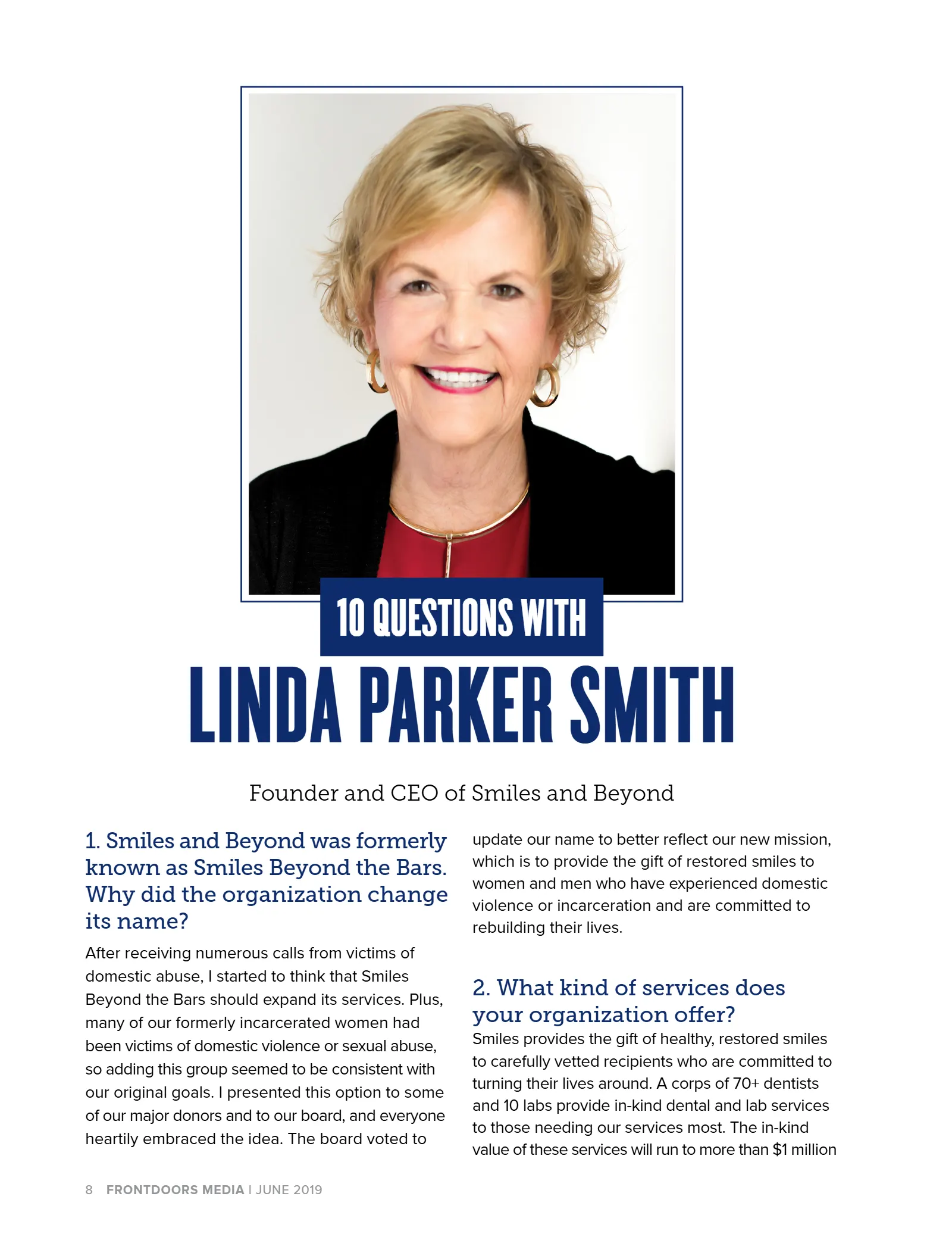
Founder and CEO of Smiles and Beyond 10 QUESTIONS WITH 1. Smiles and Beyond was formerly known as Smiles Beyond the Bars. Why did the organization change its name? After receiving numerous calls from victims of domestic abuse, I started to think that Smiles Beyond the Bars should expand its services. Plus, many of our formerly incarcerated women had been victims of domestic violence or sexual abuse, so adding this group seemed to be consistent with our original goals. I presented this option to some of our major donors and to our board, and everyone heartily embraced the idea. The board voted to update our name to better reflect our new mission, which is to provide the gift of restored smiles to women and men who have experienced domestic violence or incarceration and are committed to rebuilding their lives. 2. What kind of services does your organization offer? Smiles provides the gift of healthy, restored smiles to carefully vetted recipients who are committed to turning their lives around. A corps of 70+ dentists and 10 labs provide in-kind dental and lab services to those needing our services most. The in-kind value of these services will run to more than $1 million LINDA PARKER SMITH 8 FRONTDOORS MEDIA | JUNE 2019
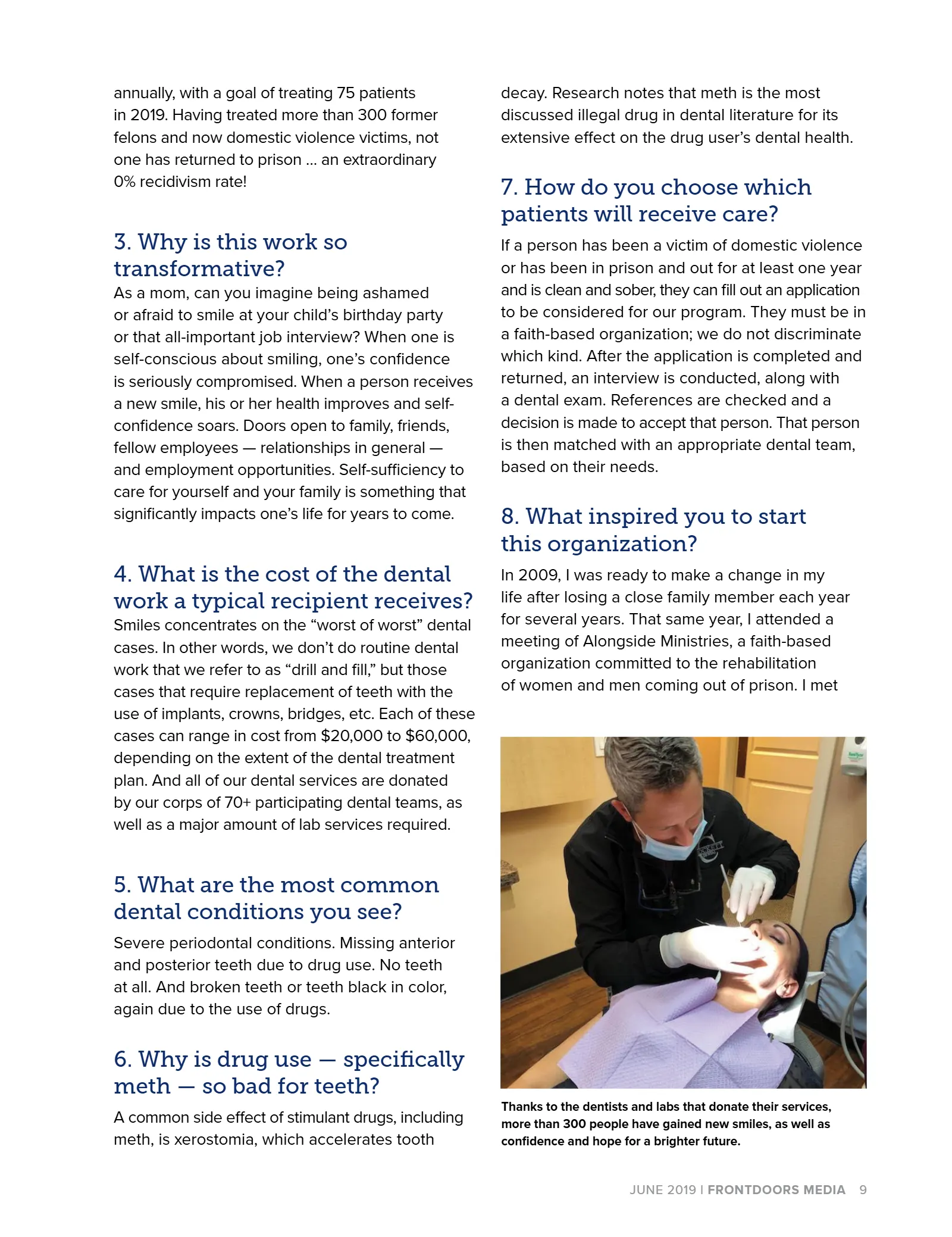
annually, with a goal of treating 75 patients in 2019. Having treated more than 300 former felons and now domestic violence victims, not one has returned to prison … an extraordinary 0% recidivism rate! 3. Why is this work so transformative? As a mom, can you imagine being ashamed or afraid to smile at your child’s birthday party or that all-important job interview? When one is self-conscious about smiling, one’s confidence is seriously compromised. When a person receives a new smile, his or her health improves and self- confidence soars. Doors open to family, friends, fellow employees — relationships in general — and employment opportunities. Self-sufficiency to care for yourself and your family is something that significantly impacts one’s life for years to come. 4. What is the cost of the dental work a typical recipient receives? Smiles concentrates on the “worst of worst” dental cases. In other words, we don’t do routine dental work that we refer to as “drill and fill,” but those cases that require replacement of teeth with the use of implants, crowns, bridges, etc. Each of these cases can range in cost from $20,000 to $60,000, depending on the extent of the dental treatment plan. And all of our dental services are donated by our corps of 70+ participating dental teams, as well as a major amount of lab services required. 5. What are the most common dental conditions you see? Severe periodontal conditions. Missing anterior and posterior teeth due to drug use. No teeth at all. And broken teeth or teeth black in color, again due to the use of drugs. 6. Why is drug use — specifically meth — so bad for teeth? A common side effect of stimulant drugs, including meth, is xerostomia, which accelerates tooth decay. Research notes that meth is the most discussed illegal drug in dental literature for its extensive effect on the drug user’s dental health. 7. How do you choose which patients will receive care? If a person has been a victim of domestic violence or has been in prison and out for at least one year and is clean and sober, they can fill out an application to be considered for our program. They must be in a faith-based organization; we do not discriminate which kind. After the application is completed and returned, an interview is conducted, along with a dental exam. References are checked and a decision is made to accept that person. That person is then matched with an appropriate dental team, based on their needs. 8. What inspired you to start this organization? In 2009, I was ready to make a change in my life after losing a close family member each year for several years. That same year, I attended a meeting of Alongside Ministries, a faith-based organization committed to the rehabilitation of women and men coming out of prison. I met Thanks to the dentists and labs that donate their services, more than 300 people have gained new smiles, as well as confidence and hope for a brighter future. JUNE 2019 | FRONTDOORS MEDIA 9