
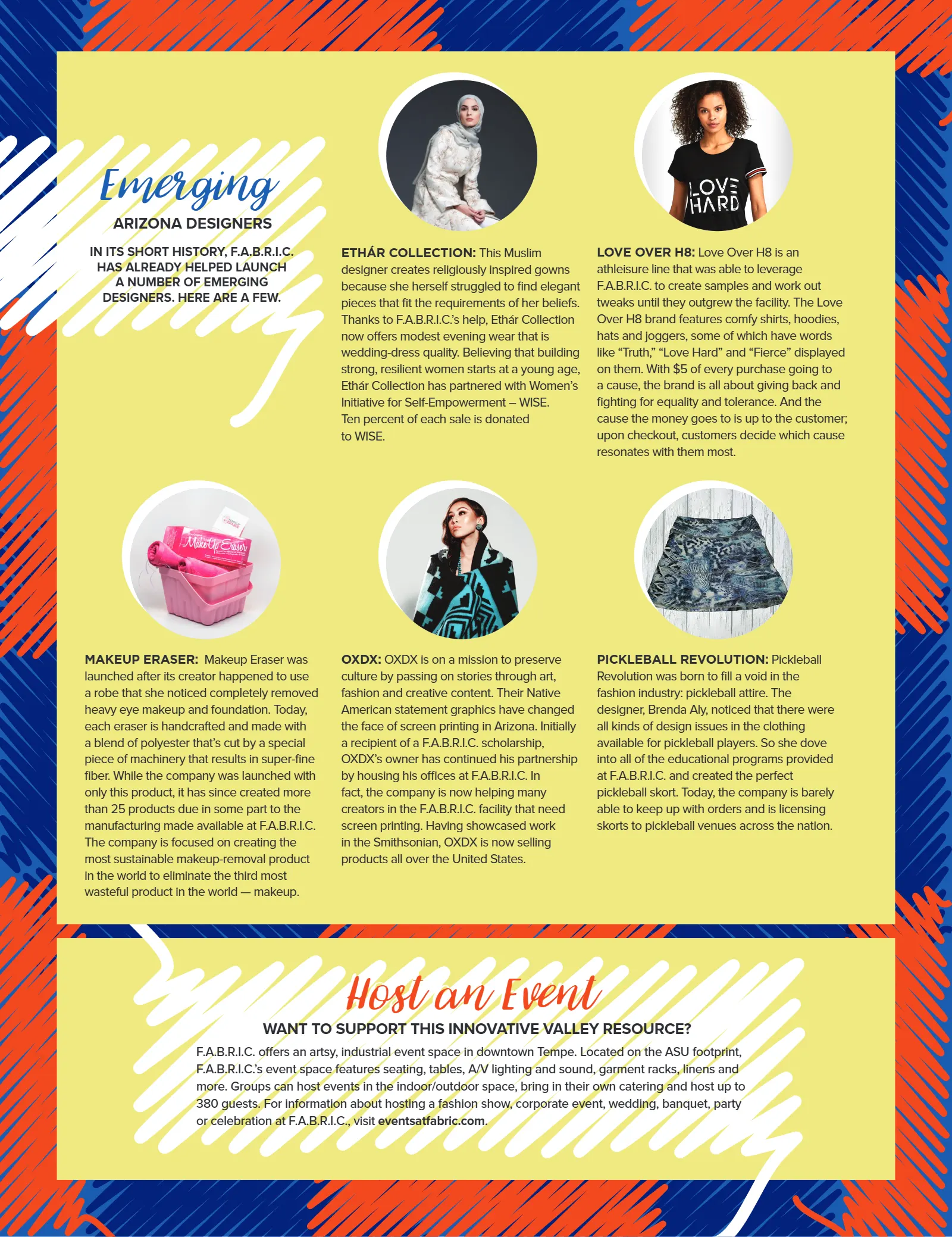
ETHÁR COLLECTION: This Muslim designer creates religiously inspired gowns because she herself struggled to find elegant pieces that fit the requirements of her beliefs. Thanks to F.A.B.R.I.C.’s help, Ethár Collection now offers modest evening wear that is wedding-dress quality. Believing that building strong, resilient women starts at a young age, Ethár Collection has partnered with Women’s Initiative for Self-Empowerment – WISE. Ten percent of each sale is donated to WISE. Emerging ARIZONA DESIGNERS IN ITS SHORT HISTORY, F.A.B.R.I.C. HAS ALREADY HELPED LAUNCH A NUMBER OF EMERGING DESIGNERS. HERE ARE A FEW. LOVE OVER H8: Love Over H8 is an athleisure line that was able to leverage F.A.B.R.I.C. to create samples and work out tweaks until they outgrew the facility. The Love Over H8 brand features comfy shirts, hoodies, hats and joggers, some of which have words like “Truth,” “Love Hard” and “Fierce” displayed on them. With $5 of every purchase going to a cause, the brand is all about giving back and fighting for equality and tolerance. And the cause the money goes to is up to the customer; upon checkout, customers decide which cause resonates with them most. MAKEUP ERASER: Makeup Eraser was launched after its creator happened to use a robe that she noticed completely removed heavy eye makeup and foundation. Today, each eraser is handcrafted and made with a blend of polyester that’s cut by a special piece of machinery that results in super-fine fiber. While the company was launched with only this product, it has since created more than 25 products due in some part to the manufacturing made available at F.A.B.R.I.C. The company is focused on creating the most sustainable makeup-removal product in the world to eliminate the third most wasteful product in the world — makeup. OXDX: OXDX is on a mission to preserve culture by passing on stories through art, fashion and creative content. Their Native American statement graphics have changed the face of screen printing in Arizona. Initially a recipient of a F.A.B.R.I.C. scholarship, OXDX’s owner has continued his partnership by housing his offices at F.A.B.R.I.C. In fact, the company is now helping many creators in the F.A.B.R.I.C. facility that need screen printing. Having showcased work in the Smithsonian, OXDX is now selling products all over the United States. PICKLEBALL REVOLUTION: Pickleball Revolution was born to fill a void in the fashion industry: pickleball attire. The designer, Brenda Aly, noticed that there were all kinds of design issues in the clothing available for pickleball players. So she dove into all of the educational programs provided at F.A.B.R.I.C. and created the perfect pickleball skort. Today, the company is barely able to keep up with orders and is licensing skorts to pickleball venues across the nation. Host an Event WANT TO SUPPORT THIS INNOVATIVE VALLEY RESOURCE? F.A.B.R.I.C. offers an artsy, industrial event space in downtown Tempe. Located on the ASU footprint, F.A.B.R.I.C.’s event space features seating, tables, A/V lighting and sound, garment racks, linens and more. Groups can host events in the indoor/outdoor space, bring in their own catering and host up to 380 guests. For information about hosting a fashion show, corporate event, wedding, banquet, party or celebration at F.A.B.R.I.C., visit eventsatfabric.com .
Johnson negotiated a unique deal. They give back $276,000 a year in free classes, events and services to counterbalance what they would have paid in rent. After two years, Johnson estimates the Fashion and Business Resource Innovation Center — better known as F.A.B.R.I.C. — has blown past that number and given back close to $1 million. THE F.A.B.R.I.C. OF OUR LIVES “We don’t think there’s a place quite like this in the United States,” Barry said. “I call it a public social enterprise. Public, because it has the support of the city.” The reason for the support is another creation of Johnson and Barry. The two co-founded a nonprofit called the Arizona Apparel Foundation whose mission is to help emerging designers and brands with small-batch manufacturing and strategic business resources so they can grow their brand sustainably in Arizona. And what do they offer at F.A.B.R.I.C.? An impressively deep and wide array of services and curriculum. Emerging designers can learn the basics, seasoned pros can fill their manufacturing orders, and entrepreneurs can hire experts to complete the job for them. Pattern making, sample sewing, industrial cutting and sewing, finishing techniques. Scholarship winners learn all of that and get an office on site and receive everything they need to take their product to market. It’s a program built on the pain of the past. Neither Barry nor Johnson can forget the sting of their early years in the fashion business and want to ease the way for emerging designers. “The whole reason we exist is because we both experienced that. We thought if we can’t do it with all of the right stuff in place, then who possibly can?” Johnson said. Inside F.A.B.R.I.C., students find apparel manufacturing, classes, consulting and design services, a sourcing library, fabric store, photo and production studio, co-working offices, a sewing studio, event and runway space, classrooms, hair and makeup rooms, industrial equipment, industry experts — basically everything they’d need to launch a fashion career. In addition to helping the designers, F.A.B.R.I.C. is creating jobs for people with valuable skills. “I have 17 employees here,” Barry said. Between patternmakers, technical designers, a cutter, a production supervisor and sewers, the team boasts several fashion degrees and almost 300 years of production industry experience. “People move here and they have these amazing skills. We can literally pick the best of the best. So we can offer highest-class industry standards,” Barry said. “And it’s all under one roof, which is not the case in L.A.,” Johnson added. Since opening, more than 330 brands have utilized the manufacturing resources at F.A.B.R.I.C., making everything from wedding gowns to dog robes to patented medical devices. “All of those people now have those resources here,” Johnson said. “They can grow and stay in Arizona. To me, that is everything.” As Barry and Johnson continue to build an industry that hasn’t existed in the past, both women are energized and confident. “You shouldn’t have to live in L.A. or New York or Paris to succeed in the fashion business. You just need resources,” Barry said. Johnson nods, looking at the building and ticking off the new services and classes to come. “F.A.B.R.I.C. is the place you can come and create your fashion dreams,” she said. “What might have been an obstacle is not anymore. It’s right here in Arizona.” COVER STORY CONTINUED MARCH 2019 | FRONTDOORS MEDIA 25