

@azgives @azgives Arizona Gives Day april 5-6, 2022 Gives day arizona FIND YOUR CAUSE AT AZGIVES.ORG Your donation on these days can help your favorite organization win a cash prize! JOIN US FOR ARIZONA’S LARGEST ONLINE FUNDRAISING EVENT! Arizona Gives is a statewide event of giving that has raised $30.1 MILLION for Arizona nonprofits since 2013.
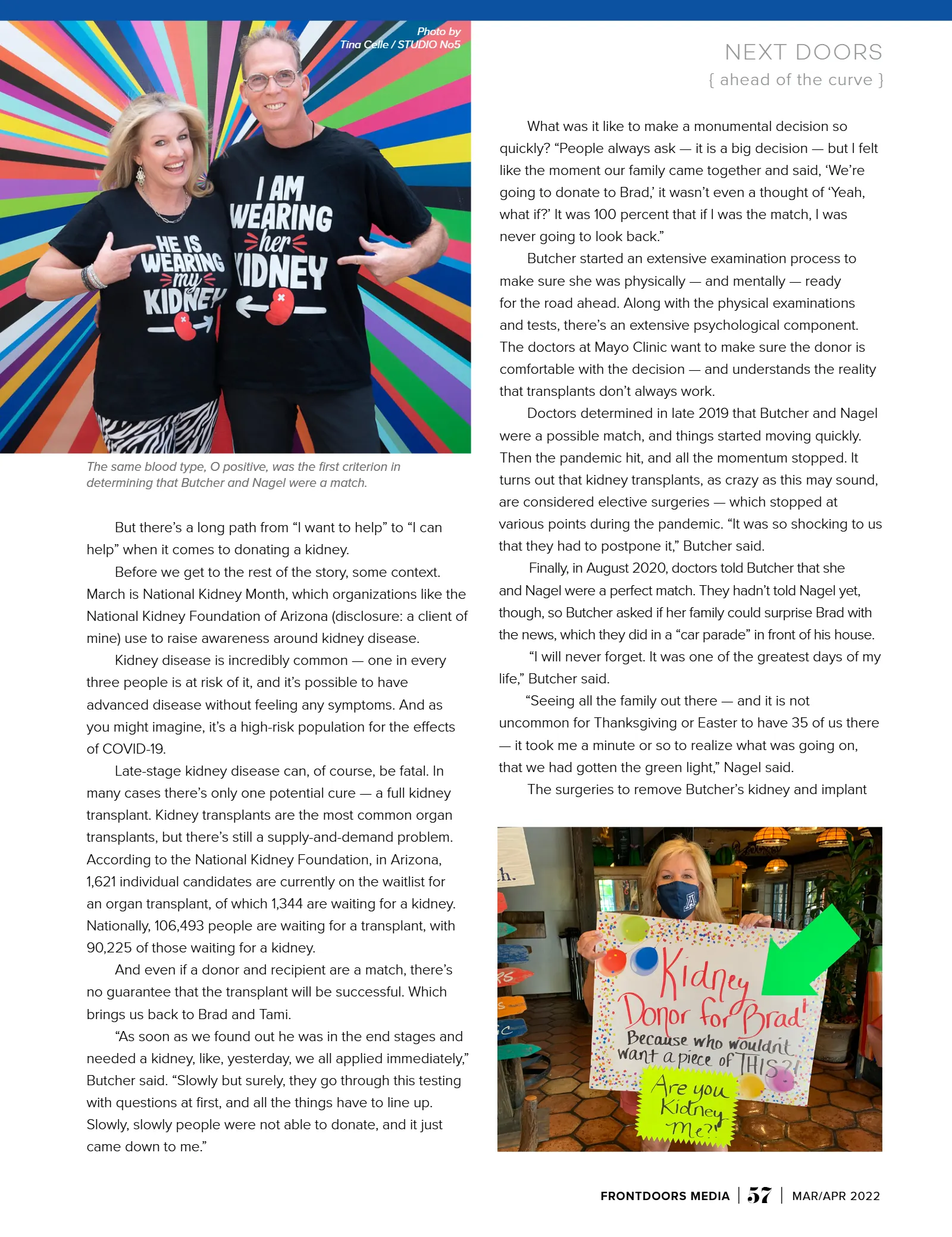
What was it like to make a monumental decision so quickly? “People always ask — it is a big decision — but I felt like the moment our family came together and said, ‘We’re going to donate to Brad,’ it wasn’t even a thought of ‘Yeah, what if?’ It was 100 percent that if I was the match, I was never going to look back.” Butcher started an extensive examination process to make sure she was physically — and mentally — ready for the road ahead. Along with the physical examinations and tests, there’s an extensive psychological component. The doctors at Mayo Clinic want to make sure the donor is comfortable with the decision — and understands the reality that transplants don’t always work. Doctors determined in late 2019 that Butcher and Nagel were a possible match, and things started moving quickly. Then the pandemic hit, and all the momentum stopped. It turns out that kidney transplants, as crazy as this may sound, are considered elective surgeries — which stopped at various points during the pandemic. “It was so shocking to us that they had to postpone it,” Butcher said. Finally, in August 2020, doctors told Butcher that she and Nagel were a perfect match. They hadn’t told Nagel yet, though, so Butcher asked if her family could surprise Brad with the news, which they did in a “car parade” in front of his house. “I will never forget. It was one of the greatest days of my life,” Butcher said. “Seeing all the family out there — and it is not uncommon for Thanksgiving or Easter to have 35 of us there — it took me a minute or so to realize what was going on, that we had gotten the green light,” Nagel said. The surgeries to remove Butcher’s kidney and implant NEXT DOORS { ahead of the curve } But there’s a long path from “I want to help” to “I can help” when it comes to donating a kidney. Before we get to the rest of the story, some context. March is National Kidney Month, which organizations like the National Kidney Foundation of Arizona (disclosure: a client of mine) use to raise awareness around kidney disease. Kidney disease is incredibly common — one in every three people is at risk of it, and it’s possible to have advanced disease without feeling any symptoms. And as you might imagine, it’s a high-risk population for the effects of COVID-19. Late-stage kidney disease can, of course, be fatal. In many cases there’s only one potential cure — a full kidney transplant. Kidney transplants are the most common organ transplants, but there’s still a supply-and-demand problem. According to the National Kidney Foundation, in Arizona, 1,621 individual candidates are currently on the waitlist for an organ transplant, of which 1,344 are waiting for a kidney. Nationally, 106,493 people are waiting for a transplant, with 90,225 of those waiting for a kidney. And even if a donor and recipient are a match, there’s no guarantee that the transplant will be successful. Which brings us back to Brad and Tami. “As soon as we found out he was in the end stages and needed a kidney, like, yesterday, we all applied immediately,” Butcher said. “Slowly but surely, they go through this testing with questions at first, and all the things have to line up. Slowly, slowly people were not able to donate, and it just came down to me.” FRONTDOORS MEDIA | 57 | MAR/APR 2022 The same blood type, O positive, was the first criterion in determining that Butcher and Nagel were a match. Photo by Tina Celle / STUDIO No5