
A 2ND ACT { survivors giving back } Gregg Goodman believes you have to work on yourself in order to work with horses. “Dogs are eager to please and adapt their behavior for humans,” he said. “But horses are intuitive to a human’s emotions, good or bad.” Goodman should know. As a rider for decades, he’s seen a lot of horses. Eighteen years ago, he found his true calling as executive director of Horses Help. The five-acre spread of land in north central Phoenix that Horses Help occupies was a farm turned into a recreational riding business. Goodman, the state chair for the Professional Association of Therapeutic Horsemanship (PATH) International, has led it to become a PATH Premier Accredited organization, serving more than 100 participants a week. Hippotherapy — the use of horseback riding as therapeutic or rehabilitative treatment — improves coordination, balance and strength and works on human emotions. There are always 16 to 18 members in Horses Help’s herd, coming from all walks of life and each living its own second act. Some are retired professional show horses or ropers. Others were donated by families whose kids went off to college, while others are rescues from various situations. But all of them are now partners in healing. The horses are generally 15 hands high and below (60 inches or less, measured from the shoulder) in order for them to be most accessible to a broad range of participant sizes. The staff interacts with the new horse recruits to learn their conformations and movements, and then works to match the breeds with the skill levels of participants. “Our programs run the gamut,” Goodman said. “We have participants with cerebral palsy, autism and more than 50 other types of disabilities. We have foster-care children and trafficked youths in our programs, most of whom have never had pets and haven’t experienced much love — animal or human — in their lives.” When Trystan, a young program participant, first arrived at Horses Help, he had a tough time keeping his emotions in check. His equine partner, Buddy, reflected the nervousness and other raw emotions back at him. Over time, Trystan become more aware of his emotions, which in turn taught him how to better manage them. Buddy taught Trystan confidence as well. Horses need a confident leader. They want to know where they’re going, that there’s a sure plan and a cool leader at the helm. That’s exactly what Trystan became. Horses Help also offers special group programs. “We created Operation Unbridled for military and first responders,” Goodman said. “And in conjunction with ASU, we developed the Family HERD program Judy Pearson | Contributing Writer Therapy on four hooves HORSING AROUND FOR GOOD 44 FRONTDOORS MEDIA | MAY 2019
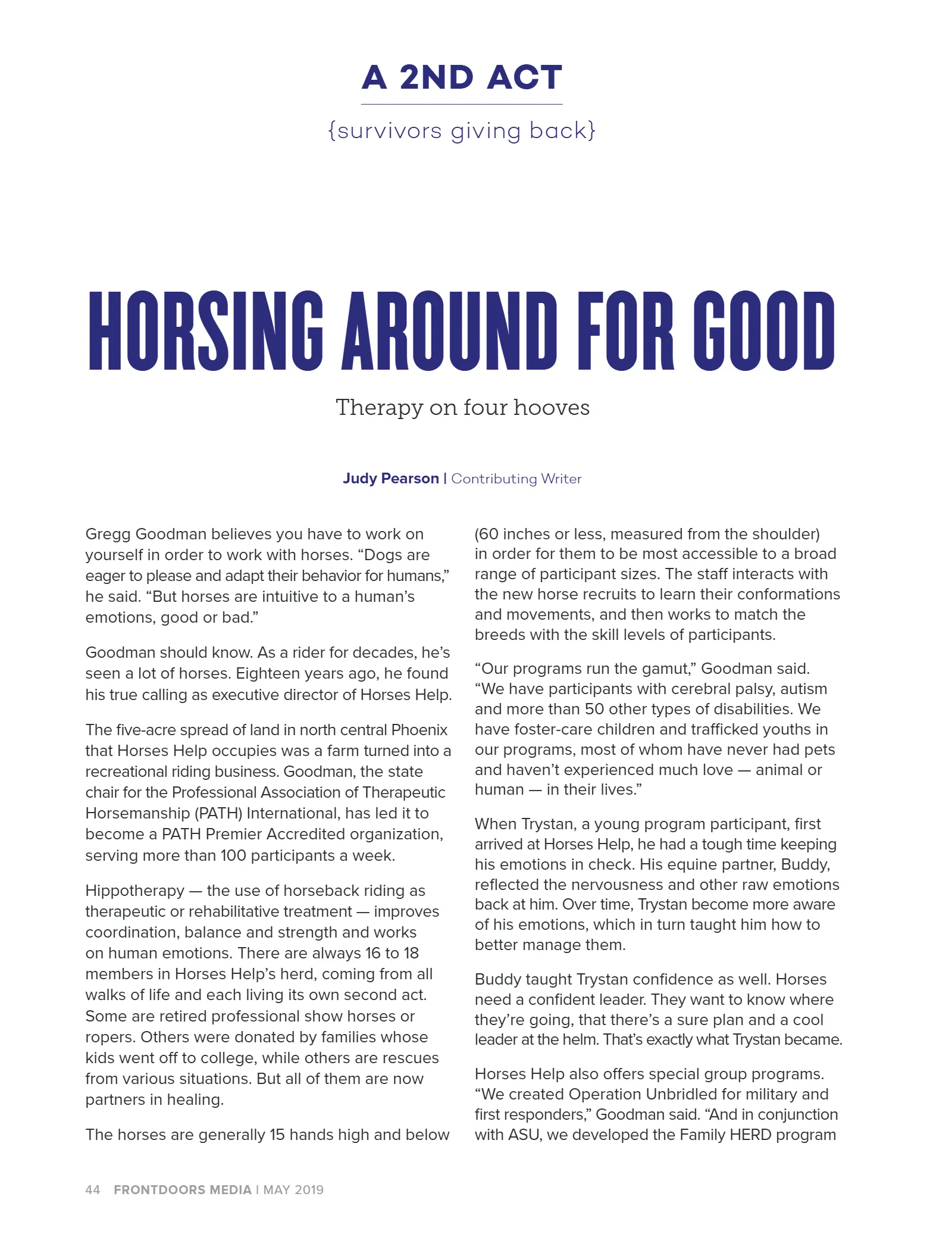
Using a unique collaboration of horses and people, Horses Help serves the special-needs population, one stride at a time. to explore family dynamics as seen through the eyes of a horse.” While some of the programs involve riding, others are all ground work, with no riding involved. And that work extends from the paddock to the stables. There’s tack to take care of, feeding to be done and grooming schedules to be doled out. Throughout, participants work with both certified instructors and volunteers. Iraq War veteran Jeremy suffered a traumatic brain injury stateside. Among his challenges, his speech is difficult to understand. But Jesse, Jeremy’s four- legged partner in healing, understands him perfectly. Jeremy also has the opportunity to groom and walk Jesse, responsibilities that allow him to feel valued and more “normal.” Of course when you have a herd of horses, you also have a lot of horse manure. The Horses Help team came up with uses for that as well. The first step was to create gardens as a part of the therapy program. Learning to care for plants that eventually produce edible bounty is a great learning tool. And bonus: a use for composted manure. Next came hydroponic gardening. Plants are grown in water, completely without soil, while being supported by gravel and special platforms — another bonus usage of the composted manure. Probably the most clever use for the composted manure are the 10-pound bags of it available for purchase. Cleverly called Thera-Pooh, they’re excellent fundraisers at practically no cost. Horses Help’s new project is aptly named the “Dream Big” project, which will allow them to expand their programs and better utilize their space. “It’s not a matter of ‘If you build it, they will come.’ It’s really a matter of, ‘They’re here, we better build it,’” Goodman said. To that end, plans have been drawn up for a $6 million building project. They include repurposing some of the buildings and spaces while completely reconstructing others. The Horses Help programs, and the horse heroes at the center of them, are truly magical, serving both special-needs and at-risk communities as well as providing unique therapy and recreational opportunities. And that’s just plain horse sense. To learn more, visit horseshelp.org . Judy Pearson CONTRIBUTING WRITER info@A2ndAct.org MAY 2019 | FRONTDOORS MEDIA 45