
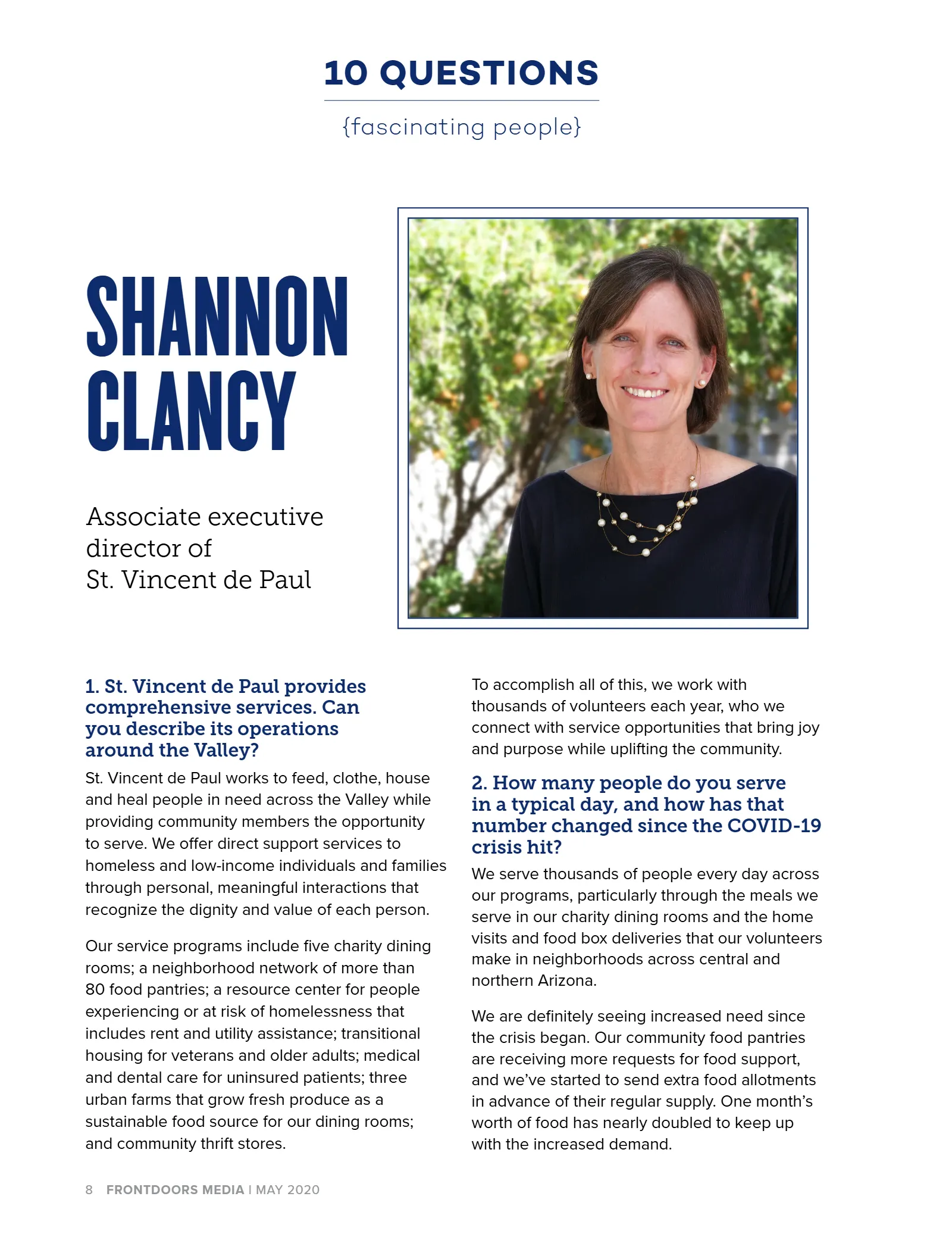
8 FRONTDOORS MEDIA | MAY 2 020 1. St. Vincent de Paul provides comprehensive services. Can you describe its operations around the Valley? St. Vincent de Paul works to feed, clothe, house and heal people in need across the Valley while providing community members the opportunity to serve. We offer direct support services to homeless and low-income individuals and families through personal, meaningful interactions that recognize the dignity and value of each person. Our service programs include five charity dining rooms; a neighborhood network of more than 80 food pantries; a resource center for people experiencing or at risk of homelessness that includes rent and utility assistance; transitional housing for veterans and older adults; medical and dental care for uninsured patients; three urban farms that grow fresh produce as a sustainable food source for our dining rooms; and community thrift stores. To accomplish all of this, we work with thousands of volunteers each year, who we connect with service opportunities that bring joy and purpose while uplifting the community. 2. How many people do you serve in a typical day, and how has that number changed since the COVID-19 crisis hit? We serve thousands of people every day across our programs, particularly through the meals we serve in our charity dining rooms and the home visits and food box deliveries that our volunteers make in neighborhoods across central and northern Arizona. We are definitely seeing increased need since the crisis began. Our community food pantries are receiving more requests for food support, and we’ve started to send extra food allotments in advance of their regular supply. One month’s worth of food has nearly doubled to keep up with the increased demand. Associate executive director of St. Vincent de Paul SHANNON CLANCY 10 QUESTIONS {fascinating people}
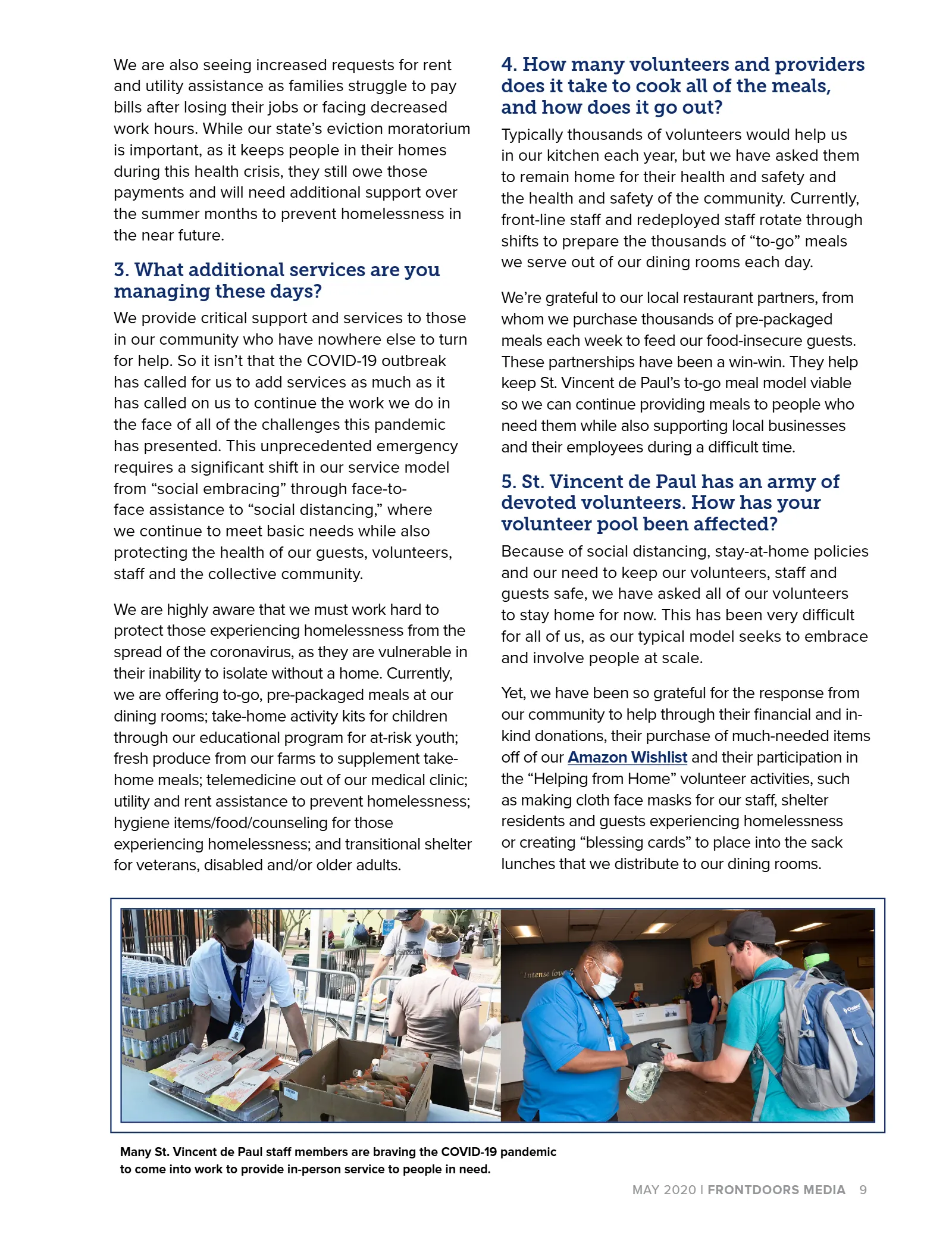
MAY 2 020 | FRONTDOORS MEDIA 9 Many St. Vincent de Paul staff members are braving the COVID-19 pandemic to come into work to provide in-person service to people in need. We are also seeing increased requests for rent and utility assistance as families struggle to pay bills after losing their jobs or facing decreased work hours. While our state’s eviction moratorium is important, as it keeps people in their homes during this health crisis, they still owe those payments and will need additional support over the summer months to prevent homelessness in the near future. 3. What additional services are you managing these days? We provide critical support and services to those in our community who have nowhere else to turn for help. So it isn’t that the COVID-19 outbreak has called for us to add services as much as it has called on us to continue the work we do in the face of all of the challenges this pandemic has presented. This unprecedented emergency requires a significant shift in our service model from “social embracing” through face-to- face assistance to “social distancing,” where we continue to meet basic needs while also protecting the health of our guests, volunteers, staff and the collective community. We are highly aware that we must work hard to protect those experiencing homelessness from the spread of the coronavirus, as they are vulnerable in their inability to isolate without a home. Currently, we are offering to-go, pre-packaged meals at our dining rooms; take-home activity kits for children through our educational program for at-risk youth; fresh produce from our farms to supplement take- home meals; telemedicine out of our medical clinic; utility and rent assistance to prevent homelessness; hygiene items/food/counseling for those experiencing homelessness; and transitional shelter for veterans, disabled and/or older adults. 4. How many volunteers and providers does it take to cook all of the meals, and how does it go out? Typically thousands of volunteers would help us in our kitchen each year, but we have asked them to remain home for their health and safety and the health and safety of the community. Currently, front-line staff and redeployed staff rotate through shifts to prepare the thousands of “to-go” meals we serve out of our dining rooms each day. We’re grateful to our local restaurant partners, from whom we purchase thousands of pre-packaged meals each week to feed our food-insecure guests. These partnerships have been a win-win. They help keep St. Vincent de Paul’s to-go meal model viable so we can continue providing meals to people who need them while also supporting local businesses and their employees during a difficult time. 5. St. Vincent de Paul has an army of devoted volunteers. How has your volunteer pool been affected? Because of social distancing, stay-at-home policies and our need to keep our volunteers, staff and guests safe, we have asked all of our volunteers to stay home for now. This has been very difficult for all of us, as our typical model seeks to embrace and involve people at scale. Yet, we have been so grateful for the response from our community to help through their financial and in- kind donations, their purchase of much-needed items off of our Amazon Wishlist and their participation in the “Helping from Home” volunteer activities, such as making cloth face masks for our staff, shelter residents and guests experiencing homelessness or creating “blessing cards” to place into the sack lunches that we distribute to our dining rooms.