
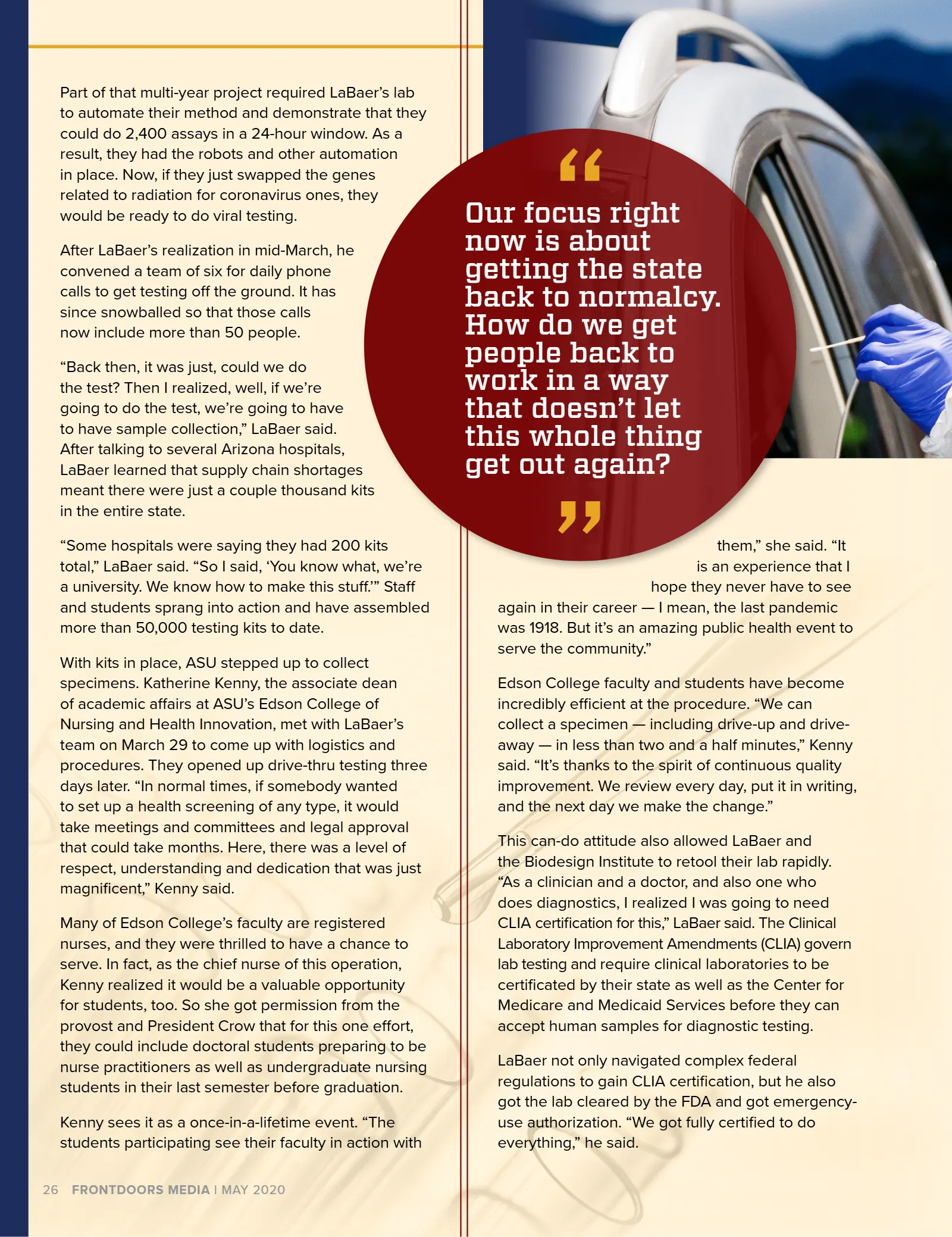
Part of that multi-year project required LaBaer’s lab to automate their method and demonstrate that they could do 2,400 assays in a 24-hour window. As a result, they had the robots and other automation in place. Now, if they just swapped the genes related to radiation for coronavirus ones, they would be ready to do viral testing. After LaBaer’s realization in mid-March, he convened a team of six for daily phone calls to get testing off the ground. It has since snowballed so that those calls now include more than 50 people. “Back then, it was just, could we do the test? Then I realized, well, if we’re going to do the test, we’re going to have to have sample collection,” LaBaer said. After talking to several Arizona hospitals, LaBaer learned that supply chain shortages meant there were just a couple thousand kits in the entire state. “Some hospitals were saying they had 200 kits total,” LaBaer said. “So I said, ‘You know what, we’re a university. We know how to make this stuff.’” Staff and students sprang into action and have assembled more than 50,000 testing kits to date. With kits in place, ASU stepped up to collect specimens. Katherine Kenny, the associate dean of academic affairs at ASU’s Edson College of Nursing and Health Innovation, met with LaBaer’s team on March 29 to come up with logistics and procedures. They opened up drive-thru testing three days later. “In normal times, if somebody wanted to set up a health screening of any type, it would take meetings and committees and legal approval that could take months. Here, there was a level of respect, understanding and dedication that was just magnificent,” Kenny said. Many of Edson College’s faculty are registered nurses, and they were thrilled to have a chance to serve. In fact, as the chief nurse of this operation, Kenny realized it would be a valuable opportunity for students, too. So she got permission from the provost and President Crow that for this one effort, they could include doctoral students preparing to be nurse practitioners as well as undergraduate nursing students in their last semester before graduation. Kenny sees it as a once-in-a-lifetime event. “The students participating see their faculty in action with them,” she said. “It is an experience that I hope they never have to see again in their career — I mean, the last pandemic was 1918. But it’s an amazing public health event to serve the community.” Edson College faculty and students have become incredibly efficient at the procedure. “We can collect a specimen — including drive-up and drive- away — in less than two and a half minutes,” Kenny said. “It’s thanks to the spirit of continuous quality improvement. We review every day, put it in writing, and the next day we make the change.” This can-do attitude also allowed LaBaer and the Biodesign Institute to retool their lab rapidly. “As a clinician and a doctor, and also one who does diagnostics, I realized I was going to need CLIA certification for this,” LaBaer said. The Clinical Laboratory Improvement Amendments (CLIA) govern lab testing and require clinical laboratories to be certificated by their state as well as the Center for Medicare and Medicaid Services before they can accept human samples for diagnostic testing. LaBaer not only navigated complex federal regulations to gain CLIA certification, but he also got the lab cleared by the FDA and got emergency- use authorization. “We got fully certified to do everything,” he said. Our focus right now is about getting the state back to normalcy. How do we get people back to work in a way that doesn’t let this whole thing get out again? “ ” 26 FRONTDOORS MEDIA | MAY 2 020
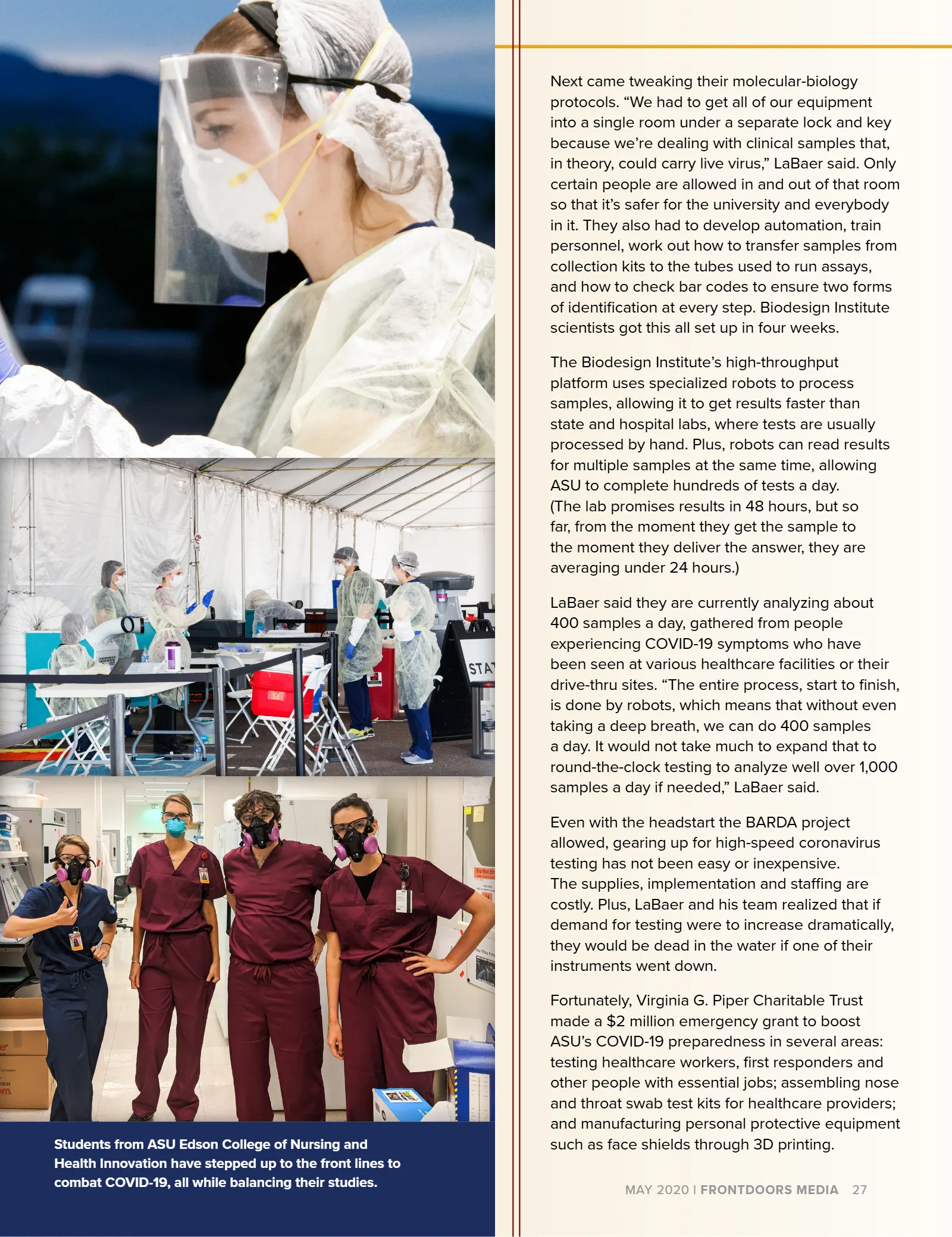
Next came tweaking their molecular-biology protocols. “We had to get all of our equipment into a single room under a separate lock and key because we’re dealing with clinical samples that, in theory, could carry live virus,” LaBaer said. Only certain people are allowed in and out of that room so that it’s safer for the university and everybody in it. They also had to develop automation, train personnel, work out how to transfer samples from collection kits to the tubes used to run assays, and how to check bar codes to ensure two forms of identification at every step. Biodesign Institute scientists got this all set up in four weeks. The Biodesign Institute’s high-throughput platform uses specialized robots to process samples, allowing it to get results faster than state and hospital labs, where tests are usually processed by hand. Plus, robots can read results for multiple samples at the same time, allowing ASU to complete hundreds of tests a day. (The lab promises results in 48 hours, but so far, from the moment they get the sample to the moment they deliver the answer, they are averaging under 24 hours.) LaBaer said they are currently analyzing about 400 samples a day, gathered from people experiencing COVID-19 symptoms who have been seen at various healthcare facilities or their drive-thru sites. “The entire process, start to finish, is done by robots, which means that without even taking a deep breath, we can do 400 samples a day. It would not take much to expand that to round-the-clock testing to analyze well over 1,000 samples a day if needed,” LaBaer said. Even with the headstart the BARDA project allowed, gearing up for high-speed coronavirus testing has not been easy or inexpensive. The supplies, implementation and staffing are costly. Plus, LaBaer and his team realized that if demand for testing were to increase dramatically, they would be dead in the water if one of their instruments went down. Fortunately, Virginia G. Piper Charitable Trust made a $2 million emergency grant to boost ASU’s COVID-19 preparedness in several areas: testing healthcare workers, first responders and other people with essential jobs; assembling nose and throat swab test kits for healthcare providers; and manufacturing personal protective equipment such as face shields through 3D printing. Students from ASU Edson College of Nursing and Health Innovation have stepped up to the front lines to combat COVID-19, all while balancing their studies. MAY 2 020 | FRONTDOORS MEDIA 27