
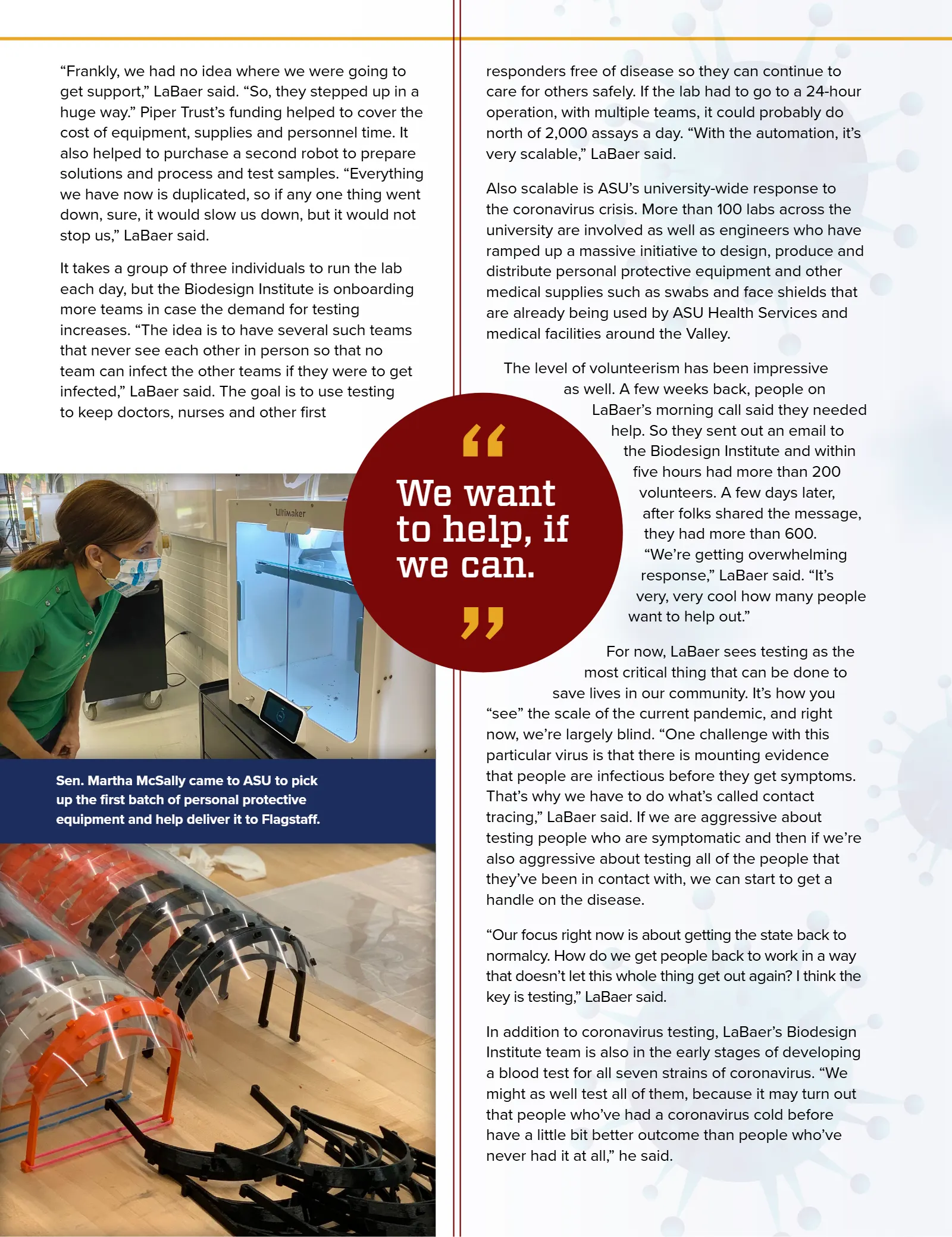
responders free of disease so they can continue to care for others safely. If the lab had to go to a 24-hour operation, with multiple teams, it could probably do north of 2,000 assays a day. “With the automation, it’s very scalable,” LaBaer said. Also scalable is ASU’s university-wide response to the coronavirus crisis. More than 100 labs across the university are involved as well as engineers who have ramped up a massive initiative to design, produce and distribute personal protective equipment and other medical supplies such as swabs and face shields that are already being used by ASU Health Services and medical facilities around the Valley. The level of volunteerism has been impressive as well. A few weeks back, people on LaBaer’s morning call said they needed help. So they sent out an email to the Biodesign Institute and within five hours had more than 200 volunteers. A few days later, after folks shared the message, they had more than 600. “We’re getting overwhelming response,” LaBaer said. “It’s very, very cool how many people want to help out.” For now, LaBaer sees testing as the most critical thing that can be done to save lives in our community. It’s how you “see” the scale of the current pandemic, and right now, we’re largely blind. “One challenge with this particular virus is that there is mounting evidence that people are infectious before they get symptoms. That’s why we have to do what’s called contact tracing,” LaBaer said. If we are aggressive about testing people who are symptomatic and then if we’re also aggressive about testing all of the people that they’ve been in contact with, we can start to get a handle on the disease. “Our focus right now is about getting the state back to normalcy. How do we get people back to work in a way that doesn’t let this whole thing get out again? I think the key is testing,” LaBaer said. In addition to coronavirus testing, LaBaer’s Biodesign Institute team is also in the early stages of developing a blood test for all seven strains of coronavirus. “We might as well test all of them, because it may turn out that people who’ve had a coronavirus cold before have a little bit better outcome than people who’ve never had it at all,” he said. “Frankly, we had no idea where we were going to get support,” LaBaer said. “So, they stepped up in a huge way.” Piper Trust’s funding helped to cover the cost of equipment, supplies and personnel time. It also helped to purchase a second robot to prepare solutions and process and test samples. “Everything we have now is duplicated, so if any one thing went down, sure, it would slow us down, but it would not stop us,” LaBaer said. It takes a group of three individuals to run the lab each day, but the Biodesign Institute is onboarding more teams in case the demand for testing increases. “The idea is to have several such teams that never see each other in person so that no team can infect the other teams if they were to get infected,” LaBaer said. The goal is to use testing to keep doctors, nurses and other first We want to help, if we can. “ ” Sen. Martha McSally came to ASU to pick up the first batch of personal protective equipment and help deliver it to Flagstaff.
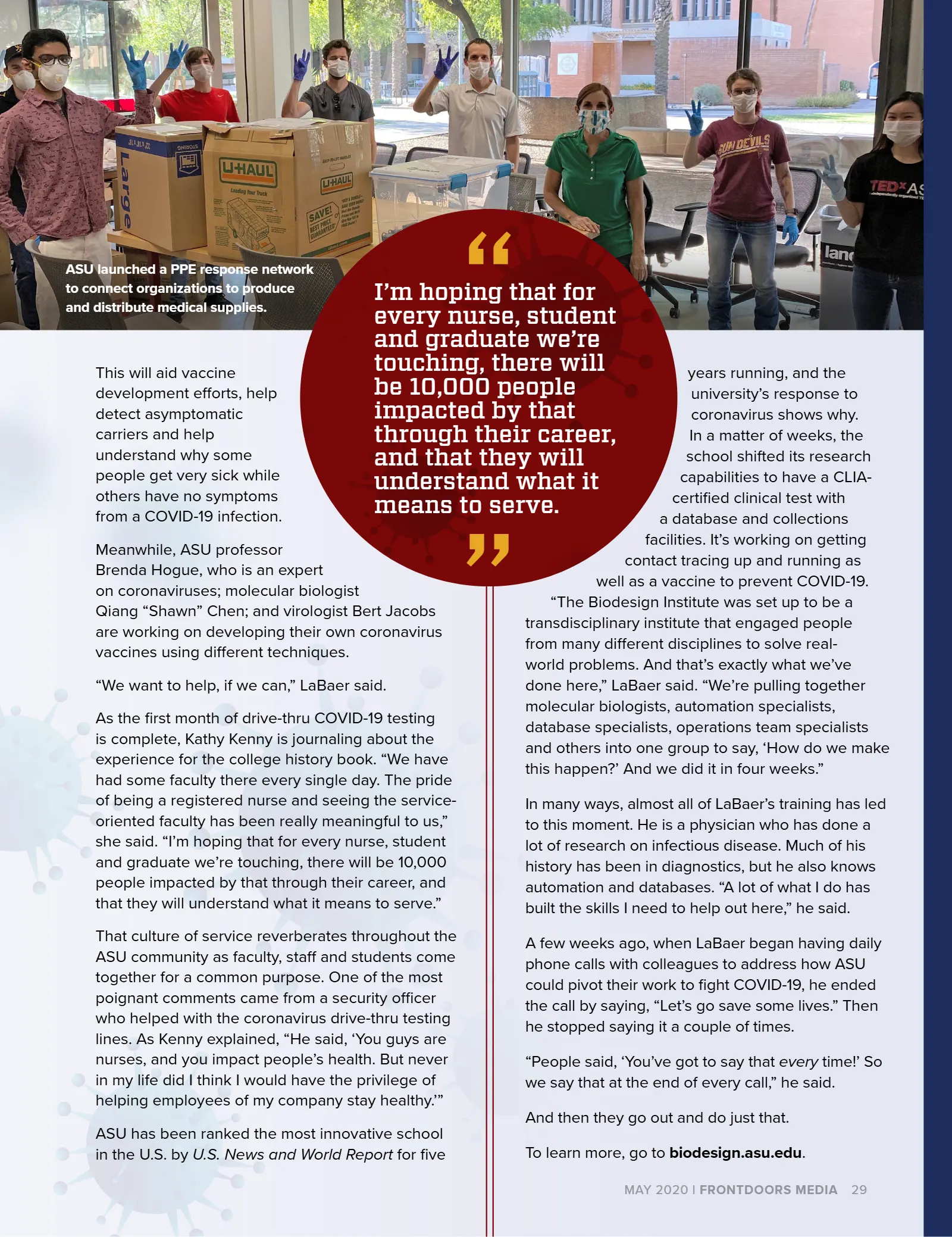
This will aid vaccine development efforts, help detect asymptomatic carriers and help understand why some people get very sick while others have no symptoms from a COVID-19 infection. Meanwhile, ASU professor Brenda Hogue, who is an expert on coronaviruses; molecular biologist Qiang “Shawn” Chen; and virologist Bert Jacobs are working on developing their own coronavirus vaccines using different techniques. “We want to help, if we can,” LaBaer said. As the first month of drive-thru COVID-19 testing is complete, Kathy Kenny is journaling about the experience for the college history book. “We have had some faculty there every single day. The pride of being a registered nurse and seeing the service- oriented faculty has been really meaningful to us,” she said. “I’m hoping that for every nurse, student and graduate we’re touching, there will be 10,000 people impacted by that through their career, and that they will understand what it means to serve.” That culture of service reverberates throughout the ASU community as faculty, staff and students come together for a common purpose. One of the most poignant comments came from a security officer who helped with the coronavirus drive-thru testing lines. As Kenny explained, “He said, ‘You guys are nurses, and you impact people’s health. But never in my life did I think I would have the privilege of helping employees of my company stay healthy.’” ASU has been ranked the most innovative school in the U.S. by U.S. News and World Report for five years running, and the university’s response to coronavirus shows why. In a matter of weeks, the school shifted its research capabilities to have a CLIA- certified clinical test with a database and collections facilities. It’s working on getting contact tracing up and running as well as a vaccine to prevent COVID-19. “The Biodesign Institute was set up to be a transdisciplinary institute that engaged people from many different disciplines to solve real- world problems. And that’s exactly what we’ve done here,” LaBaer said. “We’re pulling together molecular biologists, automation specialists, database specialists, operations team specialists and others into one group to say, ‘How do we make this happen?’ And we did it in four weeks.” In many ways, almost all of LaBaer’s training has led to this moment. He is a physician who has done a lot of research on infectious disease. Much of his history has been in diagnostics, but he also knows automation and databases. “A lot of what I do has built the skills I need to help out here,” he said. A few weeks ago, when LaBaer began having daily phone calls with colleagues to address how ASU could pivot their work to fight COVID-19, he ended the call by saying, “Let’s go save some lives.” Then he stopped saying it a couple of times. “People said, ‘You’ve got to say that every time!’ So we say that at the end of every call,” he said. And then they go out and do just that. To learn more, go to biodesign.asu.edu . ” “ I’m hoping that for every nurse, student and graduate we’re touching, there will be 10,000 people impacted by that through their career, and that they will understand what it means to serve. ASU launched a PPE response network to connect organizations to produce and distribute medical supplies. MAY 2 020 | FRONTDOORS MEDIA 29