
better. And thus the Be Kind pledge was born: I pledge to: Meyer ordered a quarter million Be Kind pledge cards and started going to schools distributing them. In a brilliant move, she decided to take along a group of hip-hop dancers. “I knew kids didn’t want to hear from me. I’m a grandma,” she said. USA Today got wind of the group and featured it in a story called, “Sharing in the USA.” As a result, feedback poured in from across the country, from “This is exactly what my kids need” to “Thank you for honoring teachers” to “Can you come to my school?” “You can’t ignore that,” Meyer said. “So we took several deep breaths and filed for nonprofit status.” Along the way, Meyer and her team did an enormous amount of research on schools and the problems kids face. As a result, the programming has changed and developed over the last six years into experience-, online- and project-based learning that equips students with tools for making good, responsible decisions and being accountable for building respectful relationships, improving grades and forming enduring values. Not exactly messages kids are always eager to hear. That’s where the Be Kind crew comes in. The crew connects with kids through hip hop dance, spoken word and rap music, positive interactions and a message of what to do, instead of what not to do. “They get a cool factor immediately,” Meyer said. “So we clearly use them to connect with students, so we can teach them something for a higher purpose. People can teach all day long but if the kids aren’t listening, it doesn’t matter.” The crew is comprised of more than 50 dancers who are all Be Kind People Project employees. In fact, Meyer said, “We’re the largest employer of dancers in Arizona and one of the largest in the United States.” Famous among fourth graders, the dancers are all screened, fingerprint-checked and instructed in education principles. They’ve also been trained by acting coaches who have helped develop their presentation skills and self-confidence. “We look for good people, and then we have them audition for dance skills, so that we get a combination of good people and good dancers,” Meyer said. The opportunity to have a job rather than just a gig is life-changing for the dancers, many of whom are recent arts graduates. “It’s fun, exciting, entertaining and a good workout but it’s also empowering to know that we’re in a position where we’re making an impact,” said crew member Ivory Myers, who writes all of the Be Kind People Project songs. “We’re not just impressing kids. We’re rewiring thinking and planting seeds of kindness, positivity and change for our future.” Change that is necessary and welcome. “Unfortunately, Arizona as a state doesn’t fare well in many key indicators for youth development,” Meyer said. “I don’t think we can change that, but I think we can change it for the kids that we have contact with.” The Be Kind People Project tackles big issues, including cyberbullying, a program introduced this year. “It’s such a big issue and it’s so scary for our kids,” Meyer said. “There is an extremely high correlation between cyberbullying and school safety, mental health issues, depression. It even goes as far as suicide. In our country, civility needs a shot in the arm. When kids learn this early, it will make a difference.” Crew leader Adri Preston agrees. “Kids have access to so much now — way more than we did 10 years ago. So giving them this one-hour program to encourage them to make kinder decisions is vital. It gets them excited about • Be encouraging • Be supportive • Be positive • Be helpful • Be honest • Be considerate • Be thankful • Be responsible • Be respectful • Be a friend COVER STORY CONTINUED 24 FRONTDOORS MEDIA | NOVEMBER 2018
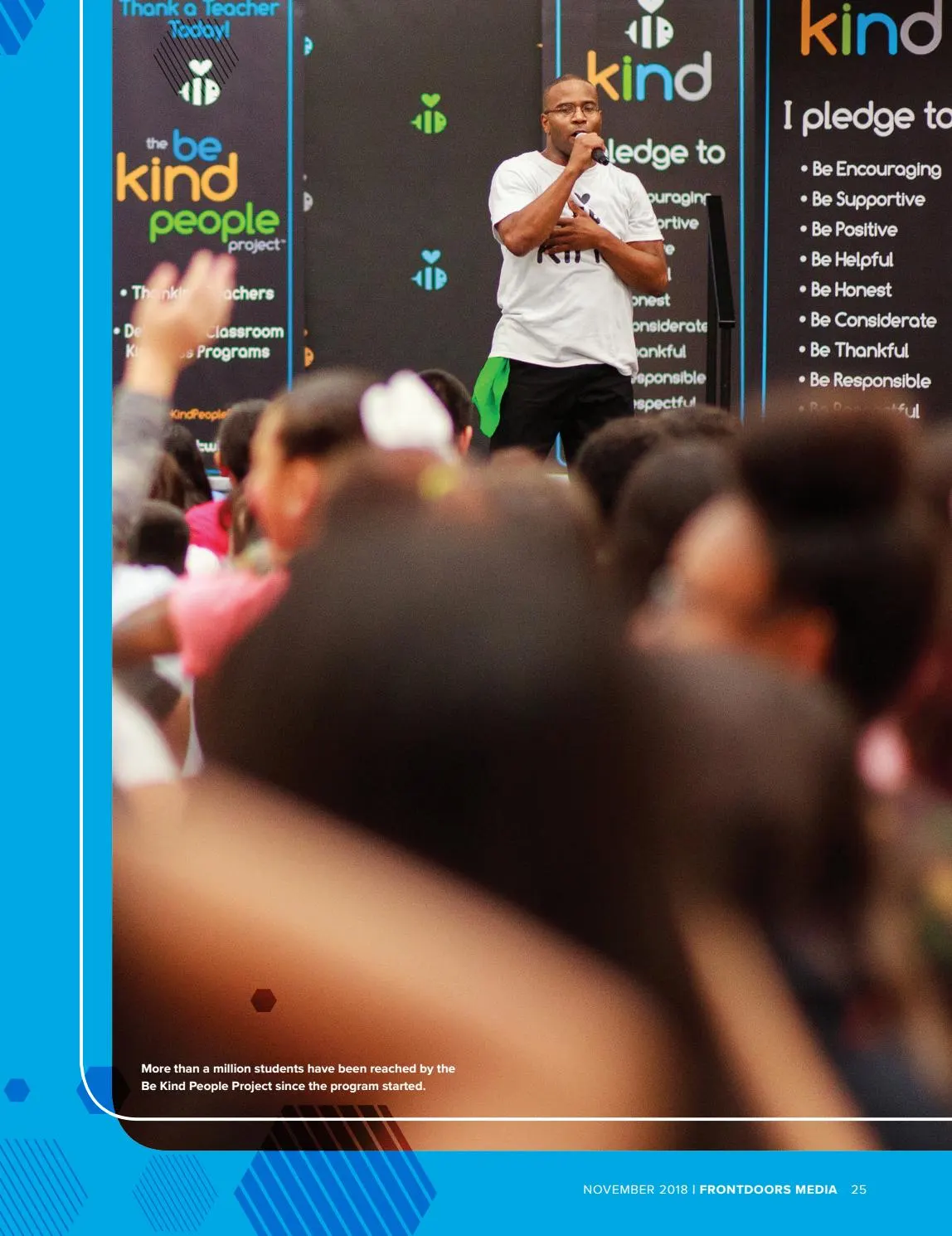
More than a million students have been reached by the Be Kind People Project since the program started. NOVEMBER 2018 | FRONTDOORS MEDIA 25