
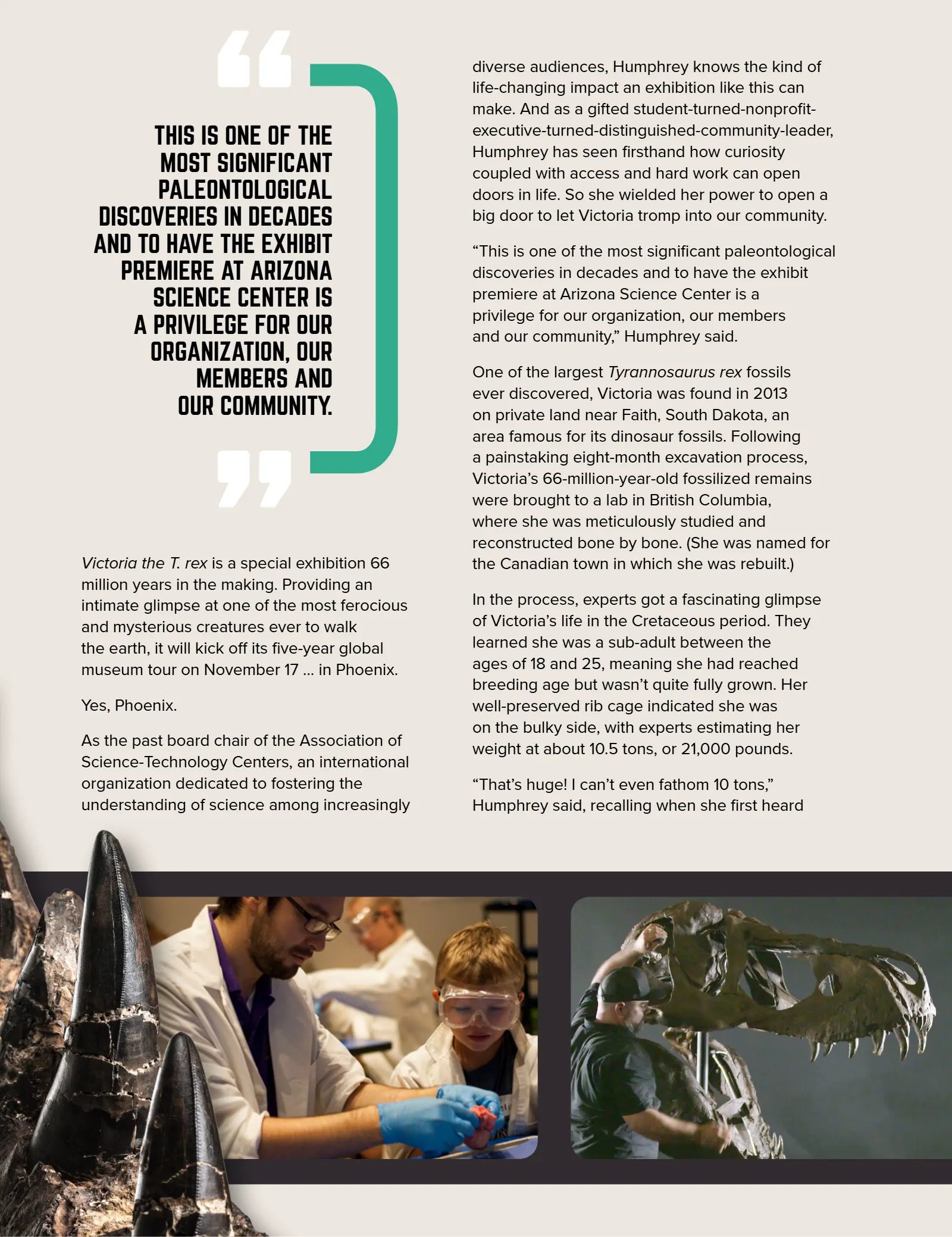
Victoria the T. rex is a special exhibition 66 million years in the making. Providing an intimate glimpse at one of the most ferocious and mysterious creatures ever to walk the earth, it will kick off its five-year global museum tour on November 17 … in Phoenix. Yes, Phoenix. As the past board chair of the Association of Science-Technology Centers, an international organization dedicated to fostering the understanding of science among increasingly diverse audiences, Humphrey knows the kind of life-changing impact an exhibition like this can make. And as a gifted student-turned-nonprofit- executive-turned-distinguished-community-leader, Humphrey has seen firsthand how curiosity coupled with access and hard work can open doors in life. So she wielded her power to open a big door to let Victoria tromp into our community. “This is one of the most significant paleontological discoveries in decades and to have the exhibit premiere at Arizona Science Center is a privilege for our organization, our members and our community,” Humphrey said. One of the largest Tyrannosaurus rex fossils ever discovered, Victoria was found in 2013 on private land near Faith, South Dakota, an area famous for its dinosaur fossils. Following a painstaking eight-month excavation process, Victoria’s 66-million-year-old fossilized remains were brought to a lab in British Columbia, where she was meticulously studied and reconstructed bone by bone. (She was named for the Canadian town in which she was rebuilt.) In the process, experts got a fascinating glimpse of Victoria’s life in the Cretaceous period. They learned she was a sub-adult between the ages of 18 and 25, meaning she had reached breeding age but wasn’t quite fully grown. Her well-preserved rib cage indicated she was on the bulky side, with experts estimating her weight at about 10.5 tons, or 21,000 pounds. “That’s huge! I can’t even fathom 10 tons,” Humphrey said, recalling when she first heard THIS IS ONE OF THE MOST SIGNIFICANT PALEONTOLOGICAL DISCOVERIES IN DECADES AND TO HAVE THE EXHIBIT PREMIERE AT ARIZONA SCIENCE CENTER IS A PRIVILEGE FOR OUR ORGANIZATION, OUR MEMBERS AND OUR COMMUNITY.
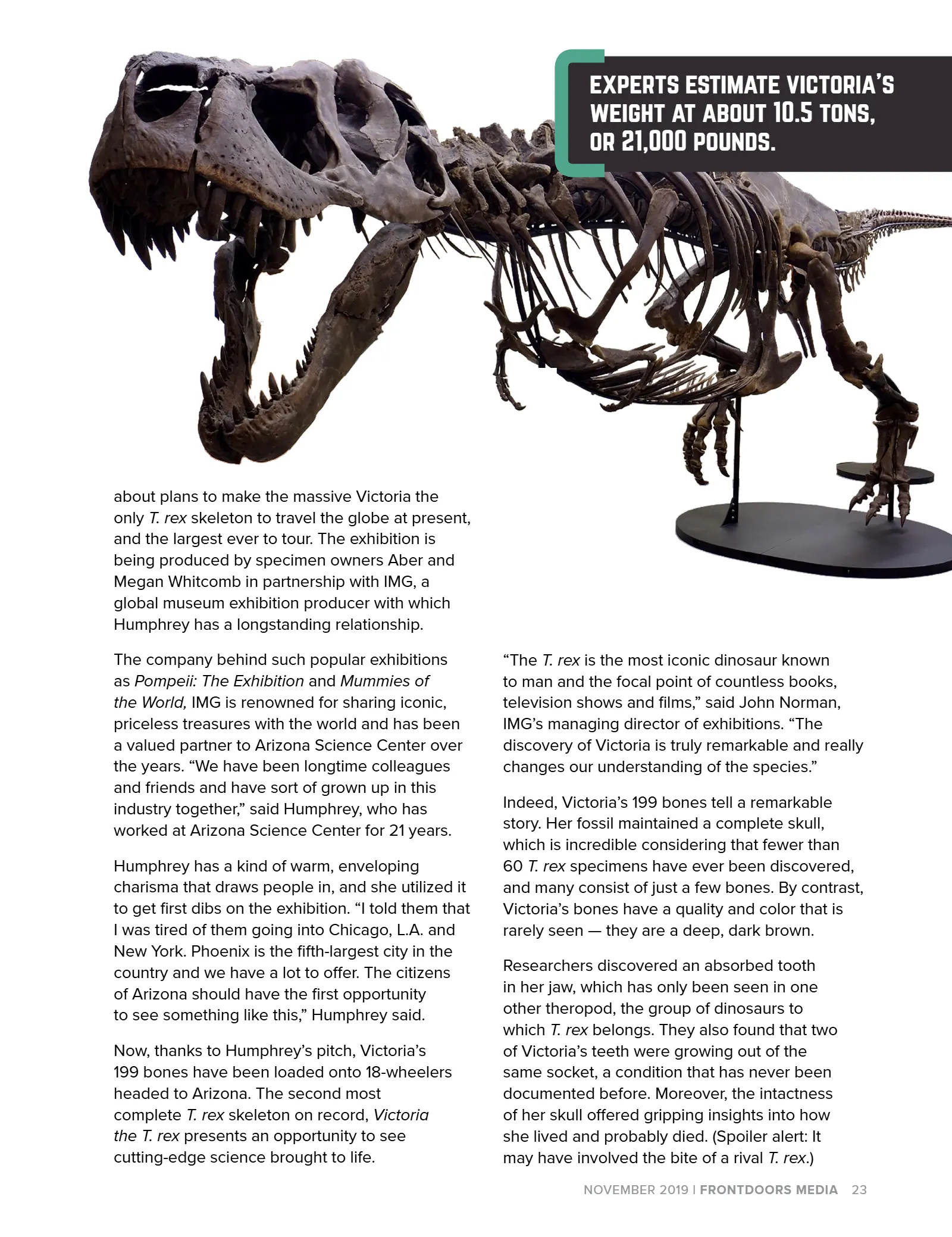
NOVEMBER 2019 | FRONTDOORS MEDIA 23 about plans to make the massive Victoria the only T. rex skeleton to travel the globe at present, and the largest ever to tour. The exhibition is being produced by specimen owners Aber and Megan Whitcomb in partnership with IMG, a global museum exhibition producer with which Humphrey has a longstanding relationship. The company behind such popular exhibitions as Pompeii: The Exhibition and Mummies of the World, IMG is renowned for sharing iconic, priceless treasures with the world and has been a valued partner to Arizona Science Center over the years. “We have been longtime colleagues and friends and have sort of grown up in this industry together,” said Humphrey, who has worked at Arizona Science Center for 21 years. Humphrey has a kind of warm, enveloping charisma that draws people in, and she utilized it to get first dibs on the exhibition. “I told them that I was tired of them going into Chicago, L.A. and New York. Phoenix is the fifth-largest city in the country and we have a lot to offer. The citizens of Arizona should have the first opportunity to see something like this,” Humphrey said. Now, thanks to Humphrey’s pitch, Victoria’s 199 bones have been loaded onto 18-wheelers headed to Arizona. The second most complete T. rex skeleton on record, Victoria the T. rex presents an opportunity to see cutting-edge science brought to life. “The T. rex is the most iconic dinosaur known to man and the focal point of countless books, television shows and films,” said John Norman, IMG’s managing director of exhibitions. “The discovery of Victoria is truly remarkable and really changes our understanding of the species.” Indeed, Victoria’s 199 bones tell a remarkable story. Her fossil maintained a complete skull, which is incredible considering that fewer than 60 T. rex specimens have ever been discovered, and many consist of just a few bones. By contrast, Victoria’s bones have a quality and color that is rarely seen — they are a deep, dark brown. Researchers discovered an absorbed tooth in her jaw, which has only been seen in one other theropod, the group of dinosaurs to which T. rex belongs. They also found that two of Victoria’s teeth were growing out of the same socket, a condition that has never been documented before. Moreover, the intactness of her skull offered gripping insights into how she lived and probably died. (Spoiler alert: It may have involved the bite of a rival T. rex .) experts estimate victoria’s weight at about 10.5 tons, or 21,000 pounds.