
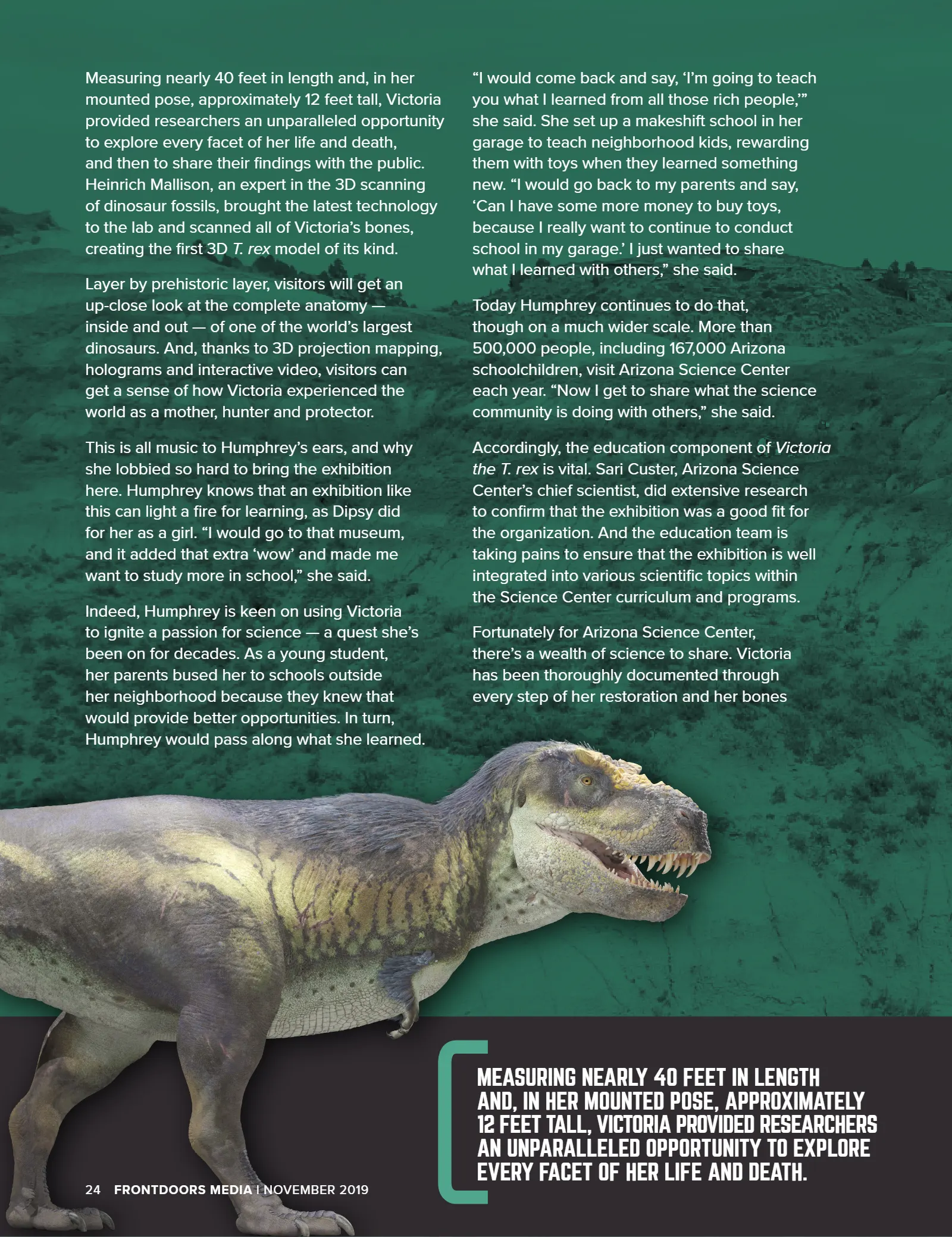
Measuring nearly 40 feet in length and, in her mounted pose, approximately 12 feet tall, Victoria provided researchers an unparalleled opportunity to explore every facet of her life and death, and then to share their findings with the public. Heinrich Mallison, an expert in the 3D scanning of dinosaur fossils, brought the latest technology to the lab and scanned all of Victoria’s bones, creating the first 3D T. rex model of its kind. Layer by prehistoric layer, visitors will get an up-close look at the complete anatomy — inside and out — of one of the world’s largest dinosaurs. And, thanks to 3D projection mapping, holograms and interactive video, visitors can get a sense of how Victoria experienced the world as a mother, hunter and protector. This is all music to Humphrey’s ears, and why she lobbied so hard to bring the exhibition here. Humphrey knows that an exhibition like this can light a fire for learning, as Dipsy did for her as a girl. “I would go to that museum, and it added that extra ‘wow’ and made me want to study more in school,” she said. Indeed, Humphrey is keen on using Victoria to ignite a passion for science — a quest she’s been on for decades. As a young student, her parents bused her to schools outside her neighborhood because they knew that would provide better opportunities. In turn, Humphrey would pass along what she learned. “I would come back and say, ‘I’m going to teach you what I learned from all those rich people,’” she said. She set up a makeshift school in her garage to teach neighborhood kids, rewarding them with toys when they learned something new. “I would go back to my parents and say, ‘Can I have some more money to buy toys, because I really want to continue to conduct school in my garage.’ I just wanted to share what I learned with others,” she said. Today Humphrey continues to do that, though on a much wider scale. More than 500,000 people, including 167,000 Arizona schoolchildren, visit Arizona Science Center each year. “Now I get to share what the science community is doing with others,” she said. Accordingly, the education component of Victoria the T. rex is vital. Sari Custer, Arizona Science Center’s chief scientist, did extensive research to confirm that the exhibition was a good fit for the organization. And the education team is taking pains to ensure that the exhibition is well integrated into various scientific topics within the Science Center curriculum and programs. Fortunately for Arizona Science Center, there’s a wealth of science to share. Victoria has been thoroughly documented through every step of her restoration and her bones 24 FRONTDOORS MEDIA | NOVEMBER 2019 MEASURING NEARLY 40 FEET IN LENGTH AND, IN HER MOUNTED POSE, APPROXIMATELY 12 FEET TALL, VICTORIA PROVIDED RESEARCHERS AN UNPARALLELED OPPORTUNITY TO EXPLORE EVERY FACET OF HER LIFE AND DEATH.
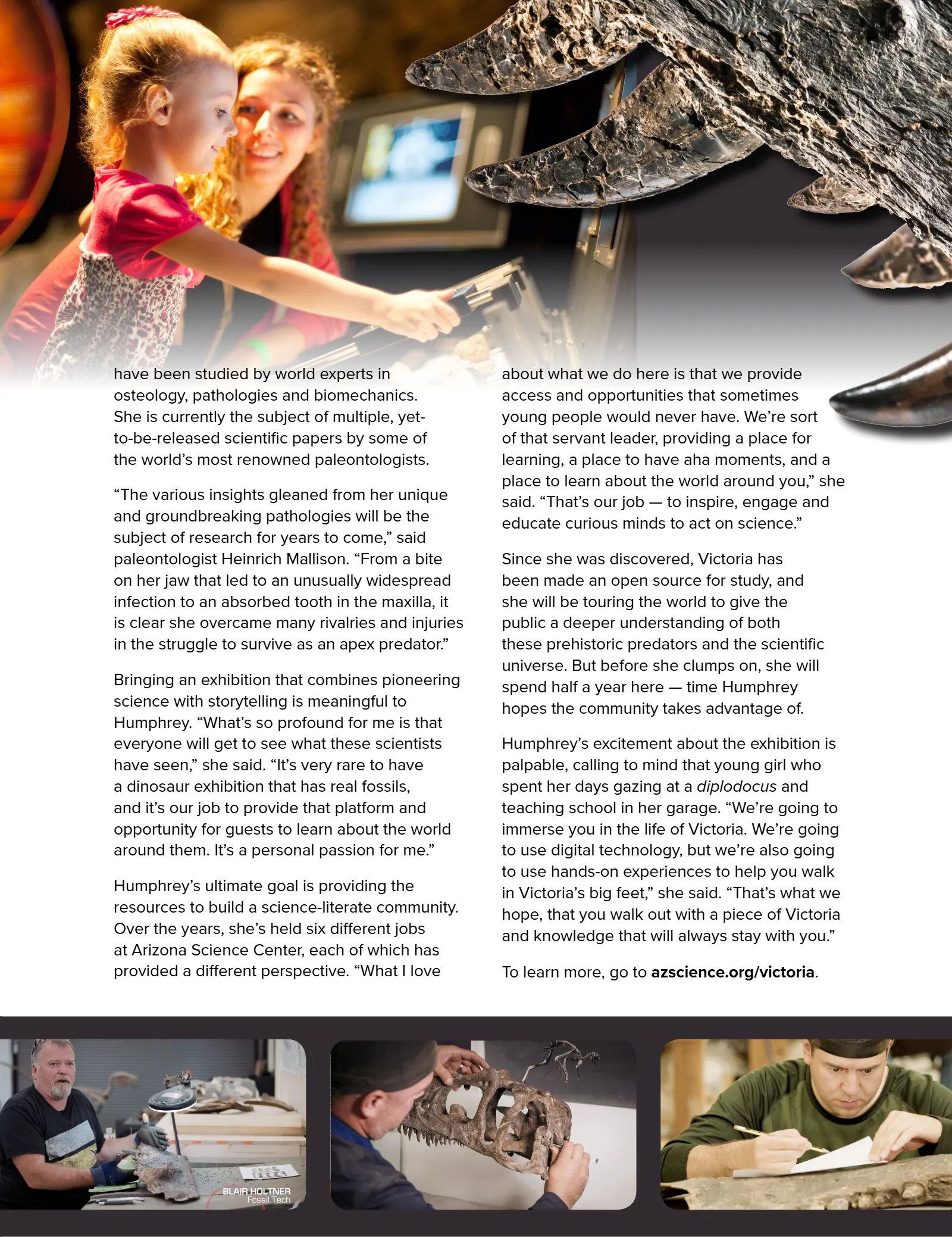
have been studied by world experts in osteology, pathologies and biomechanics. She is currently the subject of multiple, yet- to-be-released scientific papers by some of the world’s most renowned paleontologists. “The various insights gleaned from her unique and groundbreaking pathologies will be the subject of research for years to come,” said paleontologist Heinrich Mallison. “From a bite on her jaw that led to an unusually widespread infection to an absorbed tooth in the maxilla, it is clear she overcame many rivalries and injuries in the struggle to survive as an apex predator.” Bringing an exhibition that combines pioneering science with storytelling is meaningful to Humphrey. “What’s so profound for me is that everyone will get to see what these scientists have seen,” she said. “It’s very rare to have a dinosaur exhibition that has real fossils, and it’s our job to provide that platform and opportunity for guests to learn about the world around them. It’s a personal passion for me.” Humphrey’s ultimate goal is providing the resources to build a science-literate community. Over the years, she’s held six different jobs at Arizona Science Center, each of which has provided a different perspective. “What I love about what we do here is that we provide access and opportunities that sometimes young people would never have. We’re sort of that servant leader, providing a place for learning, a place to have aha moments, and a place to learn about the world around you,” she said. “That’s our job — to inspire, engage and educate curious minds to act on science.” Since she was discovered, Victoria has been made an open source for study, and she will be touring the world to give the public a deeper understanding of both these prehistoric predators and the scientific universe. But before she clumps on, she will spend half a year here — time Humphrey hopes the community takes advantage of. Humphrey’s excitement about the exhibition is palpable, calling to mind that young girl who spent her days gazing at a diplodocus and teaching school in her garage. “We’re going to immerse you in the life of Victoria. We’re going to use digital technology, but we’re also going to use hands-on experiences to help you walk in Victoria’s big feet,” she said. “That’s what we hope, that you walk out with a piece of Victoria and knowledge that will always stay with you.” To learn more, go to azscience.org/victoria .