
OCTOBER 2017 42 | FRONTDOORSMEDIA .COM {publisher’s page} OPEN DOORS Did you know that the odds of an average golfer hitting a hole-in-one are about 1 in 12,500? Even for pros, the odds are about 1 in 2,500. My experience with a golf ball had even longer odds. In fact, the odds of me encountering the golf ball I experienced were about 1 in 2.5 million. Let me explain. In 2012, I started having a lot of issues with my sinuses and breathing through my nose. My children were little and I put off dealing with it. I thought I just had a bad cold that turned into a bad sinus infection, and tried treating it with over-the-counter medications and then prescribed antibiotics and steroids. After months of this, I was referred to ear, nose and throat specialist Dr. Jeffrey Taffett and was diagnosed with some significant nasal polyps. They would have to be removed in outpatient surgery on Friday, September 14, 2012. When the surgery was done, Dr. Taffett spoke to my husband in the waiting room. He said that everything had gone well, but there was one growth that was much larger than everything else — about the size of a golf ball. This was, of course, unusual. They checked it on the spot to make sure it wasn’t a carcinoma, found that it wasn’t, and sent us home for the weekend. We went in for my follow-up visit on Monday morning and it turned out that Dr. Taffett had sent the golf ball to the pathologists at Barrow Neurological Institute for further review. In fact, no ' ONE IN 2.5 MILLION ' Becoming a
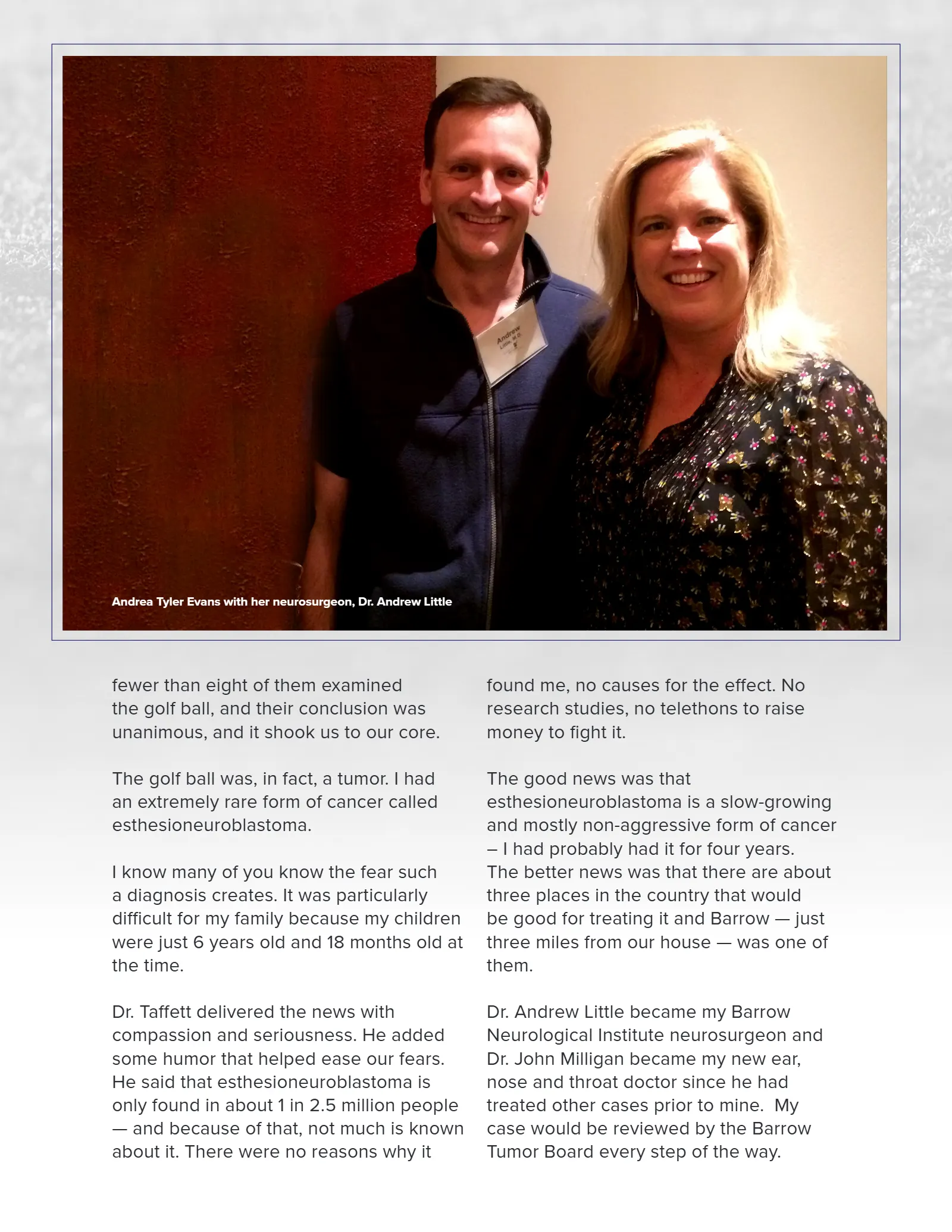
OCTOBER 2017 FRONTDOORSMEDIA .COM | 43 fewer than eight of them examined the golf ball, and their conclusion was unanimous, and it shook us to our core. The golf ball was, in fact, a tumor. I had an extremely rare form of cancer called esthesioneuroblastoma. I know many of you know the fear such a diagnosis creates. It was particularly difficult for my family because my children were just 6 years old and 18 months old at the time. Dr. Taffett delivered the news with compassion and seriousness. He added some humor that helped ease our fears. He said that esthesioneuroblastoma is only found in about 1 in 2.5 million people — and because of that, not much is known about it. There were no reasons why it found me, no causes for the effect. No research studies, no telethons to raise money to fight it. The good news was that esthesioneuroblastoma is a slow-growing and mostly non-aggressive form of cancer – I had probably had it for four years. The better news was that there are about three places in the country that would be good for treating it and Barrow — just three miles from our house — was one of them. Dr. Andrew Little became my Barrow Neurological Institute neurosurgeon and Dr. John Milligan became my new ear, nose and throat doctor since he had treated other cases prior to mine. My case would be reviewed by the Barrow Tumor Board every step of the way. Andrea Tyler Evans with her neurosurgeon, Dr. Andrew Little