
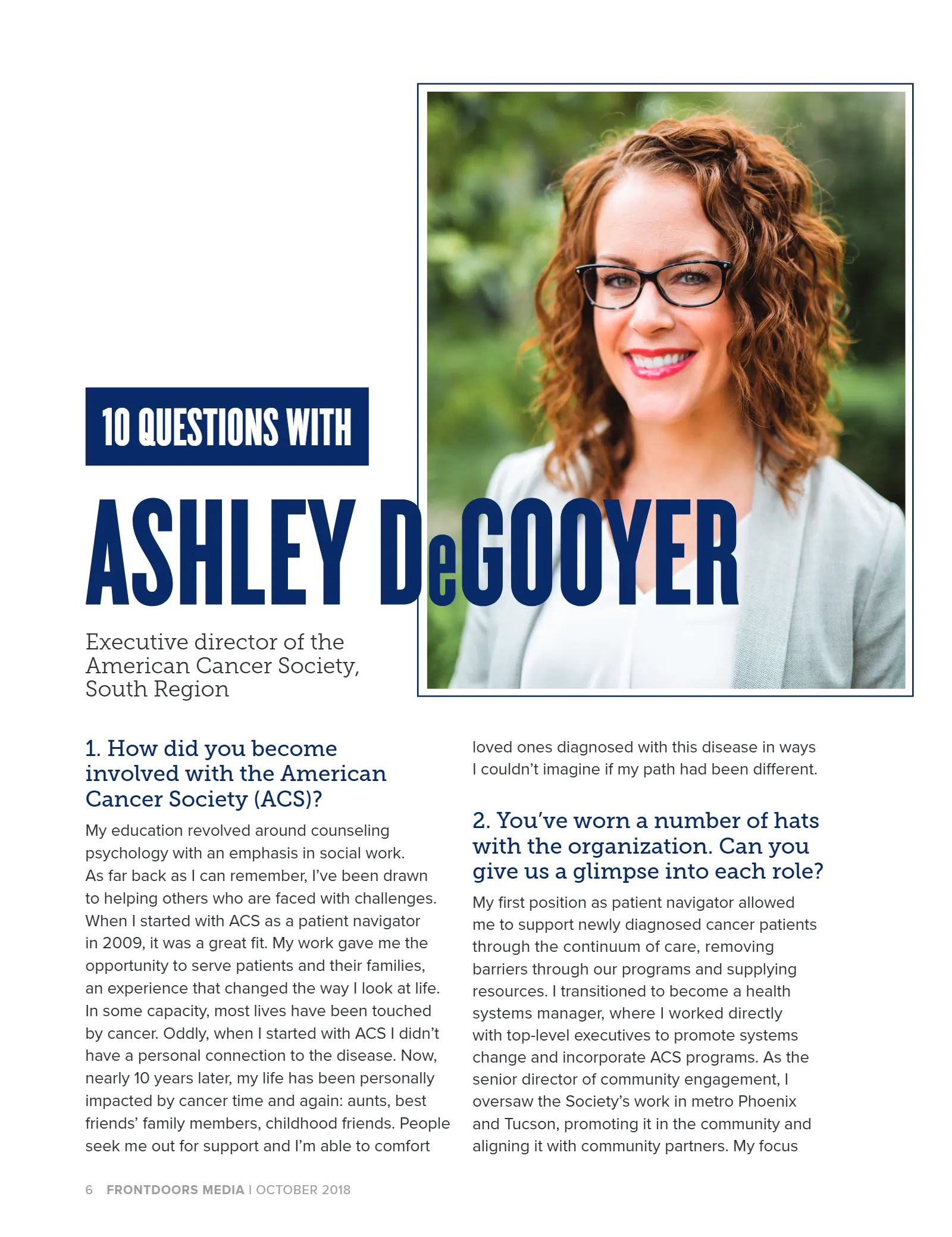
1. How did you become involved with the American Cancer Society (ACS)? My education revolved around counseling psychology with an emphasis in social work. As far back as I can remember, I’ve been drawn to helping others who are faced with challenges. When I started with ACS as a patient navigator in 2009, it was a great fit. My work gave me the opportunity to serve patients and their families, an experience that changed the way I look at life. In some capacity, most lives have been touched by cancer. Oddly, when I started with ACS I didn’t have a personal connection to the disease. Now, nearly 10 years later, my life has been personally impacted by cancer time and again: aunts, best friends’ family members, childhood friends. People seek me out for support and I’m able to comfort loved ones diagnosed with this disease in ways I couldn’t imagine if my path had been different. 2. You’ve worn a number of hats with the organization. Can you give us a glimpse into each role? My first position as patient navigator allowed me to support newly diagnosed cancer patients through the continuum of care, removing barriers through our programs and supplying resources. I transitioned to become a health systems manager, where I worked directly with top-level executives to promote systems change and incorporate ACS programs. As the senior director of community engagement, I oversaw the Society’s work in metro Phoenix and Tucson, promoting it in the community and aligning it with community partners. My focus ASHLEY D e GOOYER 10 QUESTIONS WITH Executive director of the American Cancer Society, South Region 6 FRONTDOORS MEDIA | OCTOBER 2018
was on promoting events and raising awareness of our programs, services and presence in the community. Now, as the executive director of the Southwest area, my work has expanded to include Arizona, New Mexico and El Paso. 3. What do you see as the organization’s biggest challenges? Educating communities about our lifesaving mission. The public knows our name. They know we hold fundraising events like Relay for Life and Making Strides Against Breast Cancer. But they don’t know how that fundraising translates into support for cancer patients right here in Arizona. I want my region’s population to be aware of the things we offer, such as transportation to treatment, lodging and other services for patients and caregivers. I want them to know about the importance of prevention and early detection, and how the research done nationally impacts the people diagnosed locally . 4. What has been the organization’s biggest impact? Without a doubt, it’s our research program. ACS has been at the forefront of cancer research, playing a role in nearly every major cancer breakthrough. Since 1946, we’ve invested more than $4.6 billion in research and 47 of the researchers ACS have funded have gone on to win a Nobel Prize! We were the first to acknowledge a link between smoking and lung cancer, underwrote the research and discovery of the BRCA gene mutation linked to breast and ovarian cancer, developed the drug Herceptin to treat breast cancer, and more. 5. How do you see integrative oncology fitting into cancer treatment? Many patients seek integrative oncology when faced with a cancer diagnosis, whether to relieve the treatment effects or to explore treatment options with fewer side effects. Some simply want to take a more active role in their health and wellness. Whether or not to use complementary and alternative medicine in addition to traditional treatment is up to the patient. ACS urges patients to talk to their doctors and ask questions about their personal treatment. Patients need to realize they’re empowered and are their best own advocate. 6. What are the best things a family member or friend can do for a survivor? The best thing is to continue to be “you.” What I mean by this is to continue to be the family member or friend you’ve always been. Too often, we let the diagnosis change the way we act toward people, when that loved one really needs the consistency and normalcy of the relationship not to change. Recognize that the loved one diagnosed is just as worried about you as you are about him or her. Allow them to feel their emotions; there are so many in a cancer diagnosis. Patients, too, need to be kind to others and themselves. I’ve often seen patients who feel they have to constantly be strong through cancer and put on the “I’m OK” front. That’s not necessary. Ride the roller coaster that is your treatment. Lean on the people who love you. Be true to yourself. 7. ACS does fabulous work researching better treatments and finding a cure. What kind of work does the organization do in survivorship? Survivors are the backbone of the work we do. More than 15 million Americans are alive today due in part to our efforts. Our approach is multifaceted, beginning with our patient navigators, who help newly diagnosed patients deal with the complexities of treatment and lifestyle changes. They make patients aware of free programs or discounted lodging when cancer patients must travel for treatment. Often, patients don’t have friends or family locally who can drive them to treatment, or they don’t have a car or simply don’t feel up to driving. Our Road to Recovery program provides the free transportation they need to get to potentially lifesaving appointments. ACS also OCTOBER 2018 | FRONTDOORS MEDIA 7